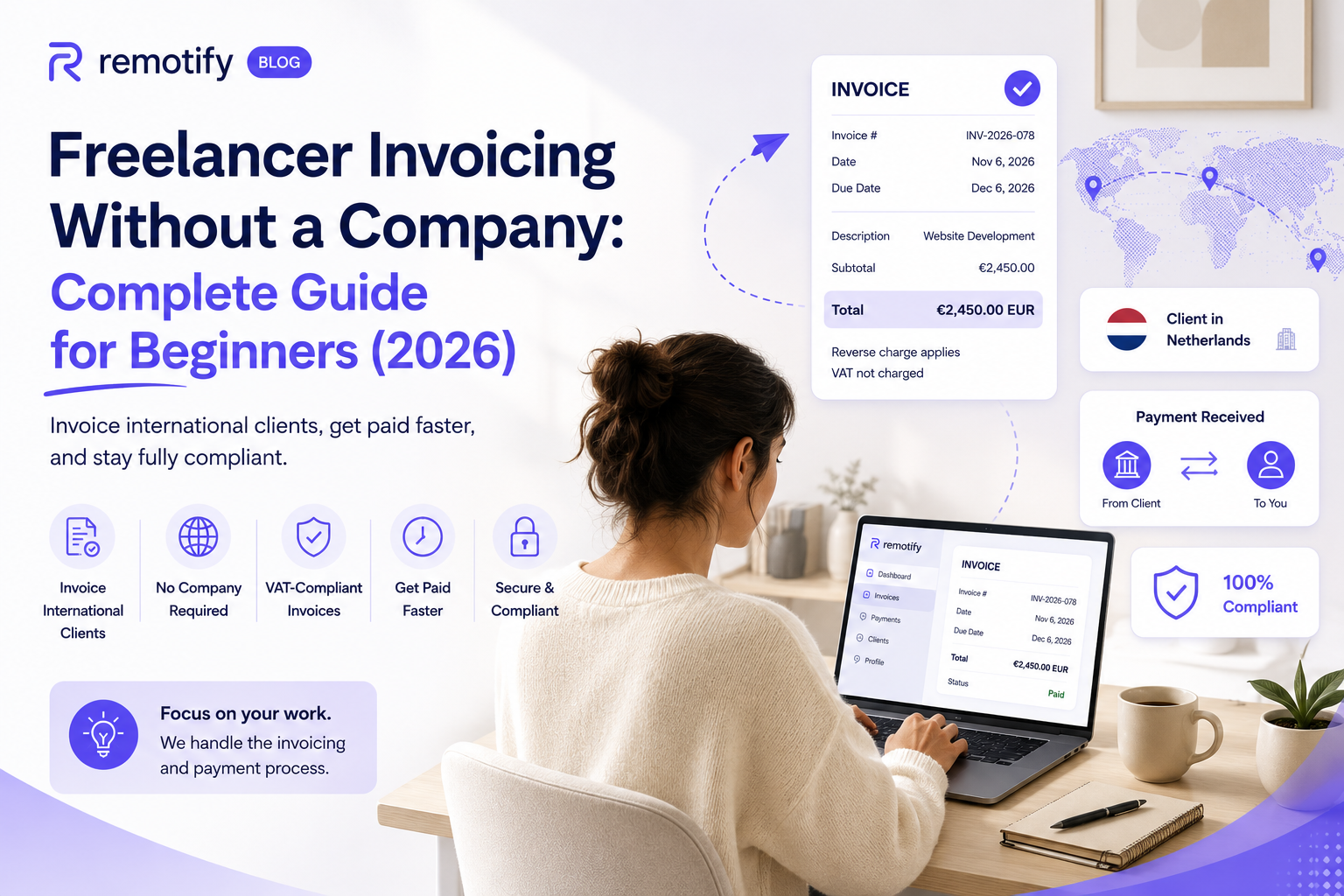
The confusion comes from how most people have experienced invoicing, through businesses. When a supplier sends your employer an invoice, it has a company name, a registration number, a VAT number. It looks official.
But that structure exists because those are registered businesses operating under company law. As an individual freelancer, a sole trader, an independent contractor, a self-employed professional, you are also a legitimate economic entity. You are allowed to charge for your services and receive payment. You are allowed to create and send invoices. The document you send is a valid invoice regardless of whether it comes from a registered company or from you as an individual.
What matters is not whether you have a company. What matters is whether your invoice contains the right information, whether it creates a clear record of the transaction, and whether it gives your client what they need to process the payment on their end.
Before you create your first freelance invoice, it helps to understand what the document is actually for.
An invoice is a formal request for payment. It tells your client what they owe you, why they owe it, and how to pay it. It creates a legal record that a transaction occurred. For your client’s finance team, it’s the document that authorises them to release payment. For you, it’s the paper trail that proves you earned the income, useful for tax purposes, for banking, and for any dispute that might arise.
For an invoice to serve all these purposes, it needs to contain specific information. Without the right fields, it may be rejected by your client’s accounting system, delay payment, or fail to satisfy tax requirements in your country.
A valid freelance invoice without a company should include the following.
Your full legal name and address. Since you don’t have a company, your personal name is the trading name. Some freelancers use a trading name, “Jane Doe Creative” or “Digital Content by James”, which is fine, but your legal name should still appear on the document.
Your contact details. An email address at minimum. A phone number is useful for larger clients.
Your client’s details. The full name of the person or company you’re invoicing, their address, and ideally the name of the contact person who commissioned the work. Getting this right matters, an invoice addressed to the wrong entity can get lost in a client’s internal system.
A unique invoice number. Every invoice you send should have a sequential number, INV-001, INV-002, and so on. This is important for your own record-keeping and for your client’s accounts payable process. It also looks professional.
The invoice date and the payment due date. Clearly state when the invoice was issued and when payment is expected. Net 14 (due 14 days from issue) is standard for most freelance work. Net 30 is common for corporate clients.
A description of services. This is where you explain what you did. Be specific enough that the payment makes sense to anyone reviewing it, not just “design work” but “UI design for mobile app, Phase 1, as per agreement dated [date].” Clear descriptions reduce disputes and help your client’s finance team categorise the payment correctly.
The amount owed, in a specified currency. State the total clearly. If the work was done in multiple phases or involves different rates, break it down. Specify the currency, USD, EUR, GBP, especially for international work. Ambiguity here causes problems.
Your payment details. How does your client actually send you the money? Include your bank details for wire transfers, your PayPal address if relevant, or a payment link if you’re using an invoicing platform. Make this as clear and simple as possible; the harder it is to pay you, the slower you’ll get paid.
Any tax-related information. Depending on your country, you may need to include a tax identification number, VAT number, or a note about tax exemption or withholding. This varies significantly by country and is worth checking for your specific situation.
Just as important as knowing what to include is knowing what you don’t need.
You don’t need a company registration number. As an individual freelancer, you don’t have one, and clients invoicing individuals don’t expect one.
You don’t need a VAT number unless you’re VAT-registered in your country, which most freelancers starting out are not. If your client asks for a VAT number and you’re not registered, a simple note that you are not VAT-registered is sufficient.
You don’t need a fancy logo or a designed template. Clean, readable, and complete beats elaborate and confusing every time.
You don’t need a lawyer to draft your invoicing terms. Your payment due date, a brief note about late payment, and a clear description of services is enough for most freelance relationships.
Understanding how to create an invoice is only part of the picture. The full invoicing to payment process involves several stages, and knowing each one helps you avoid the delays and frustrations that many new freelancers experience.
Stage 1: Agreement before work begins. Before you create any invoice, make sure you and your client have a clear written agreement, even just an email thread, that outlines what work you’re doing, what you’re charging, and when payment is due. Your invoice should reference this agreement. This protects you if any dispute arises later.
Stage 2: Create the invoice correctly. Using the fields described above, create an invoice that contains all the information your client needs. If you’re using a tool like Remotify at remotify.co/invoicing, the platform structures this for you and ensures nothing important is missing. If you’re creating it manually, double-check everything before sending.
Stage 3: Send the invoice at the right time. For project-based work, send your invoice on completion or at agreed milestones. For retainer or ongoing work, send it on a fixed date each month, the first of the month is standard. Don’t sit on invoices. The sooner you send it, the sooner the payment clock starts.
Stage 4: Follow up without apology. Most late payments are not intentional, they’re administrative. Someone forgot to approve the invoice. It went to the wrong inbox. Finance needs a reminder. On the due date, if payment hasn’t arrived, send a brief, professional follow-up. No guilt, no excessive apology. Just a clear prompt.
Stage 5: Receive payment through the right channel. This is where many freelancers, particularly those working with international clients, lose money unnecessarily. PayPal fees, unfavorable exchange rates, and slow bank wires are all costs that compound over time. Choose a payment method that makes sense for your situation, and make sure it’s clearly specified on your invoice so there’s no confusion about how to pay you.
Stage 6: Record the payment. Once payment arrives, mark the invoice as paid and file it. Keep a record of every invoice you’ve sent and every payment you’ve received. This is your income record, it matters for taxes, for banking if you ever need to show income history, and for your own clarity about how your business is performing.
The basics of invoicing are the same whether your client is in the same city or on the other side of the world. But international invoicing has additional layers worth understanding.
Currency is the first one. Agree on the billing currency before the project starts, state it clearly on every invoice, and be aware of where conversion happens in the payment chain. Invoicing in USD or EUR gives you more control and is generally preferable to invoicing in your client’s local currency unless you have a specific reason to do otherwise.
Time zones and payment timing matter more than people expect. A client in New York who owes you money and processes payments on Fridays may not see your Tuesday invoice until the following week. Factor this into your due dates and follow-up timing.
Tax and withholding is the most complex area. Some countries require clients to withhold a percentage of payments to foreign contractors, typically 10 to 30 percent, unless the contractor provides documentation showing they’re exempt under a tax treaty. If you’re invoicing clients in the US, for example, they may ask you to complete a W-8BEN form before they’ll release payment. This is normal and not a red flag, it’s just the US tax system managing withholding obligations. Knowing this ahead of time prevents surprises.
Finally, some clients, particularly larger organisations, will ask for documentation that verifies you are who you say you are. A signed contract, a government-issued ID scan, or a brief freelancer profile may be requested before their finance team processes a payment from an individual rather than a company. Having this ready speeds things up.
Creating invoices in Word or Google Docs works when you’re starting out. But it creates problems as you scale, inconsistent formatting, missing fields, no record system, and no built-in payment mechanism.
A dedicated invoicing platform solves all of these problems. It structures your invoices correctly by default, stores them in one place, numbers them sequentially, and in the best cases connects the invoice directly to a payment method so your client can pay in clicks rather than bank transfers.
For freelancers working with international clients, the payment connection matters especially. Remotify was built specifically for cross-border freelance work. At remotify.co/invoicing, you create professional invoices in USD or EUR that look right to international clients regardless of where you’re based. At remotify.co/payment, you can see how the payment infrastructure works, giving your clients an easy way to pay and getting the money to you through a documented, compliant channel.
This is particularly valuable for freelancers based in markets where major payment platforms like Stripe or PayPal have limitations. Rather than patching together informal solutions, you have one system that handles both the invoicing and the payment side professionally.
A few patterns come up repeatedly among new freelancers that are worth naming directly.
Sending invoices with missing information. An invoice without a due date, a description of services, or clear payment details will slow down your payment. Finance teams kick back incomplete invoices and ask for corrections, which adds days or weeks to your payment timeline.
Not keeping copies. If you create invoices in a document and send them without filing them somewhere organised, you will lose track of what’s been paid and what hasn’t. Use a folder system or an invoicing platform that keeps records for you.
Not following up. Many new freelancers feel awkward chasing payment. They wait days or weeks after the due date before saying anything. This is a mistake. Following up promptly is professional, not pushy. Clients who consistently pay late after reminders are clients worth reconsidering.
Accepting whatever payment method the client prefers without checking the cost. If a client wants to pay through a platform that charges you 5 percent, and you have an alternative that charges 1 percent, the difference on a $1,000 invoice is $40. Across a year of invoices, that adds up to real money. Know the cost of each payment method and factor it into your decisions.
The question of whether you need a company to invoice clients is almost always the wrong question. What you actually need is a system, a consistent, professional way of creating invoices, sending them, following up, and receiving payment.
That system doesn’t require a company registration. It doesn’t require a lawyer or an accountant to set up. It requires knowing what to include in your invoices, choosing the right tools, and being consistent about following your own process.
Start simple. Get the basics right. Use a platform that handles the structure for you so you can focus on the work.
Create your first invoice free → remotify.co
The confusion comes from how most people have experienced invoicing, through businesses. When a supplier sends your employer an invoice, it has a company name, a registration number, a VAT number. It looks official.
But that structure exists because those are registered businesses operating under company law. As an individual freelancer, a sole trader, an independent contractor, a self-employed professional, you are also a legitimate economic entity. You are allowed to charge for your services and receive payment. You are allowed to create and send invoices. The document you send is a valid invoice regardless of whether it comes from a registered company or from you as an individual.
What matters is not whether you have a company. What matters is whether your invoice contains the right information, whether it creates a clear record of the transaction, and whether it gives your client what they need to process the payment on their end.
Before you create your first freelance invoice, it helps to understand what the document is actually for.
An invoice is a formal request for payment. It tells your client what they owe you, why they owe it, and how to pay it. It creates a legal record that a transaction occurred. For your client’s finance team, it’s the document that authorises them to release payment. For you, it’s the paper trail that proves you earned the income, useful for tax purposes, for banking, and for any dispute that might arise.
For an invoice to serve all these purposes, it needs to contain specific information. Without the right fields, it may be rejected by your client’s accounting system, delay payment, or fail to satisfy tax requirements in your country.
A valid freelance invoice without a company should include the following.
Your full legal name and address. Since you don’t have a company, your personal name is the trading name. Some freelancers use a trading name, “Jane Doe Creative” or “Digital Content by James”, which is fine, but your legal name should still appear on the document.
Your contact details. An email address at minimum. A phone number is useful for larger clients.
Your client’s details. The full name of the person or company you’re invoicing, their address, and ideally the name of the contact person who commissioned the work. Getting this right matters, an invoice addressed to the wrong entity can get lost in a client’s internal system.
A unique invoice number. Every invoice you send should have a sequential number, INV-001, INV-002, and so on. This is important for your own record-keeping and for your client’s accounts payable process. It also looks professional.
The invoice date and the payment due date. Clearly state when the invoice was issued and when payment is expected. Net 14 (due 14 days from issue) is standard for most freelance work. Net 30 is common for corporate clients.
A description of services. This is where you explain what you did. Be specific enough that the payment makes sense to anyone reviewing it, not just “design work” but “UI design for mobile app, Phase 1, as per agreement dated [date].” Clear descriptions reduce disputes and help your client’s finance team categorise the payment correctly.
The amount owed, in a specified currency. State the total clearly. If the work was done in multiple phases or involves different rates, break it down. Specify the currency, USD, EUR, GBP, especially for international work. Ambiguity here causes problems.
Your payment details. How does your client actually send you the money? Include your bank details for wire transfers, your PayPal address if relevant, or a payment link if you’re using an invoicing platform. Make this as clear and simple as possible; the harder it is to pay you, the slower you’ll get paid.
Any tax-related information. Depending on your country, you may need to include a tax identification number, VAT number, or a note about tax exemption or withholding. This varies significantly by country and is worth checking for your specific situation.
Just as important as knowing what to include is knowing what you don’t need.
You don’t need a company registration number. As an individual freelancer, you don’t have one, and clients invoicing individuals don’t expect one.
You don’t need a VAT number unless you’re VAT-registered in your country, which most freelancers starting out are not. If your client asks for a VAT number and you’re not registered, a simple note that you are not VAT-registered is sufficient.
You don’t need a fancy logo or a designed template. Clean, readable, and complete beats elaborate and confusing every time.
You don’t need a lawyer to draft your invoicing terms. Your payment due date, a brief note about late payment, and a clear description of services is enough for most freelance relationships.
Understanding how to create an invoice is only part of the picture. The full invoicing to payment process involves several stages, and knowing each one helps you avoid the delays and frustrations that many new freelancers experience.
Stage 1: Agreement before work begins. Before you create any invoice, make sure you and your client have a clear written agreement, even just an email thread, that outlines what work you’re doing, what you’re charging, and when payment is due. Your invoice should reference this agreement. This protects you if any dispute arises later.
Stage 2: Create the invoice correctly. Using the fields described above, create an invoice that contains all the information your client needs. If you’re using a tool like Remotify at remotify.co/invoicing, the platform structures this for you and ensures nothing important is missing. If you’re creating it manually, double-check everything before sending.
Stage 3: Send the invoice at the right time. For project-based work, send your invoice on completion or at agreed milestones. For retainer or ongoing work, send it on a fixed date each month, the first of the month is standard. Don’t sit on invoices. The sooner you send it, the sooner the payment clock starts.
Stage 4: Follow up without apology. Most late payments are not intentional, they’re administrative. Someone forgot to approve the invoice. It went to the wrong inbox. Finance needs a reminder. On the due date, if payment hasn’t arrived, send a brief, professional follow-up. No guilt, no excessive apology. Just a clear prompt.
Stage 5: Receive payment through the right channel. This is where many freelancers, particularly those working with international clients, lose money unnecessarily. PayPal fees, unfavorable exchange rates, and slow bank wires are all costs that compound over time. Choose a payment method that makes sense for your situation, and make sure it’s clearly specified on your invoice so there’s no confusion about how to pay you.
Stage 6: Record the payment. Once payment arrives, mark the invoice as paid and file it. Keep a record of every invoice you’ve sent and every payment you’ve received. This is your income record, it matters for taxes, for banking if you ever need to show income history, and for your own clarity about how your business is performing.
The basics of invoicing are the same whether your client is in the same city or on the other side of the world. But international invoicing has additional layers worth understanding.
Currency is the first one. Agree on the billing currency before the project starts, state it clearly on every invoice, and be aware of where conversion happens in the payment chain. Invoicing in USD or EUR gives you more control and is generally preferable to invoicing in your client’s local currency unless you have a specific reason to do otherwise.
Time zones and payment timing matter more than people expect. A client in New York who owes you money and processes payments on Fridays may not see your Tuesday invoice until the following week. Factor this into your due dates and follow-up timing.
Tax and withholding is the most complex area. Some countries require clients to withhold a percentage of payments to foreign contractors, typically 10 to 30 percent, unless the contractor provides documentation showing they’re exempt under a tax treaty. If you’re invoicing clients in the US, for example, they may ask you to complete a W-8BEN form before they’ll release payment. This is normal and not a red flag, it’s just the US tax system managing withholding obligations. Knowing this ahead of time prevents surprises.
Finally, some clients, particularly larger organisations, will ask for documentation that verifies you are who you say you are. A signed contract, a government-issued ID scan, or a brief freelancer profile may be requested before their finance team processes a payment from an individual rather than a company. Having this ready speeds things up.
Creating invoices in Word or Google Docs works when you’re starting out. But it creates problems as you scale, inconsistent formatting, missing fields, no record system, and no built-in payment mechanism.
A dedicated invoicing platform solves all of these problems. It structures your invoices correctly by default, stores them in one place, numbers them sequentially, and in the best cases connects the invoice directly to a payment method so your client can pay in clicks rather than bank transfers.
For freelancers working with international clients, the payment connection matters especially. Remotify was built specifically for cross-border freelance work. At remotify.co/invoicing, you create professional invoices in USD or EUR that look right to international clients regardless of where you’re based. At remotify.co/payment, you can see how the payment infrastructure works, giving your clients an easy way to pay and getting the money to you through a documented, compliant channel.
This is particularly valuable for freelancers based in markets where major payment platforms like Stripe or PayPal have limitations. Rather than patching together informal solutions, you have one system that handles both the invoicing and the payment side professionally.
A few patterns come up repeatedly among new freelancers that are worth naming directly.
Sending invoices with missing information. An invoice without a due date, a description of services, or clear payment details will slow down your payment. Finance teams kick back incomplete invoices and ask for corrections, which adds days or weeks to your payment timeline.
Not keeping copies. If you create invoices in a document and send them without filing them somewhere organised, you will lose track of what’s been paid and what hasn’t. Use a folder system or an invoicing platform that keeps records for you.
Not following up. Many new freelancers feel awkward chasing payment. They wait days or weeks after the due date before saying anything. This is a mistake. Following up promptly is professional, not pushy. Clients who consistently pay late after reminders are clients worth reconsidering.
Accepting whatever payment method the client prefers without checking the cost. If a client wants to pay through a platform that charges you 5 percent, and you have an alternative that charges 1 percent, the difference on a $1,000 invoice is $40. Across a year of invoices, that adds up to real money. Know the cost of each payment method and factor it into your decisions.
The question of whether you need a company to invoice clients is almost always the wrong question. What you actually need is a system, a consistent, professional way of creating invoices, sending them, following up, and receiving payment.
That system doesn’t require a company registration. It doesn’t require a lawyer or an accountant to set up. It requires knowing what to include in your invoices, choosing the right tools, and being consistent about following your own process.
Start simple. Get the basics right. Use a platform that handles the structure for you so you can focus on the work.
Create your first invoice free → remotify.co