How Remote Teams Can Pay Freelancers Across Different Countries

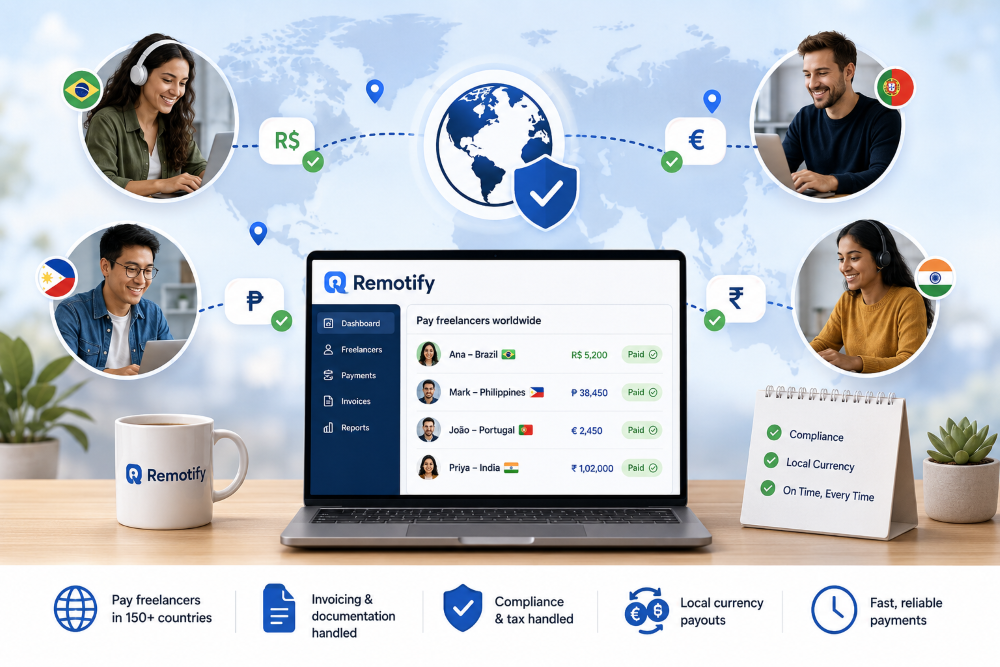
Remote teams can pay freelancers internationally by using a platform like Remotify, which handles cross-border payments, compliance, and invoicing on your behalf. Instead of setting up local entities or navigating tax laws in every country, you work with a single platform that acts as the legal and financial bridge between your business and your freelancers, wherever they are in the world.

Freelancers

Pay Freelancers Worldwide Easily With Automated Invoicing, Tax Compliance, and Reliable Global Payment Infrastructure by Remotify

The Reality of Paying Freelancers Across Borders

Building a remote team is one of the best decisions a growing business can make. You get access to talent from anywhere in the world, you are not limited by geography, and you can often build faster and leaner than companies hiring locally. But the moment you actually try to pay freelancers internationally, the excitement tends to hit a wall.

Sending money across borders sounds simple until you realise each country has its own tax rules, currency requirements, banking infrastructure, and compliance obligations. A freelancer in Brazil expects payment in a very different way than one in the Philippines or Portugal. What works for one country often fails entirely for another.

Most remote teams discover this the hard way. They try bank transfers and lose money on exchange rates. They try PayPal and find it is blocked or heavily taxed in certain regions. They try to issue invoices and realise their client does not have the right VAT documentation. None of this is about bad intentions; it is simply the complexity of global payroll alternatives that were never designed with distributed teams in mind.

If you are managing a remote team with freelancers across different countries, this guide walks through the real challenges and what actually works.

Why Standard Payment Methods Fall Short

Before getting into solutions, it is worth understanding why the obvious options tend to create more problems than they solve.

Bank wire transfers are slow, expensive, and unpredictable. Exchange rate spreads eat into what freelancers actually receive, and many countries have restrictions on how much money can enter or leave without triggering compliance reviews.

PayPal and similar platforms have become unreliable for international freelancer management. Fees stack up on both ends, accounts get flagged or frozen in certain markets, and there is no clean paper trail for tax purposes.

Crypto payments get suggested a lot, but they introduce currency volatility, tax complexity for the freelancer, and limited support for professionals who simply want stable, local-currency income.

Paying through your own business entity works if you are only operating in one or two markets, but the moment you scale across five or ten countries, the compliance burden becomes a full-time job. You need local legal entities, local bank accounts, local accountants, and a deep understanding of employment and contractor law in each market.

None of these approaches were built for the way remote teams actually work today.

What Actually Works: A Platform Built for Global Payments

The most effective way to pay freelancers internationally is to use a platform that was designed specifically for this purpose. Rather than stitching together a patchwork of bank accounts, wire services, and spreadsheets, you work through a single system that handles everything from invoicing to compliance to actual payment delivery.

This is where Remotify comes in.

Remotify acts as a Merchant of Record, meaning it issues the invoice to your client or acts as the compliant payer on your behalf, then pays your freelancers after the transaction is complete. You do not need your own legal entity in each country. Remotify handles the legal and compliance side, so your team gets paid correctly and you stay protected on the business side.

For remote teams managing freelancer management across multiple regions, this removes an enormous amount of operational overhead. You know payments will go out on time, in the right currency, with the right documentation attached.

The Compliance Problem Nobody Talks About

One of the biggest risks when you pay freelancers internationally is misclassification. In many countries, if someone works for you consistently, the government may consider them an employee rather than a freelancer, regardless of what your contract says. This can trigger back taxes, penalties, and legal liability on your end.

Different countries have wildly different thresholds for when a contractor relationship becomes an employment relationship. Some countries require you to register as an employer the moment you pay someone above a certain amount. Others require local currency payments and withholding taxes even for short-term contracts.

Most small and mid-sized remote teams do not have the legal resources to track all of this. And frankly, they should not have to. Their focus should be on building products and serving clients, not navigating cross-border employment law.

A structured approach to freelancer management, using a platform that stays current with regulations in each market, removes this risk entirely. Remotify monitors compliance requirements so that both you and your freelancers are protected, regardless of where they are located.

Currency and Exchange Rate Considerations

When you pay freelancers internationally, currency is a constant challenge. Freelancers want to receive money in their local currency. You want predictable costs. In between, exchange rates fluctuate, banks take their cut, and the freelancer often ends up receiving less than expected.

This matters more than most businesses realise. A freelancer in Southeast Asia who quotes a rate of 1,000 USD might receive significantly less after conversion fees and local bank charges. Over time, this erodes trust and pushes good talent toward clients who offer cleaner payment arrangements.

Global payroll alternatives built for distributed teams handle this by offering local currency payouts and transparent fee structures. Rather than each freelancer absorbing unpredictable conversion losses, the platform manages the exchange and the freelancer receives an expected amount in the currency they actually use day to day.

For the business, this also means cleaner financial reporting. Instead of reconciling dozens of international transactions across multiple currencies, you work with a single payment flow.

Setting Up a Scalable Payment Process for Your Remote Team

Once you have the right infrastructure in place, building a reliable payment process for your remote team is straightforward. Here is what a clean system looks like in practice.

Your freelancers complete their work and submit invoices or time reports through a central platform. The platform, in this case Remotify, verifies the documentation, handles any required tax filings or withholding, and initiates payment in the freelancer’s local currency. Your business receives a single consolidated invoice or payment record covering all freelancers in all markets.

This approach scales cleanly. Whether you have three freelancers or thirty, the process does not change. You are not adding complexity every time you bring someone new onto the team from a new country.

It also creates a reliable experience for your freelancers, which matters for retention. Talent chooses clients partly based on how reliably and how easily they get paid. A remote team that has solved its payment infrastructure is a more attractive client than one that asks freelancers to chase invoices or accept awkward payment arrangements.

What to Look for in a Global Payment Platform

Not all platforms designed for international freelancer management are equal. When evaluating your options, a few things matter most.

Local currency payouts are non-negotiable if you want your freelancers to have a good experience. Platforms that only pay in USD or EUR create unnecessary friction for people in most of the world.

Compliance coverage should be broad and current. The platform needs to stay on top of changing tax and contractor regulations across the markets you operate in, not just the major ones.

Invoicing and documentation need to be clean and complete. Every payment should come with the documentation required for tax purposes on both ends.

Transparent fees matter for your budget planning. Platforms that bury their fees in exchange rate spreads make it impossible to forecast your actual costs.

Speed of payment affects your freelancers directly. Platforms that hold funds for extended periods create cash flow problems for independent workers.

Remotify is built with all of these in mind, specifically for businesses that want to pay freelancers internationally without building an internal compliance team to make it work.

Remote Team Payments Are an Investment in Your Team

There is a tendency to treat payment infrastructure as a back-office problem, something to patch together cheaply and revisit later. But for remote teams, how you pay people is part of how you manage them. It signals how seriously you take the relationship, how professionally you operate, and whether working with your team is a reliable experience or a frustrating one.

Freelancers talk to each other. The ones who get paid cleanly, on time, in their local currency, with proper documentation, are the ones who refer other good people and who come back for more work. The ones who chase invoices or absorb payment losses move on.

Investing in a proper solution for freelancer management across borders is not just about compliance. It is about building the kind of remote team that actually works well long term.

Frequently Asked Questions

Can I pay freelancers in different countries without setting up a legal entity in each one?

Yes, you can. Platforms like Remotify act as the legal and financial intermediary, so you do not need to register a local entity in every country where your freelancers are based. Remotify handles the compliance and invoicing on your behalf, making it possible to work with talent globally without the overhead of international company registration.

What is the easiest way to pay freelancers internationally without losing money on fees? 

The easiest approach is to use a platform built specifically for global remote team payments, one that offers local currency payouts and transparent pricing. Traditional bank transfers and PayPal tend to have hidden costs spread across exchange rates and transaction fees. Dedicated platforms like Remotify are designed to reduce those losses and give both parties a clear picture of what is being paid and received.

How do I stay compliant when paying freelancers in other countries? 

Compliance requirements vary significantly by country and depend on how often and how much you pay a freelancer, among other factors. The safest approach is to work through a platform like Remotify that monitors local regulations and handles documentation, tax filings, and contractor classification on your behalf. This removes the legal risk from your side.

What are the best global payroll alternatives for small remote teams? 

For small remote teams, the best global payroll alternatives are platforms that handle compliance, invoicing, and local payments without requiring you to manage complex international payroll infrastructure yourself. Remotify is built specifically for this use case, giving small teams access to the same payment reliability that larger companies achieve through dedicated legal and finance teams.

Is Remotify free to use? 

Remotify charges a transparent fee for its services rather than hiding costs in exchange rate markups. For accurate, current pricing details, visit remotify.co to see the plans available for your specific payment volume and the countries your freelancers are based in.

How long does it take for freelancers to receive payment through Remotify? 

Payment timelines depend on the destination country and currency, but Remotify is designed to process payments efficiently with clear timelines communicated upfront. Freelancers do not need to chase invoices or wait on unclear timelines, which is one of the key advantages of using a dedicated platform for international freelancer management.

What documentation do freelancers need to get paid through Remotify? 

The documentation requirements vary by country, but Remotify guides freelancers through what is needed in their specific market. In most cases, basic identification and payment details are sufficient to get started. Remotify handles the invoice generation and compliance documentation, so freelancers do not need to navigate complex international tax paperwork themselves.


Building a remote team is one of the best decisions a growing business can make. You get access to talent from anywhere in the world, you are not limited by geography, and you can often build faster and leaner than companies hiring locally. But the moment you actually try to pay freelancers internationally, the excitement tends to hit a wall.

Sending money across borders sounds simple until you realise each country has its own tax rules, currency requirements, banking infrastructure, and compliance obligations. A freelancer in Brazil expects payment in a very different way than one in the Philippines or Portugal. What works for one country often fails entirely for another.

Most remote teams discover this the hard way. They try bank transfers and lose money on exchange rates. They try PayPal and find it is blocked or heavily taxed in certain regions. They try to issue invoices and realise their client does not have the right VAT documentation. None of this is about bad intentions; it is simply the complexity of global payroll alternatives that were never designed with distributed teams in mind.

If you are managing a remote team with freelancers across different countries, this guide walks through the real challenges and what actually works.

Before getting into solutions, it is worth understanding why the obvious options tend to create more problems than they solve.

Bank wire transfers are slow, expensive, and unpredictable. Exchange rate spreads eat into what freelancers actually receive, and many countries have restrictions on how much money can enter or leave without triggering compliance reviews.

PayPal and similar platforms have become unreliable for international freelancer management. Fees stack up on both ends, accounts get flagged or frozen in certain markets, and there is no clean paper trail for tax purposes.

Crypto payments get suggested a lot, but they introduce currency volatility, tax complexity for the freelancer, and limited support for professionals who simply want stable, local-currency income.

Paying through your own business entity works if you are only operating in one or two markets, but the moment you scale across five or ten countries, the compliance burden becomes a full-time job. You need local legal entities, local bank accounts, local accountants, and a deep understanding of employment and contractor law in each market.

None of these approaches were built for the way remote teams actually work today.

The most effective way to pay freelancers internationally is to use a platform that was designed specifically for this purpose. Rather than stitching together a patchwork of bank accounts, wire services, and spreadsheets, you work through a single system that handles everything from invoicing to compliance to actual payment delivery.

This is where Remotify comes in.

Remotify acts as a Merchant of Record, meaning it issues the invoice to your client or acts as the compliant payer on your behalf, then pays your freelancers after the transaction is complete. You do not need your own legal entity in each country. Remotify handles the legal and compliance side, so your team gets paid correctly and you stay protected on the business side.

For remote teams managing freelancer management across multiple regions, this removes an enormous amount of operational overhead. You know payments will go out on time, in the right currency, with the right documentation attached.

One of the biggest risks when you pay freelancers internationally is misclassification. In many countries, if someone works for you consistently, the government may consider them an employee rather than a freelancer, regardless of what your contract says. This can trigger back taxes, penalties, and legal liability on your end.

Different countries have wildly different thresholds for when a contractor relationship becomes an employment relationship. Some countries require you to register as an employer the moment you pay someone above a certain amount. Others require local currency payments and withholding taxes even for short-term contracts.

Most small and mid-sized remote teams do not have the legal resources to track all of this. And frankly, they should not have to. Their focus should be on building products and serving clients, not navigating cross-border employment law.

A structured approach to freelancer management, using a platform that stays current with regulations in each market, removes this risk entirely. Remotify monitors compliance requirements so that both you and your freelancers are protected, regardless of where they are located.

When you pay freelancers internationally, currency is a constant challenge. Freelancers want to receive money in their local currency. You want predictable costs. In between, exchange rates fluctuate, banks take their cut, and the freelancer often ends up receiving less than expected.

This matters more than most businesses realise. A freelancer in Southeast Asia who quotes a rate of 1,000 USD might receive significantly less after conversion fees and local bank charges. Over time, this erodes trust and pushes good talent toward clients who offer cleaner payment arrangements.

Global payroll alternatives built for distributed teams handle this by offering local currency payouts and transparent fee structures. Rather than each freelancer absorbing unpredictable conversion losses, the platform manages the exchange and the freelancer receives an expected amount in the currency they actually use day to day.

For the business, this also means cleaner financial reporting. Instead of reconciling dozens of international transactions across multiple currencies, you work with a single payment flow.

Once you have the right infrastructure in place, building a reliable payment process for your remote team is straightforward. Here is what a clean system looks like in practice.

Your freelancers complete their work and submit invoices or time reports through a central platform. The platform, in this case Remotify, verifies the documentation, handles any required tax filings or withholding, and initiates payment in the freelancer’s local currency. Your business receives a single consolidated invoice or payment record covering all freelancers in all markets.

This approach scales cleanly. Whether you have three freelancers or thirty, the process does not change. You are not adding complexity every time you bring someone new onto the team from a new country.

It also creates a reliable experience for your freelancers, which matters for retention. Talent chooses clients partly based on how reliably and how easily they get paid. A remote team that has solved its payment infrastructure is a more attractive client than one that asks freelancers to chase invoices or accept awkward payment arrangements.

Not all platforms designed for international freelancer management are equal. When evaluating your options, a few things matter most.

Local currency payouts are non-negotiable if you want your freelancers to have a good experience. Platforms that only pay in USD or EUR create unnecessary friction for people in most of the world.

Compliance coverage should be broad and current. The platform needs to stay on top of changing tax and contractor regulations across the markets you operate in, not just the major ones.

Invoicing and documentation need to be clean and complete. Every payment should come with the documentation required for tax purposes on both ends.

Transparent fees matter for your budget planning. Platforms that bury their fees in exchange rate spreads make it impossible to forecast your actual costs.

Speed of payment affects your freelancers directly. Platforms that hold funds for extended periods create cash flow problems for independent workers.

Remotify is built with all of these in mind, specifically for businesses that want to pay freelancers internationally without building an internal compliance team to make it work.

There is a tendency to treat payment infrastructure as a back-office problem, something to patch together cheaply and revisit later. But for remote teams, how you pay people is part of how you manage them. It signals how seriously you take the relationship, how professionally you operate, and whether working with your team is a reliable experience or a frustrating one.

Freelancers talk to each other. The ones who get paid cleanly, on time, in their local currency, with proper documentation, are the ones who refer other good people and who come back for more work. The ones who chase invoices or absorb payment losses move on.

Investing in a proper solution for freelancer management across borders is not just about compliance. It is about building the kind of remote team that actually works well long term.

Can I pay freelancers in different countries without setting up a legal entity in each one?

Yes, you can. Platforms like Remotify act as the legal and financial intermediary, so you do not need to register a local entity in every country where your freelancers are based. Remotify handles the compliance and invoicing on your behalf, making it possible to work with talent globally without the overhead of international company registration.

What is the easiest way to pay freelancers internationally without losing money on fees? 

The easiest approach is to use a platform built specifically for global remote team payments, one that offers local currency payouts and transparent pricing. Traditional bank transfers and PayPal tend to have hidden costs spread across exchange rates and transaction fees. Dedicated platforms like Remotify are designed to reduce those losses and give both parties a clear picture of what is being paid and received.

How do I stay compliant when paying freelancers in other countries? 

Compliance requirements vary significantly by country and depend on how often and how much you pay a freelancer, among other factors. The safest approach is to work through a platform like Remotify that monitors local regulations and handles documentation, tax filings, and contractor classification on your behalf. This removes the legal risk from your side.

What are the best global payroll alternatives for small remote teams? 

For small remote teams, the best global payroll alternatives are platforms that handle compliance, invoicing, and local payments without requiring you to manage complex international payroll infrastructure yourself. Remotify is built specifically for this use case, giving small teams access to the same payment reliability that larger companies achieve through dedicated legal and finance teams.

Is Remotify free to use? 

Remotify charges a transparent fee for its services rather than hiding costs in exchange rate markups. For accurate, current pricing details, visit remotify.co to see the plans available for your specific payment volume and the countries your freelancers are based in.

How long does it take for freelancers to receive payment through Remotify? 

Payment timelines depend on the destination country and currency, but Remotify is designed to process payments efficiently with clear timelines communicated upfront. Freelancers do not need to chase invoices or wait on unclear timelines, which is one of the key advantages of using a dedicated platform for international freelancer management.

What documentation do freelancers need to get paid through Remotify? 

The documentation requirements vary by country, but Remotify guides freelancers through what is needed in their specific market. In most cases, basic identification and payment details are sufficient to get started. Remotify handles the invoice generation and compliance documentation, so freelancers do not need to navigate complex international tax paperwork themselves.