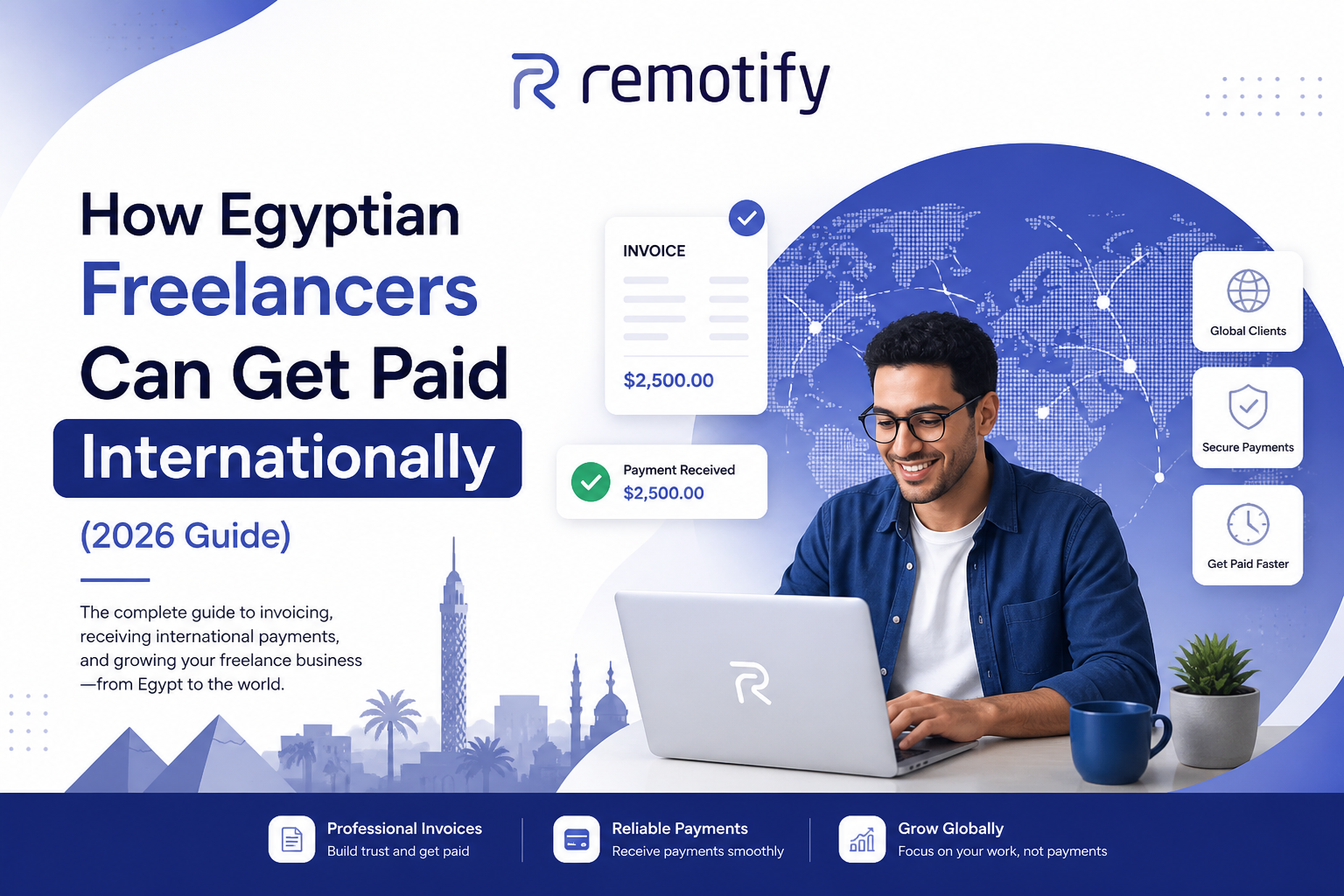
How Egyptian Freelancers Can Get Paid Internationally (2026 Guide)

For Egyptian freelancers, the global market has never been more accessible. Platforms like Upwork, LinkedIn, and direct outreach have made it easier than ever to land international clients.

But there’s a catch.

Getting paid is still one of the biggest challenges.

In 2026, many Egyptian freelancers are not struggling because of lack of skill or opportunity—but because of payment barriers, banking limitations, and invoicing issues that make working with international clients unnecessarily difficult.

This guide explains:

  • The real payment problems freelancers face in Egypt
  • Why traditional tools fall short
  • And how solutions like Remotify are changing the game
Egyptian freelancers

That's the real cost of Egypt's payment infrastructure gap. Not just friction. Lost contracts.

Stripe is Not Available in Egypt

Globally, Stripe is the most trusted payment processor for freelancers and businesses. Clients in the US, Europe, and even startups worldwide prefer to pay through Stripe because it is fast, secure, and easy to use.

However:

  • Stripe is not supported for Egyptian residents
  • Freelancers cannot create local Stripe accounts
  • Clients often expect Stripe invoices as a standard

This creates a serious problem.

Imagine landing a $2,000 project, only to realize your client wants to pay via Stripe—and you simply can’t accept it.

Result: Many freelancers either:

  • Lose the client
  • Or are forced to use complicated workarounds

PayPal Limitations in Egypt

PayPal is often seen as the “default” solution—but in Egypt, it comes with significant drawbacks:

  • Withdrawals can be slow or restricted
  • Accounts may face random limitations or reviews
  • High currency conversion fees
  • Delays in transferring money to local banks
  • Some clients avoid PayPal due to disputes and reversals

Even when payments go through, accessing your funds isn’t always smooth.

Result: Freelancers deal with uncertainty, delays, and reduced earnings.

Currency Restrictions & Banking Barriers

Egypt’s financial system adds another layer of friction:

  • Strict foreign currency controls
  • Limited access to USD accounts
  • High conversion losses when converting to EGP
  • SWIFT transfers take 3–5 business days
  • International transfer fees can be significant

This means that even if a client pays you $1,000:

  • You may receive less due to conversion rates
  • You may wait days to access it
  • You may lose additional money in fees

Result: Your real income becomes unpredictable.

Invoicing is a Hidden Deal-Breaker

One of the most overlooked issues is invoicing.

Freelancers often assume that sending a simple message like
“Please pay me $500” is enough.

But for international clients—especially companies—this is not acceptable.

They require:

  • Proper invoice structure
  • Business identification details
  • Itemized services
  • Legal and tax-compliant formatting

Without this:

  • Payments can be delayed by finance teams
  • Invoices can be rejected
  • Clients may hesitate to work with you

In many real-world cases: No professional invoice = no payment

Why Existing Tools Don’t Solve the Problem

Most freelancers try to combine multiple tools, but each one solves only part of the problem:

Payoneer

  • Good for receiving international payments
  • But lacks proper invoicing features

Wise (formerly TransferWise)

  • Excellent exchange rates
  • But not built for invoicing or client workflows

PayPal

  • Easy to use globally
  • But unreliable and expensive in Egypt

Freelance Platforms (Upwork, Fiverr)

  • Handle payments internally
  • But charge 10–20% fees
  • Limit your independence and branding

The core issue is simple: There is no unified system that handles both invoicing and payments efficiently for Egyptian freelancers.

The Solution: Remotify

This is where Remotify comes in.

Instead of forcing freelancers to patch together multiple tools, Remotify provides a complete workflow designed for international freelancing—especially for regions like Egypt.

1. Professional, Internationally Compliant Invoices

Remotify allows you to create invoices that meet global standards.

Each invoice includes:

  • Proper formatting
  • Business details
  • Client information
  • Clear breakdown of services

This ensures that:

  • Clients trust your professionalism
  • Finance teams approve payments faster
  • You avoid unnecessary delays

You instantly appear more credible and “business-ready”

2. Simplified Payment Flow

Instead of asking clients to figure out how to pay you, Remotify creates a structured flow:

  • You send an invoice
  • The client pays against it
  • The process is tracked and organized

No confusion. No back-and-forth.

This removes one of the biggest friction points in freelancing.

3. Designed for Cross-Border Freelancers

Remotify is not just another payment tool—it’s designed specifically for freelancers working with international clients.

It understands:

  • Payment expectations of US/EU clients
  • The limitations of countries like Egypt
  • The need for compliance and simplicity

This makes it far more practical than generic tools.

How the Process Works

The workflow is intentionally simple:

  1. Sign up
  2. Create an invoice
  3. Send it to your client
  4. Receive payment

That’s it.

No accounting complexity. No technical setup.

Why This Matters for Your Freelance Growth

Many freelancers underestimate how important payments are.

But in reality:

Your ability to get paid smoothly is directly tied to your ability to grow.

When your system is broken:

  • Clients hesitate
  • Payments get delayed
  • Trust decreases

When your system is smooth:

  • Clients pay faster
  • You look professional
  • Repeat work increases
  • Referrals grow

The Competitive Advantage Most Freelancers Miss

In global freelancing, skill is only part of the equation.

The real winners are freelancers who are:

  • Easy to communicate with
  • Easy to work with
  • And most importantly—easy to pay

If a client has to struggle to send you money, they may simply choose someone else.

Conclusion

Egypt is full of talented freelancers competing on a global stage.

But outdated payment infrastructure continues to create unnecessary barriers.

To succeed internationally in 2026, you need more than just skill—you need:

  • Reliable payment systems
  • Professional invoicing
  • A frictionless client experience

That’s exactly what platforms like Remotify are solving.

Globally, Stripe is the most trusted payment processor for freelancers and businesses. Clients in the US, Europe, and even startups worldwide prefer to pay through Stripe because it is fast, secure, and easy to use.

However:

  • Stripe is not supported for Egyptian residents
  • Freelancers cannot create local Stripe accounts
  • Clients often expect Stripe invoices as a standard

This creates a serious problem.

Imagine landing a $2,000 project, only to realize your client wants to pay via Stripe—and you simply can’t accept it.

Result: Many freelancers either:

  • Lose the client
  • Or are forced to use complicated workarounds

PayPal Limitations in Egypt

PayPal is often seen as the “default” solution—but in Egypt, it comes with significant drawbacks:

  • Withdrawals can be slow or restricted
  • Accounts may face random limitations or reviews
  • High currency conversion fees
  • Delays in transferring money to local banks
  • Some clients avoid PayPal due to disputes and reversals

Even when payments go through, accessing your funds isn’t always smooth.

Result: Freelancers deal with uncertainty, delays, and reduced earnings.

Currency Restrictions & Banking Barriers

Egypt’s financial system adds another layer of friction:

  • Strict foreign currency controls
  • Limited access to USD accounts
  • High conversion losses when converting to EGP
  • SWIFT transfers take 3–5 business days
  • International transfer fees can be significant

This means that even if a client pays you $1,000:

  • You may receive less due to conversion rates
  • You may wait days to access it
  • You may lose additional money in fees

Result: Your real income becomes unpredictable.

Invoicing is a Hidden Deal-Breaker

One of the most overlooked issues is invoicing.

Freelancers often assume that sending a simple message like
“Please pay me $500” is enough.

But for international clients—especially companies—this is not acceptable.

They require:

  • Proper invoice structure
  • Business identification details
  • Itemized services
  • Legal and tax-compliant formatting

Without this:

  • Payments can be delayed by finance teams
  • Invoices can be rejected
  • Clients may hesitate to work with you

In many real-world cases: No professional invoice = no payment
Most freelancers try to combine multiple tools, but each one solves only part of the problem:

Payoneer

  • Good for receiving international payments
  • But lacks proper invoicing features

Wise (formerly TransferWise)

  • Excellent exchange rates
  • But not built for invoicing or client workflows

PayPal

  • Easy to use globally
  • But unreliable and expensive in Egypt

Freelance Platforms (Upwork, Fiverr)

  • Handle payments internally
  • But charge 10–20% fees
  • Limit your independence and branding

The core issue is simple: There is no unified system that handles both invoicing and payments efficiently for Egyptian freelancers.

This is where Remotify comes in.

Instead of forcing freelancers to patch together multiple tools, Remotify provides a complete workflow designed for international freelancing—especially for regions like Egypt.

1. Professional, Internationally Compliant Invoices

Remotify allows you to create invoices that meet global standards.

Each invoice includes:

  • Proper formatting
  • Business details
  • Client information
  • Clear breakdown of services

This ensures that:

  • Clients trust your professionalism
  • Finance teams approve payments faster
  • You avoid unnecessary delays

You instantly appear more credible and “business-ready”

2. Simplified Payment Flow

Instead of asking clients to figure out how to pay you, Remotify creates a structured flow:

  • You send an invoice
  • The client pays against it
  • The process is tracked and organized

No confusion. No back-and-forth.

This removes one of the biggest friction points in freelancing.

3. Designed for Cross-Border Freelancers

Remotify is not just another payment tool—it’s designed specifically for freelancers working with international clients.

It understands:

  • Payment expectations of US/EU clients
  • The limitations of countries like Egypt
  • The need for compliance and simplicity

This makes it far more practical than generic tools.

The workflow is intentionally simple:

  1. Sign up
  2. Create an invoice
  3. Send it to your client
  4. Receive payment

That’s it.

No accounting complexity. No technical setup.

Many freelancers underestimate how important payments are.

But in reality:

Your ability to get paid smoothly is directly tied to your ability to grow.

When your system is broken:

  • Clients hesitate
  • Payments get delayed
  • Trust decreases

When your system is smooth:

  • Clients pay faster
  • You look professional
  • Repeat work increases
  • Referrals grow

In global freelancing, skill is only part of the equation.

The real winners are freelancers who are:

  • Easy to communicate with
  • Easy to work with
  • And most importantly—easy to pay

If a client has to struggle to send you money, they may simply choose someone else.

Egypt is full of talented freelancers competing on a global stage.

But outdated payment infrastructure continues to create unnecessary barriers.

To succeed internationally in 2026, you need more than just skill—you need:

  • Reliable payment systems
  • Professional invoicing
  • A frictionless client experience

That’s exactly what platforms like Remotify are solving.