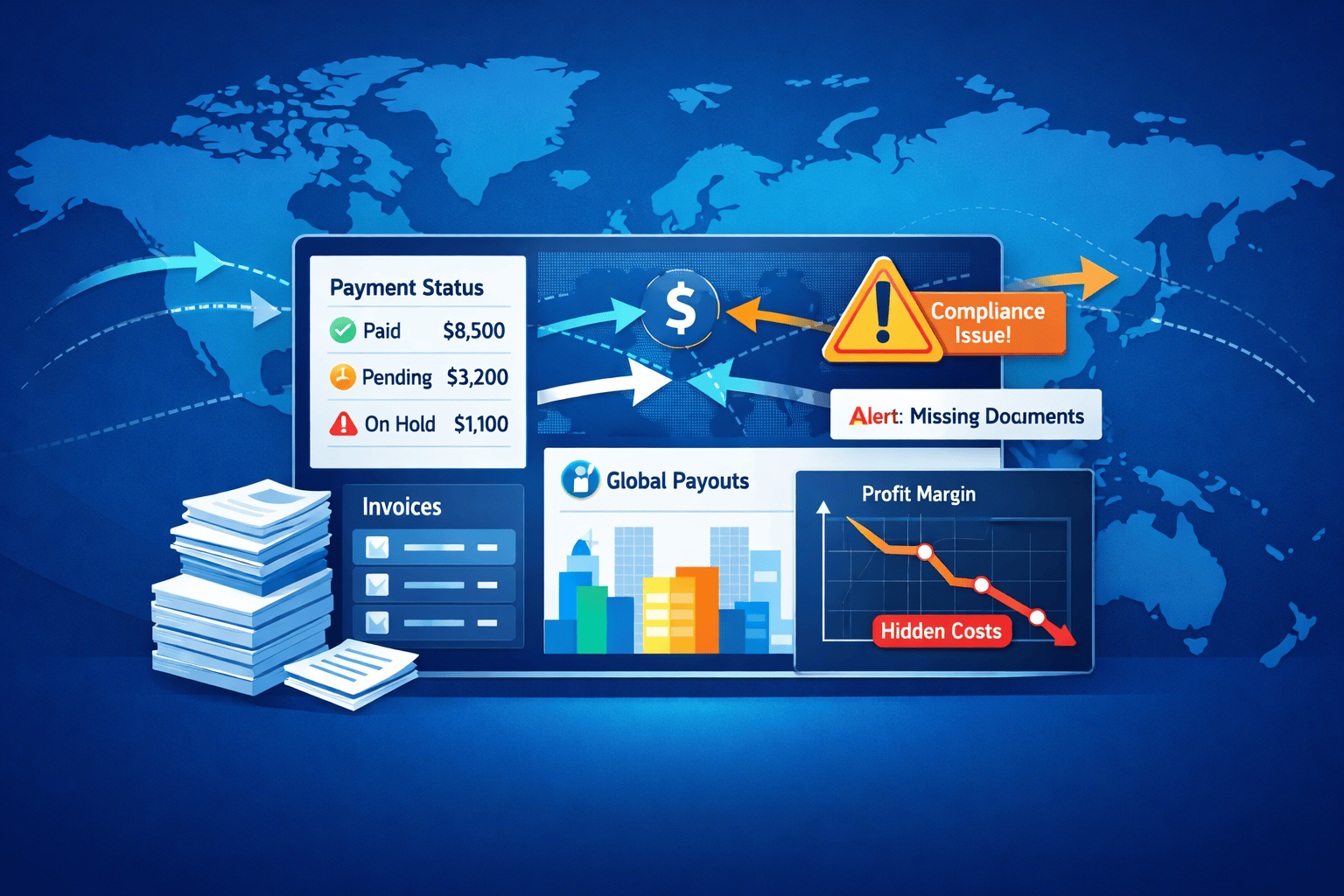
Remote Agency Payroll: 7 Hidden Costs Killing Your Margins Slug: remote-agency-payroll
Author: Callum Gracie, Founder, Gia AI
Remote agency payroll is broken for small teams. If your remote agency payroll involves contractors across three to five countries, you already know this. You are too small for Deel. Too complex for a spreadsheet. And too busy to fix the mess in between.
So your payment stack ends up looking like this: Wise for half your team, PayPal for the rest, a Google Sheet tracking who got paid when, and a prayer that nobody asks about tax compliance in the Philippines.
I have been there. Running a global team with contractors scattered across multiple time zones means paying people is never just “sending money.” It is an ongoing source of friction, hidden costs, and risk that quietly eats your margins.
Remote Agency Payroll Costs Small Teams 7x More
Here is the number that should make every agency owner sit up. The Deloitte Global Payroll Benchmarking Survey found that organisations with fewer than 500 employees pay $971 per employee annually for payroll services. Large enterprises pay just $137. That is a sevenfold cost disadvantage, driven entirely by missing economies of scale.
Per payslip, the gap widens to 16x. Small firms pay $33.60 while organisations above 25,000 workers pay $2.14.
Meanwhile, every major EOR platform prices its services between $499 and $699 per employee per month. For an agency placing five workers through an EOR, that is $36,000 to $42,000 per year in platform fees alone. Before salaries. Before benefits.
No wonder most small agencies skip formal platforms for their remote agency payroll. G2’s payroll statistics put the number at 51% of small businesses still using spreadsheets. Employment Hero’s 2025 survey found that 44% of businesses with 5 to 19 employees manage payroll through spreadsheets or manual forms.
Your “Cheap” DIY Stack Is Not Cheap
Transfer fees look cheap on paper. Wise charges 0.33 to 0.59% on average. That feels reasonable. But transfer fees are a misleading basis for comparing your true payment costs.
The real expense is time. Oncore Services data shows that managing a single contractor over eight months takes 32 timesheets, 16 invoices, 32 payments, 10 phone calls, 20 emails, and 12 hours of administration. Multiply that by 10 contractors and your team burns roughly 3 hours per contractor per month.
At $60 per hour, that is $21,600 per year in admin overhead alone. Add $6,000 for legal consultation, $3,600 for accounting, and $2,400 for compliance monitoring. Your total DIY cost hits about $36,000 annually. That is roughly what you would have spent on a proper platform.
On top of that, 70% of U.S. firms report higher failed payment rates on cross-border transactions compared to domestic ones. And a Mastercard study found that 40% of SME cross-border payments take more than four days to clear.
So you are spending the same money. Getting worse results. And taking on all the compliance risk yourself.
Compliance Risk Compounds With Every Country You Add
This is where remote agency payroll gets dangerous for most agency owners. An Alight survey of payroll professionals found that 67% of organisations operating in 2 to 5 countries had received payroll fines. Only 24% of single-country firms reported the same.
That 2 to 5 country range is precisely the profile of a small distributed agency handling remote agency payroll across borders.
Misclassification penalties hit hard. In the U.S., fines range from $5,000 to $25,000 per misclassified worker depending on the state. California alone imposes $10,000 to $25,000 per willful violation. The UK’s IR35 rules carry penalties of 30 to 100% of unpaid tax. And the EU Platform Work Directive, which member states must adopt by December 2026, creates a presumption of employment that could affect agencies with long-term contractors.
Spain has already fined Glovo €136 million for misclassification. The Netherlands ended its enforcement moratorium entirely. Enforcement is not theoretical anymore. For agencies managing international payroll informally, each new country adds another layer of exposure.
How to Fix Your Remote Agency Payroll Without Enterprise Pricing
The good news is that contractor management tiers have separated from full EOR pricing. You no longer need to spend $599 per employee per month to get compliant remote agency payroll.
Budget options now start at $19 to $49 per contractor monthly. Payoneer Workforce Management comes in at $19. RemoFirst sits at $25. Remote.com charges $29 for contractor management.
For an agency with 10 international contractors, a platform in this range costs $3,480 to $5,880 per year. Combined with reduced admin time (dropping from 3 hours to 1 hour per contractor per month), total costs fall to roughly $10,000 to $12,000 annually.
Compare that to $36,000 for the duct-tape approach. The savings run between $24,000 and $28,000 per year.
The breakeven point is straightforward. Once your remote agency payroll involves 5 or more contractors in 3 or more countries, the admin burden alone justifies switching. Factor in the 67% penalty rate for multi-country operations, and sticking with spreadsheets becomes the expensive option.
You do not need enterprise infrastructure. But you do need something better than spreadsheets and prayers. Start by auditing your true per-payment costs this month. The number will probably change how you think about “cheap.”