This sounds like semantics, but it’s not. When a European company needs to book an expense – actually book it, deduct it, and have it survive an audit – they need a document that clears a legal bar. Your Canva PDF doesn’t clear it.
Here’s the specific problem:
European businesses operate under VAT rules that require invoices to come from a registered legal entity. That means a company name, a VAT number, a tax reference, a proper invoice number. The stuff you’d find on a receipt from any legitimate supplier.
When your invoice doesn’t have those things, it’s not that their accountant is being difficult. It’s that their own tax compliance depends on rejecting it. They literally cannot claim the expense without the right documentation.
And the reverse charge mechanism – which is how cross-border B2B payments work inside the EU – requires a VAT number on both sides of the transaction. Without yours, the accounting doesn’t add up on their end.
What’s actually missing from your PDF
You might have done perfect work. The invoice still fails.

Germany, France, the Netherlands, Poland, Spain, Italy – 30+ countries across the SEPA zone all work from the same rulebook. VAT-compliant invoices, legal entity information, reverse charge for cross-border work.
If your client is anywhere in that zone, this is the standard their accountants enforce. It’s not negotiable on their end, which means it can’t be optional on yours.
That’s the part most freelancers don’t realize. You don’t need a VAT number. You don’t need an Estonian entity. You don’t need to spend three months navigating business registration in a country where you don’t live.
When you invoice through Remotify, your client receives a proper EU invoice – issued from Remotify’s Estonia-registered entity, with all the mandatory fields included, VAT number, reverse charge reference, the whole thing. Their accounting team sees a document that looks exactly like what they’d get from any European supplier.
Same work you did. Same amount you quoted. Invoice that actually gets processed.
| Your PDF | Remotify Invoice | |
| Legal entity | Personal name | EU-registered (Estonia) |
| VAT number | None | Included |
| Reverse charge | Missing | Applied automatically |
| SEPA payment | Not possible | Full zone coverage |
| Accepted by accounting | Often rejected | Consistently accepted |
Q1. Why do European companies reject personal invoices?
They need VAT-compliant documentation to process expenses and handle their own tax filings. A personal invoice without a VAT number and legal entity doesn’t meet that threshold.
Q2. Can I just add a VAT number?
Only if you have one – and getting one requires registering a business entity first, which is a whole separate process.
Q3. How does Remotify’s invoice look different?
It comes from a registered EU entity in Estonia. All mandatory fields, VAT number, and reverse charge language are included automatically.
Q4. Does this cover the whole EU?
Yes – the entire SEPA zone, 30+ countries.
Q5. Is this just for people without a company?
No. Even freelancers with their own company use it for SEPA speed and cross-border compliance.
This sounds like semantics, but it’s not. When a European company needs to book an expense – actually book it, deduct it, and have it survive an audit – they need a document that clears a legal bar. Your Canva PDF doesn’t clear it.
Here’s the specific problem:
European businesses operate under VAT rules that require invoices to come from a registered legal entity. That means a company name, a VAT number, a tax reference, a proper invoice number. The stuff you’d find on a receipt from any legitimate supplier.
When your invoice doesn’t have those things, it’s not that their accountant is being difficult. It’s that their own tax compliance depends on rejecting it. They literally cannot claim the expense without the right documentation.
And the reverse charge mechanism – which is how cross-border B2B payments work inside the EU – requires a VAT number on both sides of the transaction. Without yours, the accounting doesn’t add up on their end.
What’s actually missing from your PDF
You might have done perfect work. The invoice still fails.
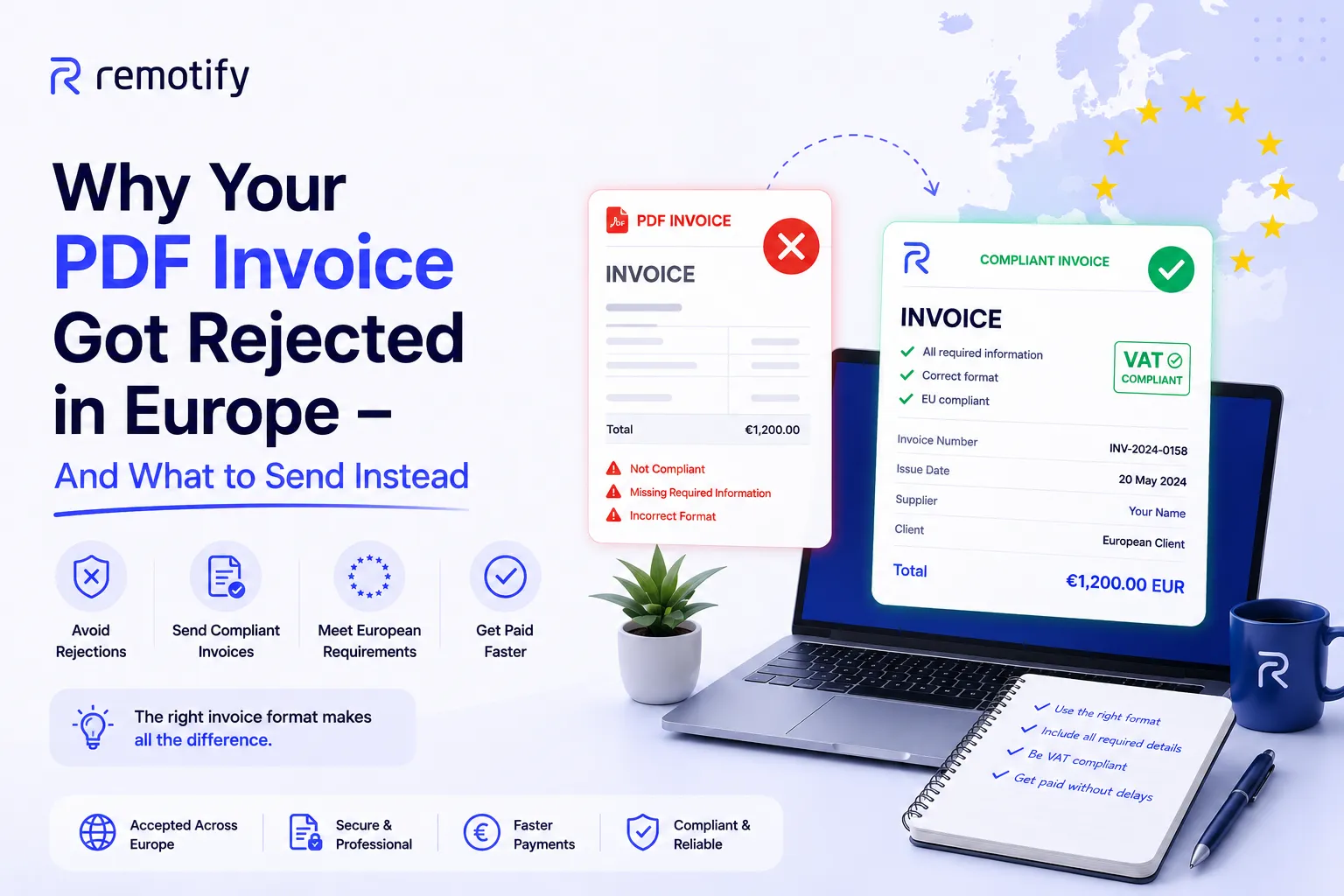
Germany, France, the Netherlands, Poland, Spain, Italy – 30+ countries across the SEPA zone all work from the same rulebook. VAT-compliant invoices, legal entity information, reverse charge for cross-border work.
If your client is anywhere in that zone, this is the standard their accountants enforce. It’s not negotiable on their end, which means it can’t be optional on yours.
That’s the part most freelancers don’t realize. You don’t need a VAT number. You don’t need an Estonian entity. You don’t need to spend three months navigating business registration in a country where you don’t live.
When you invoice through Remotify, your client receives a proper EU invoice – issued from Remotify’s Estonia-registered entity, with all the mandatory fields included, VAT number, reverse charge reference, the whole thing. Their accounting team sees a document that looks exactly like what they’d get from any European supplier.
Same work you did. Same amount you quoted. Invoice that actually gets processed.
| Your PDF | Remotify Invoice | |
| Legal entity | Personal name | EU-registered (Estonia) |
| VAT number | None | Included |
| Reverse charge | Missing | Applied automatically |
| SEPA payment | Not possible | Full zone coverage |
| Accepted by accounting | Often rejected | Consistently accepted |
Q1. Why do European companies reject personal invoices?
They need VAT-compliant documentation to process expenses and handle their own tax filings. A personal invoice without a VAT number and legal entity doesn’t meet that threshold.
Q2. Can I just add a VAT number?
Only if you have one – and getting one requires registering a business entity first, which is a whole separate process.
Q3. How does Remotify’s invoice look different?
It comes from a registered EU entity in Estonia. All mandatory fields, VAT number, and reverse charge language are included automatically.
Q4. Does this cover the whole EU?
Yes – the entire SEPA zone, 30+ countries.
Q5. Is this just for people without a company?
No. Even freelancers with their own company use it for SEPA speed and cross-border compliance.