On paper, hiring a Polish freelancer sounds simple. Poland has a large, skilled freelance workforce in software development, design, and marketing, and Dutch companies increasingly want that talent without opening a local office or registering as an employer abroad. In practice, three things get complicated fast.
First, there is the invoicing question. If a Dutch company pays a Polish freelancer directly, someone has to determine whether VAT applies, at what rate, and who is responsible for reporting it. Cross-border B2B services between EU member states have specific VAT rules, and getting them wrong creates accounting headaches at best and compliance exposure at worst.
Second, there is the payment itself. A direct bank transfer from a Dutch account to a Polish one can still route through correspondent banks if it is not set up correctly, adding delays and fees on both ends. Freelancers depending on that income do not want to wait a week to see it land.
Third, and often overlooked, is the employment classification question. Dutch companies are increasingly cautious about “false self-employment” (schijnzelfstandigheid) after tightened enforcement around the wet DBA, and Poland has its own tests for distinguishing a genuine B2B relationship from disguised employment. When a Dutch company pays a Polish freelancer directly, on a recurring basis, without a clear invoicing structure in between, it starts to resemble a payroll relationship rather than a commercial one. That ambiguity is the real risk, and it is the one most companies do not think about until a tax authority asks about it.
Reverse charge is the mechanism that makes cross-border B2B services within the EU workable without every invoice becoming a VAT puzzle. Under the standard EU VAT rule for B2B services, when a VAT-registered business in one member state supplies a service to a VAT-registered business in another member state, the seller does not charge VAT on the invoice. Instead, the liability to account for VAT shifts, or “reverse charges,” to the buyer, who self-assesses the VAT through their own domestic VAT return.
For a Dutch company receiving an invoice tied to work performed by a Polish freelancer, this means the invoice can be issued VAT-free at the line-item level, with a reverse charge note, and the Dutch company handles the VAT reporting on its own return. No Polish VAT is charged, no Dutch VAT is added at the point of invoicing, and both sides stay compliant as long as the invoice is formatted correctly and both parties are properly registered.
This is one of the areas where a Merchant of Record earns its keep. Because Remotify is an EU-registered entity incorporated in Estonia, it can issue invoices that are already structured for reverse charge treatment on qualifying cross-border B2B transactions. The Dutch company gets an invoice its finance team can process the same way it would process any other EU services invoice, without needing to research Polish VAT registration thresholds or double check reverse charge eligibility line by line.
The Netherlands and Poland are both within the SEPA (Single Euro Payments Area) zone, which means euro-denominated transfers between the two countries can move through the SEPA Credit Transfer scheme rather than international wire networks like SWIFT. That distinction matters more than it sounds.
A SWIFT transfer can pass through one or more correspondent banks before it reaches the recipient, and each hop can add a processing fee and a delay measured in days rather than hours. A SEPA transfer, by contrast, is designed to settle within one business day, and often faster. For a freelancer relying on that payment to cover ongoing costs, the difference between a same-day SEPA settlement and a multi-day SWIFT transfer chain is not a minor convenience, it is the difference between predictable cash flow and constant follow-up emails asking where the payment is.
Using SEPA payments as the settlement rail is a core part of how Remotify pays out freelancers once an invoice clears, which is one of the practical reasons country pairs like Netherlands and Poland, both firmly inside the SEPA zone, are well suited to this kind of setup.
This is the part that tends to worry finance and legal teams the most, and for good reason. When a Dutch company pays a Polish freelancer directly, especially on a recurring monthly basis for ongoing work, the relationship can start to look less like a genuine freelance engagement and more like an employment relationship without the paperwork. Neither the Dutch nor the Polish tax authority wants to see that, and both have frameworks for catching it.
The core issue is that a direct, recurring payment from a company to an individual, without a clear invoicing structure and without a third party in the middle handling the commercial mechanics, blurs the line between “we hired a contractor for a project” and “we have an unregistered employee.” Introducing a Merchant of Record does not eliminate this risk entirely, no invoicing structure can guarantee that, but it does reduce it meaningfully by keeping the relationship anchored to a clear invoice-and-payment chain between three distinct parties rather than a direct, informal cash flow between two.
It is worth being precise here: the freelancer’s income tax obligation in Poland does not go away, and it should not be expected to. The freelancer remains responsible for declaring that income and filing according to Polish tax rules. What changes is the structure around the payment itself, which is what actually matters for the misclassification question.
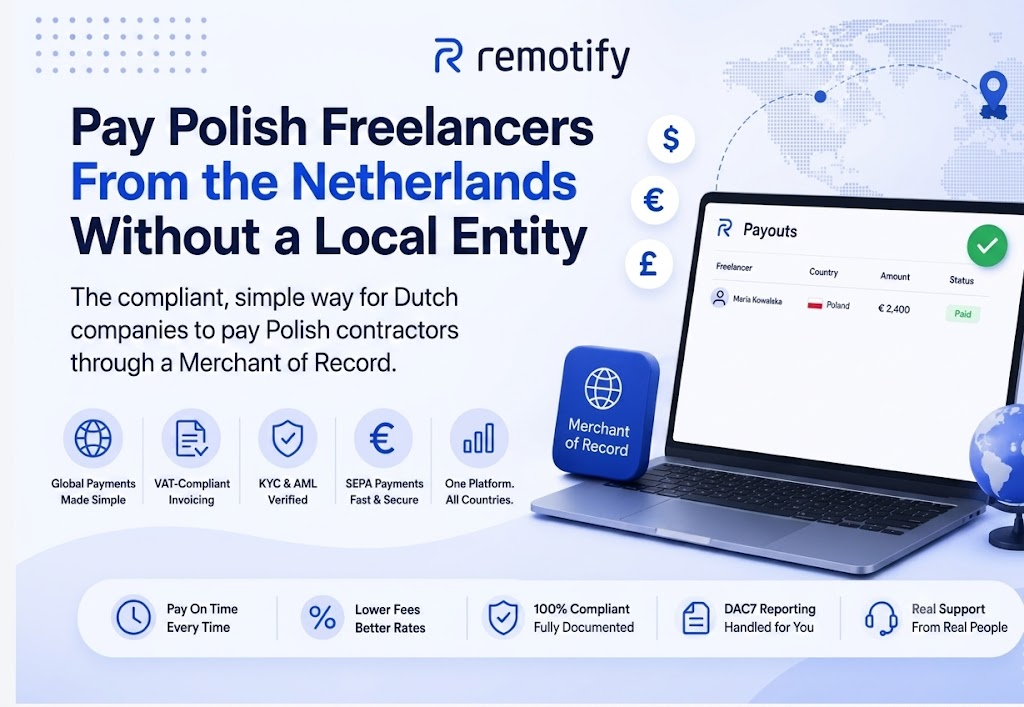
Remotify acts as the Merchant of Record between the Dutch company and the Polish freelancer. It issues the invoice, applies the correct VAT treatment for the cross-border transaction, runs KYC and AML checks on the freelancer before onboarding, and settles the payout by SEPA once the invoice is confirmed. Remotify is not an Employer of Record, a payroll provider, or an umbrella company, and it does not take over the freelancer’s income tax filings in Poland. What it does is remove the ambiguity around who is issuing the invoice and how the money moves, so the relationship stays clearly commercial instead of drifting toward something that resembles employment.
Picture a Dutch software company that wants to bring on a Polish backend developer for a three-month project, with the possibility of extending it. Instead of asking the developer to invoice directly, or trying to set up some form of local registration in Poland, the company routes the engagement through Remotify.
The developer completes KYC and AML verification once, during onboarding. Each month, an invoice is issued to the Dutch company, VAT-compliant and correctly formatted for the reverse charge, so the Dutch finance team can process it the same way it processes any other EU vendor invoice. Once the Dutch company pays that invoice, the developer receives their payout via SEPA, usually landing within one to two business days. Because Remotify is registered in the EU, it also handles DAC7 reporting obligations, the EU requirement for digital platforms to report certain payment information to tax authorities, which is one more thing the Dutch company does not need to track independently.
Nothing about this setup requires the Dutch company to open a Polish entity, run Polish payroll, or make a legal determination about employment status. The freelancer relationship stays a freelancer relationship, on paper and in practice.
If your company is currently paying Polish freelancers directly, or is about to start, the first step is deciding whether you want to keep managing VAT treatment, cross-border payment rails, and classification risk in-house, or hand that structure to a platform built for it. Remotify is set up to handle the invoicing, VAT compliance, KYC and AML checks, and SEPA payouts for exactly this kind of Netherlands-to-Poland arrangement. You can see current plans and details at remotify.co/pricing.
Yes. A Dutch company can work with a Polish freelancer without setting up any local entity by using a Merchant of Record to handle the invoicing and payment. The Dutch company simply pays one compliant invoice, and the platform manages the rest.
Under the EU reverse charge mechanism, cross-border B2B services between VAT-registered businesses in different member states are typically invoiced without VAT added at the line item, with the buyer self-assessing VAT on their own return. The exact treatment depends on registration status on both sides.
SEPA Credit Transfers between countries in the SEPA zone, which includes both the Netherlands and Poland, typically settle within one business day, sometimes faster. This is generally much quicker than international wire transfers routed through correspondent banks.
Recurring direct payments without a clear invoicing structure can raise misclassification questions in both Dutch and Polish frameworks for distinguishing contractors from employees. Using a Merchant of Record to structure the invoice and payment reduces this risk, though no setup removes it completely.
The freelancer is always responsible for declaring and filing their own income tax in Poland. A Merchant of Record like Remotify handles invoicing, VAT treatment, and payment settlement, but it does not take over the freelancer’s personal tax obligations.
No. Remotify is a Merchant of Record. It issues invoices, applies VAT treatment, runs KYC and AML checks, and settles payments via SEPA. It does not employ freelancers, run payroll, or handle income tax filings on their behalf.
DAC7 is an EU reporting rule that requires digital platforms to report certain payment and seller information to tax authorities. Because Remotify is an EU-registered platform, it handles DAC7 reporting obligations tied to these transactions, so the Dutch company does not need to manage that separately.

On paper, hiring a Polish freelancer sounds simple. Poland has a large, skilled freelance workforce in software development, design, and marketing, and Dutch companies increasingly want that talent without opening a local office or registering as an employer abroad. In practice, three things get complicated fast.
First, there is the invoicing question. If a Dutch company pays a Polish freelancer directly, someone has to determine whether VAT applies, at what rate, and who is responsible for reporting it. Cross-border B2B services between EU member states have specific VAT rules, and getting them wrong creates accounting headaches at best and compliance exposure at worst.
Second, there is the payment itself. A direct bank transfer from a Dutch account to a Polish one can still route through correspondent banks if it is not set up correctly, adding delays and fees on both ends. Freelancers depending on that income do not want to wait a week to see it land.
Third, and often overlooked, is the employment classification question. Dutch companies are increasingly cautious about “false self-employment” (schijnzelfstandigheid) after tightened enforcement around the wet DBA, and Poland has its own tests for distinguishing a genuine B2B relationship from disguised employment. When a Dutch company pays a Polish freelancer directly, on a recurring basis, without a clear invoicing structure in between, it starts to resemble a payroll relationship rather than a commercial one. That ambiguity is the real risk, and it is the one most companies do not think about until a tax authority asks about it.
Reverse charge is the mechanism that makes cross-border B2B services within the EU workable without every invoice becoming a VAT puzzle. Under the standard EU VAT rule for B2B services, when a VAT-registered business in one member state supplies a service to a VAT-registered business in another member state, the seller does not charge VAT on the invoice. Instead, the liability to account for VAT shifts, or “reverse charges,” to the buyer, who self-assesses the VAT through their own domestic VAT return.
For a Dutch company receiving an invoice tied to work performed by a Polish freelancer, this means the invoice can be issued VAT-free at the line-item level, with a reverse charge note, and the Dutch company handles the VAT reporting on its own return. No Polish VAT is charged, no Dutch VAT is added at the point of invoicing, and both sides stay compliant as long as the invoice is formatted correctly and both parties are properly registered.
This is one of the areas where a Merchant of Record earns its keep. Because Remotify is an EU-registered entity incorporated in Estonia, it can issue invoices that are already structured for reverse charge treatment on qualifying cross-border B2B transactions. The Dutch company gets an invoice its finance team can process the same way it would process any other EU services invoice, without needing to research Polish VAT registration thresholds or double check reverse charge eligibility line by line.
The Netherlands and Poland are both within the SEPA (Single Euro Payments Area) zone, which means euro-denominated transfers between the two countries can move through the SEPA Credit Transfer scheme rather than international wire networks like SWIFT. That distinction matters more than it sounds.
A SWIFT transfer can pass through one or more correspondent banks before it reaches the recipient, and each hop can add a processing fee and a delay measured in days rather than hours. A SEPA transfer, by contrast, is designed to settle within one business day, and often faster. For a freelancer relying on that payment to cover ongoing costs, the difference between a same-day SEPA settlement and a multi-day SWIFT transfer chain is not a minor convenience, it is the difference between predictable cash flow and constant follow-up emails asking where the payment is.
Using SEPA payments as the settlement rail is a core part of how Remotify pays out freelancers once an invoice clears, which is one of the practical reasons country pairs like Netherlands and Poland, both firmly inside the SEPA zone, are well suited to this kind of setup.
This is the part that tends to worry finance and legal teams the most, and for good reason. When a Dutch company pays a Polish freelancer directly, especially on a recurring monthly basis for ongoing work, the relationship can start to look less like a genuine freelance engagement and more like an employment relationship without the paperwork. Neither the Dutch nor the Polish tax authority wants to see that, and both have frameworks for catching it.
The core issue is that a direct, recurring payment from a company to an individual, without a clear invoicing structure and without a third party in the middle handling the commercial mechanics, blurs the line between “we hired a contractor for a project” and “we have an unregistered employee.” Introducing a Merchant of Record does not eliminate this risk entirely, no invoicing structure can guarantee that, but it does reduce it meaningfully by keeping the relationship anchored to a clear invoice-and-payment chain between three distinct parties rather than a direct, informal cash flow between two.
It is worth being precise here: the freelancer’s income tax obligation in Poland does not go away, and it should not be expected to. The freelancer remains responsible for declaring that income and filing according to Polish tax rules. What changes is the structure around the payment itself, which is what actually matters for the misclassification question.
Remotify acts as the Merchant of Record between the Dutch company and the Polish freelancer. It issues the invoice, applies the correct VAT treatment for the cross-border transaction, runs KYC and AML checks on the freelancer before onboarding, and settles the payout by SEPA once the invoice is confirmed. Remotify is not an Employer of Record, a payroll provider, or an umbrella company, and it does not take over the freelancer’s income tax filings in Poland. What it does is remove the ambiguity around who is issuing the invoice and how the money moves, so the relationship stays clearly commercial instead of drifting toward something that resembles employment.
Picture a Dutch software company that wants to bring on a Polish backend developer for a three-month project, with the possibility of extending it. Instead of asking the developer to invoice directly, or trying to set up some form of local registration in Poland, the company routes the engagement through Remotify.
The developer completes KYC and AML verification once, during onboarding. Each month, an invoice is issued to the Dutch company, VAT-compliant and correctly formatted for the reverse charge, so the Dutch finance team can process it the same way it processes any other EU vendor invoice. Once the Dutch company pays that invoice, the developer receives their payout via SEPA, usually landing within one to two business days. Because Remotify is registered in the EU, it also handles DAC7 reporting obligations, the EU requirement for digital platforms to report certain payment information to tax authorities, which is one more thing the Dutch company does not need to track independently.
Nothing about this setup requires the Dutch company to open a Polish entity, run Polish payroll, or make a legal determination about employment status. The freelancer relationship stays a freelancer relationship, on paper and in practice.
If your company is currently paying Polish freelancers directly, or is about to start, the first step is deciding whether you want to keep managing VAT treatment, cross-border payment rails, and classification risk in-house, or hand that structure to a platform built for it. Remotify is set up to handle the invoicing, VAT compliance, KYC and AML checks, and SEPA payouts for exactly this kind of Netherlands-to-Poland arrangement. You can see current plans and details at remotify.co/pricing.
Yes. A Dutch company can work with a Polish freelancer without setting up any local entity by using a Merchant of Record to handle the invoicing and payment. The Dutch company simply pays one compliant invoice, and the platform manages the rest.
Under the EU reverse charge mechanism, cross-border B2B services between VAT-registered businesses in different member states are typically invoiced without VAT added at the line item, with the buyer self-assessing VAT on their own return. The exact treatment depends on registration status on both sides.
SEPA Credit Transfers between countries in the SEPA zone, which includes both the Netherlands and Poland, typically settle within one business day, sometimes faster. This is generally much quicker than international wire transfers routed through correspondent banks.
Recurring direct payments without a clear invoicing structure can raise misclassification questions in both Dutch and Polish frameworks for distinguishing contractors from employees. Using a Merchant of Record to structure the invoice and payment reduces this risk, though no setup removes it completely.
The freelancer is always responsible for declaring and filing their own income tax in Poland. A Merchant of Record like Remotify handles invoicing, VAT treatment, and payment settlement, but it does not take over the freelancer’s personal tax obligations.
No. Remotify is a Merchant of Record. It issues invoices, applies VAT treatment, runs KYC and AML checks, and settles payments via SEPA. It does not employ freelancers, run payroll, or handle income tax filings on their behalf.
DAC7 is an EU reporting rule that requires digital platforms to report certain payment and seller information to tax authorities. Because Remotify is an EU-registered platform, it handles DAC7 reporting obligations tied to these transactions, so the Dutch company does not need to manage that separately.