Dutch Company, Romanian Freelancer: A Compliance Checklist Before You Pay

A Dutch company can pay a Romanian freelance developer without registering a local entity in Romania by working through a Merchant of Record, but there are still a handful of things worth confirming before the first invoice goes out: VAT treatment, identity verification, payment rails, and how the relationship is structured to avoid looking like disguised employment. This checklist walks through each one, specifically for hiring managers bringing on Romanian freelance talent at scale.

Romanian Freelancer

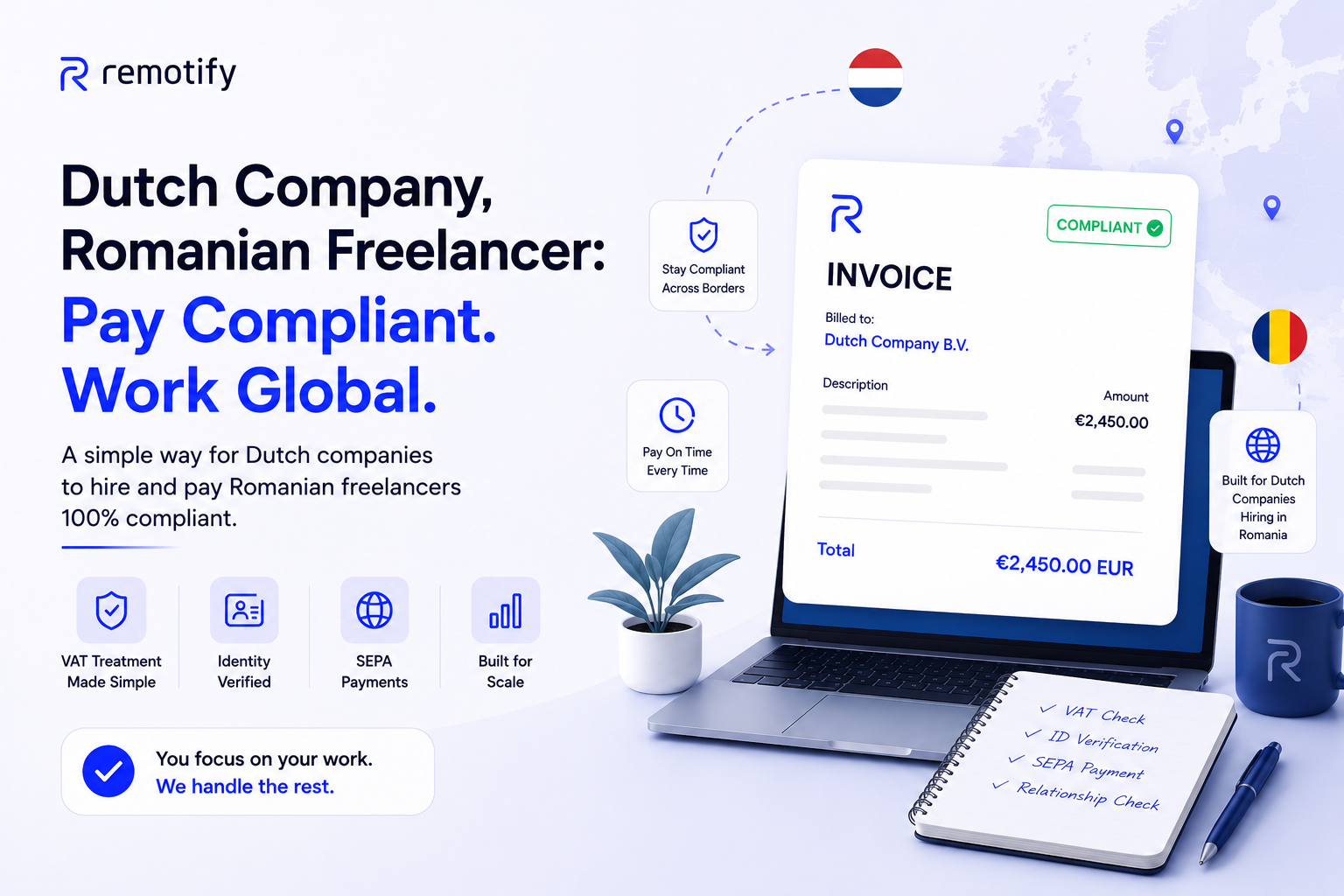
Pay Romanian freelancers compliantly without opening a local entity. Simplify VAT, verify identities, and make secure cross-border payments with confidence.

Why Romania Comes Up So Often for Dutch Tech Teams

Romania has one of the largest freelance and contract developer workforces in the EU, concentrated in cities like Cluj-Napoca, Bucharest, and Iasi, with strong representation in backend engineering, DevOps, and data roles. For Dutch tech companies scaling engineering capacity without opening a second office, Romania is a natural sourcing market: strong technical education, EU membership, and rates that are competitive relative to Western Europe.

The catch is that “hiring one Romanian freelancer” and “hiring ten Romanian freelancers across three product teams” are very different operational problems. A single freelance invoice is easy to handle manually. A recurring stream of them, each needing correct VAT treatment, verified identity, and a payment structure that will not raise misclassification questions, is where most finance and hiring teams start looking for a repeatable process instead of a one-off workaround. This checklist is built for that second situation.

It is also worth saying upfront what this checklist is not. It is not a way to avoid VAT, avoid tax, or route around Dutch or Romanian labor law. Every item below assumes the underlying engagement is a genuine freelance relationship, with a defined scope, freelancer control over how the work gets done, and none of the exclusivity or day-to-day supervision that would normally define employment. Compliant invoicing does not change the nature of the underlying work, it just makes sure the paperwork around a genuinely independent engagement holds up to scrutiny as the number of freelancers grows.

1. Confirm How VAT Applies to the Invoice

The first thing to check, every time, is how VAT applies to the specific invoice. For cross-border B2B services between VAT-registered businesses in different EU member states, the reverse charge mechanism generally applies. Under reverse charge, the Romanian freelancer’s invoice is issued without VAT added at the line item, and the Dutch company accounts for the VAT itself through its own VAT return rather than paying it upfront.

This sounds straightforward until you are processing invoices from several different freelancers, some of whom may not be VAT registered at all depending on their turnover in Romania, and each formatting their invoice slightly differently. At scale, inconsistent invoice formatting is one of the most common reasons finance teams end up with a backlog of invoices they cannot process cleanly. A Merchant of Record that is itself EU-registered, such as Remotify, which is incorporated in Estonia, issues invoices in a consistent, reverse-charge-compliant format regardless of which freelancer the work is tied to, which removes the formatting variability entirely.

2. Verify the Freelancer's Identity Before the First Payment

Before any payment goes out, the freelancer’s identity should be verified, and this is not just a compliance box to tick. KYC (know your customer) and AML (anti-money laundering) checks confirm that the person being paid is who they say they are and that the payment is not moving through a flagged or high-risk channel. For a Dutch company hiring one freelancer, this might be handled informally. For a company hiring across a dozen Romanian contractors over a year, doing this consistently without a system behind it becomes a real operational gap.

Remotify runs KYC and AML verification on freelancers as part of onboarding, once, before the first invoice, rather than leaving each hiring manager to informally vet freelancers on a case-by-case basis.

3. Make Sure the Payment Rail Is Actually Efficient

Romania is part of the SEPA (Single Euro Payments Area) zone, even though its national currency is the leu rather than the euro. This matters for how payments are structured. A SEPA Credit Transfer in euros between a Dutch company and a Romanian freelancer’s euro-denominated account can settle in around one business day. Routing the same payment through a standard international wire, particularly if it passes through multiple correspondent banks, can take several days and rack up fees at each hop.

For a single freelancer, the difference between a one-day SEPA settlement and a four-day international wire is mildly annoying. For a team paying ten or twenty freelancers monthly, that delay multiplies into a genuine cash-flow and satisfaction problem on the freelancer side, and a reconciliation headache on the finance side. Using SEPA as the default settlement rail, which is how Remotify pays out freelancers once an invoice is confirmed, keeps this predictable regardless of how many freelancers are on the books.

4. Structure the Relationship to Reduce Misclassification Risk

This is the item hiring managers most often underestimate. When a company pays the same freelancer a similar amount every month, for ongoing work, without a clear invoicing structure sitting between the two parties, the relationship can start to resemble employment rather than a genuine B2B engagement. This matters under Dutch rules around false self-employment (schijnzelfstandigheid) and under Romania’s own criteria for distinguishing an independent contractor from a disguised employee.

The risk grows with scale. One long-running freelance relationship might not attract attention. Ten freelancers, each paid monthly, each working full time hours, each without a formal invoicing intermediary, looks a lot more like an unregistered workforce to a tax authority reviewing the pattern. This is exactly the kind of pattern that shows up when a hiring manager treats freelance headcount growth the same way they would treat regular hiring, adding contractors one at a time without ever stepping back to look at how the group as a whole is structured and paid.

Using a Merchant of Record does not eliminate this risk. No invoicing structure can promise that. What it does is reduce the risk meaningfully by keeping every payment routed through a clear invoice-and-settlement chain between three distinct parties, the Dutch company, the platform, and the freelancer, rather than a direct and informal payment pattern that regulators are specifically trained to notice.

Remotify acts as the Merchant of Record in this relationship. It issues the invoice, applies the correct VAT treatment, runs identity verification, and settles the payout by SEPA. Remotify is not an Employer of Record, a payroll provider, or an umbrella company, and it does not take on the freelancer’s income tax obligations. The freelancer remains fully responsible for declaring and filing their own income tax in Romania. What changes is the structure sitting around each payment, which is the part that actually reduces exposure to a misclassification finding.

5. Know Who Handles DAC7 Reporting

DAC7 is an EU rule requiring digital platforms to report certain payment and seller information to tax authorities. If your company is paying freelancers directly, without a platform in the middle, this reporting obligation does not disappear, it simply becomes something your own team has to track and manage. Because Remotify is an EU-registered platform, it handles DAC7 reporting for the transactions it processes, which is one less compliance thread for a hiring manager or finance lead to keep tabs on as the number of freelancers grows.

6. Decide How This Scales Before It Has To

The checklist above works fine for one freelancer handled manually. It becomes a genuine operational risk once a company is managing five, ten, or twenty Romanian freelancers across different teams, each potentially at a different stage of the VAT, identity verification, and payment process. The companies that run into trouble are usually not the ones who never thought about compliance, they are the ones who had a system that worked for one freelancer and never revisited it as headcount grew.

Building this once, through a Merchant of Record that handles invoicing, VAT treatment, KYC and AML, SEPA payouts, and DAC7 reporting consistently across every freelancer, means the process does not need to be rebuilt or re-checked every time a new hiring manager brings on a new contractor.

Getting Started

If your company already works with Romanian freelancers, or is about to start hiring at scale, it is worth reviewing this checklist against your current process before the next invoice goes out. Remotify is built to handle invoicing, VAT compliance, KYC and AML checks, and SEPA payouts for Dutch companies working with Romanian freelance talent, whether that is one developer or a growing team. You can see current plans and details at remotify.co/pricing.

Frequently Asked Questions

Can a Dutch company pay a Romanian freelancer without setting up a business in Romania?

Yes. A Dutch company can pay a Romanian freelancer without registering a local entity by using a Merchant of Record to handle the invoicing and payment. The Dutch company pays one compliant invoice per freelancer, and the platform manages the rest.

How does VAT work when paying a Romanian freelancer from the Netherlands?

Cross-border B2B services between VAT-registered businesses in different EU member states are generally covered under the reverse charge mechanism, meaning VAT is not added at the invoice line item and the buyer accounts for it on their own VAT return. Registration status on both sides affects the exact treatment.

Is Romania part of the SEPA payment zone?

Yes. Romania is part of the SEPA zone for euro-denominated transfers, even though its national currency is the leu. This allows euro payments between a Dutch company and a Romanian freelancer’s euro account to settle through the SEPA Credit Transfer scheme, typically within one business day.

What happens if we’re paying several Romanian freelancers every month?

Paying multiple freelancers on a recurring basis increases the importance of consistent invoicing, identity verification, and payment structure. Without a repeatable process, inconsistent handling across freelancers can create both administrative backlog and misclassification risk as the number of contractors grows.

Does using a Merchant of Record remove misclassification risk entirely?

No. It reduces the risk by keeping each payment routed through a clear invoice-and-settlement structure between three parties instead of a direct, informal arrangement, but no setup can eliminate the risk completely. The underlying nature of the work and the relationship still matters.

Who is responsible for a Romanian freelancer’s income tax?

The freelancer is always responsible for declaring and filing their own income tax in Romania. A Merchant of Record like Remotify handles invoicing, VAT treatment, and payment settlement, but it does not take over personal tax obligations.

Is Remotify a payroll provider or Employer of Record for Romanian freelancers?

No. Remotify is a Merchant of Record. It issues invoices, applies VAT treatment, runs KYC and AML checks, and settles payments via SEPA. It does not employ freelancers, run payroll, or manage income tax filings on their behalf.

Romania has one of the largest freelance and contract developer workforces in the EU, concentrated in cities like Cluj-Napoca, Bucharest, and Iasi, with strong representation in backend engineering, DevOps, and data roles. For Dutch tech companies scaling engineering capacity without opening a second office, Romania is a natural sourcing market: strong technical education, EU membership, and rates that are competitive relative to Western Europe.

The catch is that “hiring one Romanian freelancer” and “hiring ten Romanian freelancers across three product teams” are very different operational problems. A single freelance invoice is easy to handle manually. A recurring stream of them, each needing correct VAT treatment, verified identity, and a payment structure that will not raise misclassification questions, is where most finance and hiring teams start looking for a repeatable process instead of a one-off workaround. This checklist is built for that second situation.

It is also worth saying upfront what this checklist is not. It is not a way to avoid VAT, avoid tax, or route around Dutch or Romanian labor law. Every item below assumes the underlying engagement is a genuine freelance relationship, with a defined scope, freelancer control over how the work gets done, and none of the exclusivity or day-to-day supervision that would normally define employment. Compliant invoicing does not change the nature of the underlying work, it just makes sure the paperwork around a genuinely independent engagement holds up to scrutiny as the number of freelancers grows.

The first thing to check, every time, is how VAT applies to the specific invoice. For cross-border B2B services between VAT-registered businesses in different EU member states, the reverse charge mechanism generally applies. Under reverse charge, the Romanian freelancer’s invoice is issued without VAT added at the line item, and the Dutch company accounts for the VAT itself through its own VAT return rather than paying it upfront.

This sounds straightforward until you are processing invoices from several different freelancers, some of whom may not be VAT registered at all depending on their turnover in Romania, and each formatting their invoice slightly differently. At scale, inconsistent invoice formatting is one of the most common reasons finance teams end up with a backlog of invoices they cannot process cleanly. A Merchant of Record that is itself EU-registered, such as Remotify, which is incorporated in Estonia, issues invoices in a consistent, reverse-charge-compliant format regardless of which freelancer the work is tied to, which removes the formatting variability entirely.

Before any payment goes out, the freelancer’s identity should be verified, and this is not just a compliance box to tick. KYC (know your customer) and AML (anti-money laundering) checks confirm that the person being paid is who they say they are and that the payment is not moving through a flagged or high-risk channel. For a Dutch company hiring one freelancer, this might be handled informally. For a company hiring across a dozen Romanian contractors over a year, doing this consistently without a system behind it becomes a real operational gap.

Remotify runs KYC and AML verification on freelancers as part of onboarding, once, before the first invoice, rather than leaving each hiring manager to informally vet freelancers on a case-by-case basis.

Romania is part of the SEPA (Single Euro Payments Area) zone, even though its national currency is the leu rather than the euro. This matters for how payments are structured. A SEPA Credit Transfer in euros between a Dutch company and a Romanian freelancer’s euro-denominated account can settle in around one business day. Routing the same payment through a standard international wire, particularly if it passes through multiple correspondent banks, can take several days and rack up fees at each hop.

For a single freelancer, the difference between a one-day SEPA settlement and a four-day international wire is mildly annoying. For a team paying ten or twenty freelancers monthly, that delay multiplies into a genuine cash-flow and satisfaction problem on the freelancer side, and a reconciliation headache on the finance side. Using SEPA as the default settlement rail, which is how Remotify pays out freelancers once an invoice is confirmed, keeps this predictable regardless of how many freelancers are on the books.

This is the item hiring managers most often underestimate. When a company pays the same freelancer a similar amount every month, for ongoing work, without a clear invoicing structure sitting between the two parties, the relationship can start to resemble employment rather than a genuine B2B engagement. This matters under Dutch rules around false self-employment (schijnzelfstandigheid) and under Romania’s own criteria for distinguishing an independent contractor from a disguised employee.

The risk grows with scale. One long-running freelance relationship might not attract attention. Ten freelancers, each paid monthly, each working full time hours, each without a formal invoicing intermediary, looks a lot more like an unregistered workforce to a tax authority reviewing the pattern. This is exactly the kind of pattern that shows up when a hiring manager treats freelance headcount growth the same way they would treat regular hiring, adding contractors one at a time without ever stepping back to look at how the group as a whole is structured and paid.

Using a Merchant of Record does not eliminate this risk. No invoicing structure can promise that. What it does is reduce the risk meaningfully by keeping every payment routed through a clear invoice-and-settlement chain between three distinct parties, the Dutch company, the platform, and the freelancer, rather than a direct and informal payment pattern that regulators are specifically trained to notice.

Remotify acts as the Merchant of Record in this relationship. It issues the invoice, applies the correct VAT treatment, runs identity verification, and settles the payout by SEPA. Remotify is not an Employer of Record, a payroll provider, or an umbrella company, and it does not take on the freelancer’s income tax obligations. The freelancer remains fully responsible for declaring and filing their own income tax in Romania. What changes is the structure sitting around each payment, which is the part that actually reduces exposure to a misclassification finding.

DAC7 is an EU rule requiring digital platforms to report certain payment and seller information to tax authorities. If your company is paying freelancers directly, without a platform in the middle, this reporting obligation does not disappear, it simply becomes something your own team has to track and manage. Because Remotify is an EU-registered platform, it handles DAC7 reporting for the transactions it processes, which is one less compliance thread for a hiring manager or finance lead to keep tabs on as the number of freelancers grows.

The checklist above works fine for one freelancer handled manually. It becomes a genuine operational risk once a company is managing five, ten, or twenty Romanian freelancers across different teams, each potentially at a different stage of the VAT, identity verification, and payment process. The companies that run into trouble are usually not the ones who never thought about compliance, they are the ones who had a system that worked for one freelancer and never revisited it as headcount grew.

Building this once, through a Merchant of Record that handles invoicing, VAT treatment, KYC and AML, SEPA payouts, and DAC7 reporting consistently across every freelancer, means the process does not need to be rebuilt or re-checked every time a new hiring manager brings on a new contractor.

If your company already works with Romanian freelancers, or is about to start hiring at scale, it is worth reviewing this checklist against your current process before the next invoice goes out. Remotify is built to handle invoicing, VAT compliance, KYC and AML checks, and SEPA payouts for Dutch companies working with Romanian freelance talent, whether that is one developer or a growing team. You can see current plans and details at remotify.co/pricing.

Can a Dutch company pay a Romanian freelancer without setting up a business in Romania?

Yes. A Dutch company can pay a Romanian freelancer without registering a local entity by using a Merchant of Record to handle the invoicing and payment. The Dutch company pays one compliant invoice per freelancer, and the platform manages the rest.

How does VAT work when paying a Romanian freelancer from the Netherlands?

Cross-border B2B services between VAT-registered businesses in different EU member states are generally covered under the reverse charge mechanism, meaning VAT is not added at the invoice line item and the buyer accounts for it on their own VAT return. Registration status on both sides affects the exact treatment.

Is Romania part of the SEPA payment zone?

Yes. Romania is part of the SEPA zone for euro-denominated transfers, even though its national currency is the leu. This allows euro payments between a Dutch company and a Romanian freelancer’s euro account to settle through the SEPA Credit Transfer scheme, typically within one business day.

What happens if we’re paying several Romanian freelancers every month?

Paying multiple freelancers on a recurring basis increases the importance of consistent invoicing, identity verification, and payment structure. Without a repeatable process, inconsistent handling across freelancers can create both administrative backlog and misclassification risk as the number of contractors grows.

Does using a Merchant of Record remove misclassification risk entirely?

No. It reduces the risk by keeping each payment routed through a clear invoice-and-settlement structure between three parties instead of a direct, informal arrangement, but no setup can eliminate the risk completely. The underlying nature of the work and the relationship still matters.

Who is responsible for a Romanian freelancer’s income tax?

The freelancer is always responsible for declaring and filing their own income tax in Romania. A Merchant of Record like Remotify handles invoicing, VAT treatment, and payment settlement, but it does not take over personal tax obligations.

Is Remotify a payroll provider or Employer of Record for Romanian freelancers?

No. Remotify is a Merchant of Record. It issues invoices, applies VAT treatment, runs KYC and AML checks, and settles payments via SEPA. It does not employ freelancers, run payroll, or manage income tax filings on their behalf.