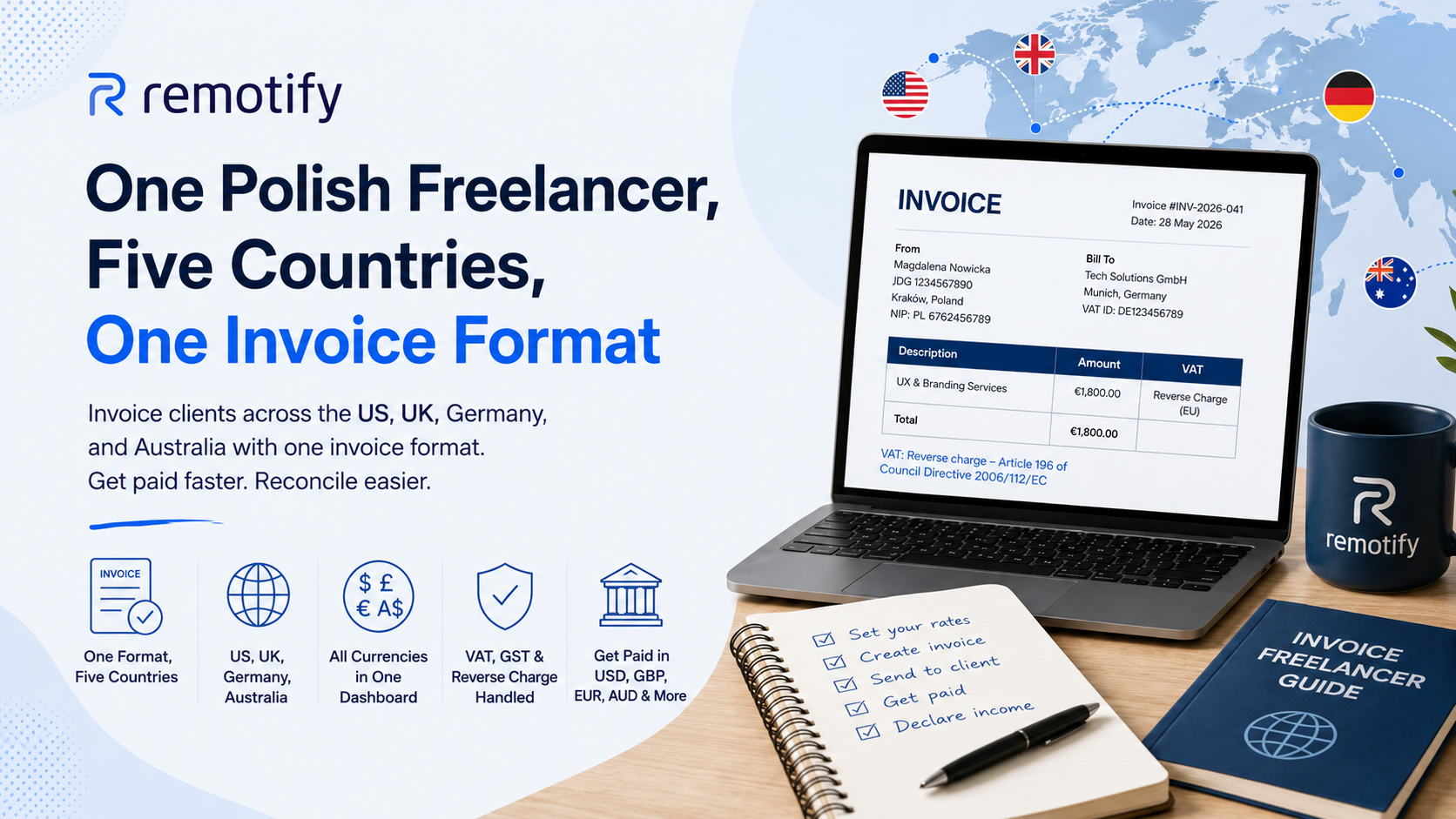
One Polish Freelancer, Five Countries, One Invoice Format

Poland → Multiple Markets

Kraków, Monday morning. Four invoices open in four browser tabs. Four different formats, four different sets of rules, and one freelancer who just wants to get paid.

Magdalena Nowicka runs a one-woman UX and branding studio in Kraków, registered as a JDG (jednoosobowa działalność gospodarcza). Over eighteen months she picked up four steady clients: a SaaS startup in Austin, a fintech in London, a manufacturing firm in Munich, and an e-commerce brand in Melbourne. A great problem to have, until invoicing day comes around.

One Polish Freelancer

Working with clients across five countries shouldn't require five invoice templates. But getting paid often does.

The Problem

  1. Four clients, four invoicing standards. The Austin client’s accounts team doesn’t need VAT language on the invoice at all, just a clean statement of services in USD. The German client expects a specific reverse-charge notation for their Finanzamt. The UK client, post-Brexit, expects the invoice to reflect a supply from outside the UK. The Australian client’s finance team asks about GST treatment on every invoice.
  2. Manual reformatting every month. Magda keeps four separate invoice templates across four different documents, updating each one by hand. One wrong line in the VAT or GST section triggers a round of clarifying emails before payment gets approved.
  3. Currency conversion guesswork. Payments arrive in USD, GBP, EUR, and AUD, on different days, at different rates. Reconciling those against PLN-denominated bookkeeping means recalculating exchange rates by hand for every invoice, every month.
  4. Bookkeeping that never lines up cleanly. Her Polish accountant needs consistent, auditable records to prepare filings with the Urząd Skarbowy and to calculate her ZUS contributions, but four currencies moving through four different rails at four different rates make monthly reconciliation slow and error-prone.
  5. No time left for the actual work. What should be an afternoon of admin a month stretches into days spent chasing invoice corrections, checking bank statements, and updating spreadsheets, time that isn’t going toward client work.

Why Magda Moved to Remotify

Remotify didn’t ask Magda to pick a single corridor. It gave her one invoicing format that adapts to each client’s market context automatically, without asking her to become a cross-border tax expert.

  • One invoice engine, four contexts: each invoice Remotify generates reflects standard conventions for the receiving market, a clean net format for the US client, EU reverse-charge notation for Germany, appropriate post-Brexit framing for the UK, and GST-aware formatting for Australia, all issued from the same Remotify account, in the same layout Magda already knows.
  • One place to see all four currencies: instead of four separate payment trails, Magda sees every incoming payment, USD, GBP, EUR, AUD, in a single dashboard, with the conversion recorded at the time of payment.
  • One monthly export for her accountant: rather than reconciling four currencies by hand, her accountant works from a single, consistent record when preparing her filings.
  • Verified once, paid by anyone: Remotify’s KYC and AML verification happens once, at setup, not separately for every new client relationship.

Remotify handles invoicing and payment formatting; it is not a substitute for Magda’s own tax adviser. The specific VAT, GST, and reverse-charge treatment that applies to her situation is something she confirms with a qualified accountant familiar with Polish and destination-market rules.

How It Works

  • Register once. Magda sets up her JDG on Remotify and completes verification a single time.
  • Add her clients. She sets up her four clients, in the US, UK, Germany, and Australia, inside her Remotify account.
  • Invoices generate automatically. Each client receives an invoice formatted to match their own market’s expectations.
  • Clients pay their usual way. Clients pay via their preferred method, without needing to learn how Polish invoicing works.
  • Records land in one place. Magda gets consolidated payment records in a single dashboard, ready to hand to her accountant.

Who This Is For

→ US clients: clean, VAT-free invoicing in USD

→ UK clients: post-Brexit-appropriate invoice formatting

→ German and other EU clients: reverse-charge EU VAT notation

→ Australian clients: GST-aware invoice formatting

→ Magda: one dashboard, one format to learn, one monthly reconciliation

Frequently Asked Questions

1. Does Remotify determine how VAT or GST applies to each of Magda’s invoices?

Remotify formats invoices to reflect standard conventions for each client’s market, but the final tax treatment for her specific situation is something Magda confirms with her own accountant or tax adviser.

2. Does Magda need a separate registration for each country she invoices?

No. She uses a single Remotify account tied to her JDG, regardless of how many markets her clients are in.

3. What happens if Magda takes on a new client in a market she hasn’t invoiced before?

She adds the new client’s details, and Remotify applies the appropriate invoice formatting for that market going forward.

4. Does Remotify replace the need for a Polish accountant?

No. Remotify handles invoicing and payment consolidation; Magda’s accountant still handles her Polish tax filings and ZUS contributions.

5. What currencies can Magda receive payments in?

She can receive USD, GBP, EUR, AUD, and other supported currencies, with conversion details recorded at the time of payment.

See how one Polish freelancer invoices five countries without reformatting a single line — get started with Remotify.

  1. Four clients, four invoicing standards. The Austin client’s accounts team doesn’t need VAT language on the invoice at all, just a clean statement of services in USD. The German client expects a specific reverse-charge notation for their Finanzamt. The UK client, post-Brexit, expects the invoice to reflect a supply from outside the UK. The Australian client’s finance team asks about GST treatment on every invoice.
  2. Manual reformatting every month. Magda keeps four separate invoice templates across four different documents, updating each one by hand. One wrong line in the VAT or GST section triggers a round of clarifying emails before payment gets approved.
  3. Currency conversion guesswork. Payments arrive in USD, GBP, EUR, and AUD, on different days, at different rates. Reconciling those against PLN-denominated bookkeeping means recalculating exchange rates by hand for every invoice, every month.
  4. Bookkeeping that never lines up cleanly. Her Polish accountant needs consistent, auditable records to prepare filings with the Urząd Skarbowy and to calculate her ZUS contributions, but four currencies moving through four different rails at four different rates make monthly reconciliation slow and error-prone.
  5. No time left for the actual work. What should be an afternoon of admin a month stretches into days spent chasing invoice corrections, checking bank statements, and updating spreadsheets, time that isn’t going toward client work.

Remotify didn’t ask Magda to pick a single corridor. It gave her one invoicing format that adapts to each client’s market context automatically, without asking her to become a cross-border tax expert.

  • One invoice engine, four contexts: each invoice Remotify generates reflects standard conventions for the receiving market, a clean net format for the US client, EU reverse-charge notation for Germany, appropriate post-Brexit framing for the UK, and GST-aware formatting for Australia, all issued from the same Remotify account, in the same layout Magda already knows.
  • One place to see all four currencies: instead of four separate payment trails, Magda sees every incoming payment, USD, GBP, EUR, AUD, in a single dashboard, with the conversion recorded at the time of payment.
  • One monthly export for her accountant: rather than reconciling four currencies by hand, her accountant works from a single, consistent record when preparing her filings.
  • Verified once, paid by anyone: Remotify’s KYC and AML verification happens once, at setup, not separately for every new client relationship.

Remotify handles invoicing and payment formatting; it is not a substitute for Magda’s own tax adviser. The specific VAT, GST, and reverse-charge treatment that applies to her situation is something she confirms with a qualified accountant familiar with Polish and destination-market rules.

  • Register once. Magda sets up her JDG on Remotify and completes verification a single time.
  • Add her clients. She sets up her four clients, in the US, UK, Germany, and Australia, inside her Remotify account.
  • Invoices generate automatically. Each client receives an invoice formatted to match their own market’s expectations.
  • Clients pay their usual way. Clients pay via their preferred method, without needing to learn how Polish invoicing works.
  • Records land in one place. Magda gets consolidated payment records in a single dashboard, ready to hand to her accountant.

→ US clients: clean, VAT-free invoicing in USD

→ UK clients: post-Brexit-appropriate invoice formatting

→ German and other EU clients: reverse-charge EU VAT notation

→ Australian clients: GST-aware invoice formatting

→ Magda: one dashboard, one format to learn, one monthly reconciliation

1. Does Remotify determine how VAT or GST applies to each of Magda’s invoices?

Remotify formats invoices to reflect standard conventions for each client’s market, but the final tax treatment for her specific situation is something Magda confirms with her own accountant or tax adviser.

2. Does Magda need a separate registration for each country she invoices?

No. She uses a single Remotify account tied to her JDG, regardless of how many markets her clients are in.

3. What happens if Magda takes on a new client in a market she hasn’t invoiced before?

She adds the new client’s details, and Remotify applies the appropriate invoice formatting for that market going forward.

4. Does Remotify replace the need for a Polish accountant?

No. Remotify handles invoicing and payment consolidation; Magda’s accountant still handles her Polish tax filings and ZUS contributions.

5. What currencies can Magda receive payments in?

She can receive USD, GBP, EUR, AUD, and other supported currencies, with conversion details recorded at the time of payment.

See how one Polish freelancer invoices five countries without reformatting a single line — get started with Remotify.