...

How a European Agency Pays 20+ Freelancers Worldwide — With One Invoice

An Amsterdam-based digital agency has built its creative operation the modern way: a lean in-house team, and a deep bench of freelancer specialists spread across the world. Copywriters in Ukraine. Developers in Pakistan. Motion designers in Nigeria. A UX consultant in Brazil.

Every month, the work gets done. The clients are happy. And then the invoices arrive.

Twenty-three of them. From twenty-three different people. In twenty-three different formats. Some with VAT numbers, some without. Some in euros, some in dollars. Some from registered sole traders, some from individuals with nothing but a bank account and a PayPal link.

The agency’s finance manager spent the better part of every month chasing, reconciling, and explaining. Explaining to the accountant why certain invoices didn’t have VAT numbers. Explaining to freelancers why their SWIFT payments were delayed or short. Explaining to the CFO why the same process took longer every quarter.

Something had to change.

European Agency

Agencies don't scale freelance payments by processing more invoices. They scale by turning 20+ global freelancer invoices into one compliant monthly invoice.

The Problem With Paying 20+ People Across Four Continents

Managing a global freelance roster isn’t just a payments problem. It’s a compliance problem, an accounting problem, and a time problem, all at once.

  1. No invoice standard, no accounting standard Every freelancer invoiced differently. Some sent PDFs with their personal name and IBAN. Others sent Google Docs. A few sent WhatsApp messages. For a Dutch company required to maintain clean financial records, none of this worked. The accountant needed VAT-compliant EU invoices for every line item. What they got was chaos.
  2. SWIFT transfers to four continents Paying a developer in Lahore, a designer in Lagos, a writer in Kyiv, and a consultant in São Paulo meant four different banking corridors, four different fee structures, and four different arrival timelines. SWIFT transfers could take anywhere from two to seven business days. Intermediary banks took cuts. Freelancers received less than agreed. The disputes and follow-ups cost more time than the transfers themselves.
  1. KYC and AML exposure A European company sending money to individuals in multiple high-scrutiny corridors draws attention from compliance systems. Without verified counterparty documentation, each payment was a potential flag. The agency’s finance team wasn’t equipped to run KYC checks on twenty-three individuals across four continents. But their bank expected it.
  1. Reconciliation took days At month-end, matching twenty-three payments to twenty-three invoices to twenty-three project codes was a manual spreadsheet exercise. One mismatched reference number meant hours of back-and-forth. The finance manager estimated she was spending three full days every month just on freelance payment admin.
  1. The roster kept growing The agency was winning more clients. That meant more freelancers. More invoices. More corridors. More compliance exposure. The problem wasn’t going to solve itself.

Why They Chose Remotify

The agency’s CFO came across Remotify while researching compliant payment infrastructure for cross-border contractors. Within a week, they had onboarded their full freelance roster. The difference was immediate. 

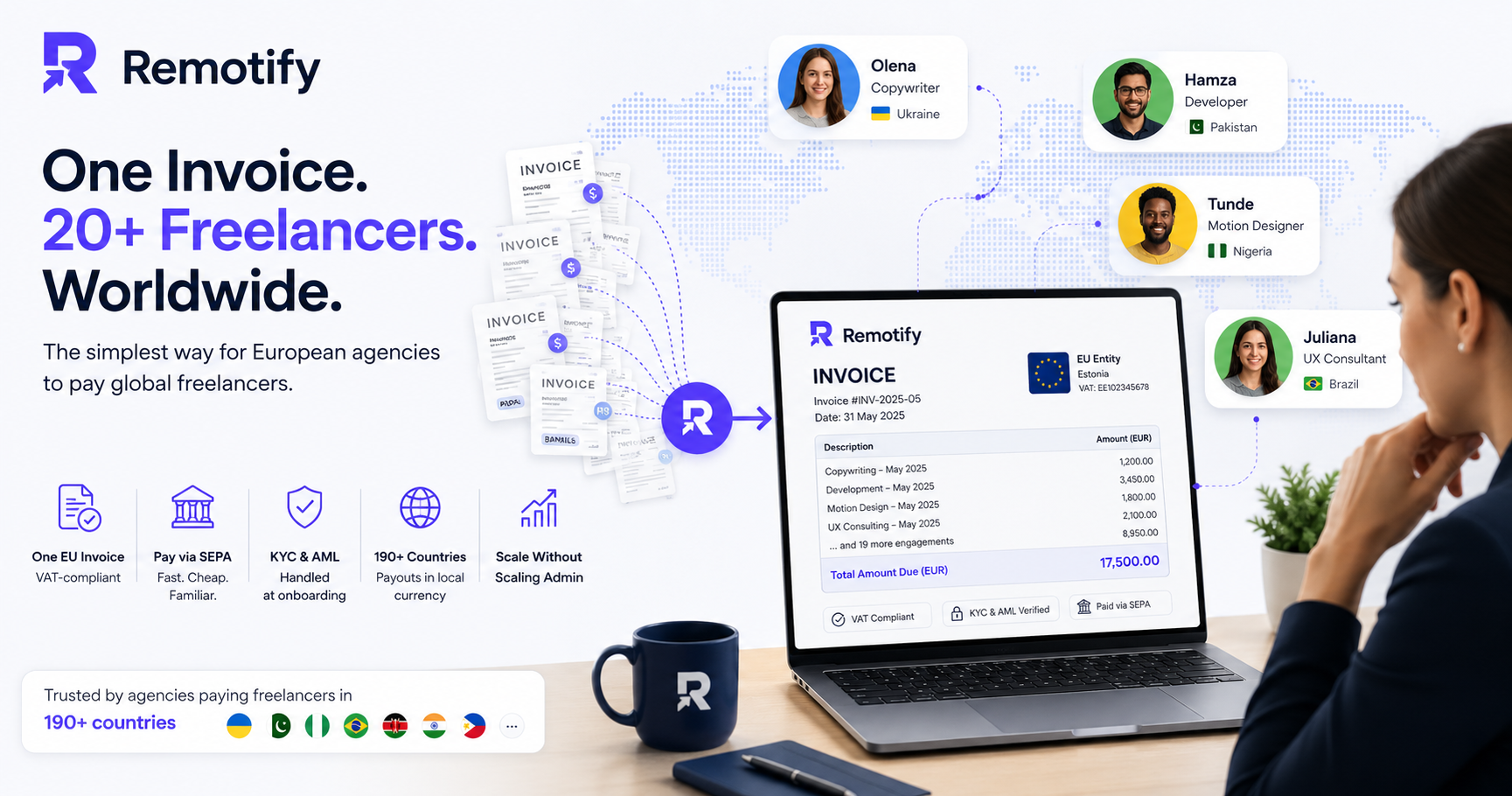
One invoice, not twenty-three. Instead of receiving a different invoice from every freelancer at the end of the month, the agency now receives a single consolidated invoice from Remotify. It is EU-registered, VAT-compliant, and formatted exactly as their accountant needs it. One line item per engagement, all under one document. The finance manager’s three-day reconciliation process became a thirty-minute review.

SEPA for everything. Remotify operates a European bank account. Regardless of where the freelancer is based — Nigeria, Pakistan, Brazil, or Ukraine — the agency pays a single SEPA transfer to Remotify. No SWIFT. No correspondent banks. No multi-day delays. The payment clears the same day. Remotify handles the onward disbursement to each freelancer in their local currency or in EUR, depending on their preference.

KYC and AML handled at onboarding. Every freelancer on the agency’s roster was verified by Remotify before receiving their first payment. Identity checks, AML screening, documentation — all done. The agency’s finance team no longer needed to run compliance on individuals they’d never met in person. Remotify’s verification status became the compliance answer.

Freelancers got paid faster and in full. Because the agency pays SEPA and Remotify handles cross-border disbursement efficiently, freelancers in Lagos and Lahore started receiving their payments within hours, not days. No surprise deductions from intermediary banks. No conversion losses hidden inside the transfer. What was agreed is what arrived.

The roster scaled without the admin scaling with it. When the agency brought on three new freelancers the following quarter, the process was identical to onboarding the original twenty-three. Each new freelancer registered on Remotify, completed verification, and was added to the consolidated invoice cycle. No new banking relationships. No new compliance exposure. No new spreadsheet columns.

What This Means for Your Agency

If you run a team of distributed freelancers and the payment side of that operation feels heavier than it should, you’re not alone.

The talent is global. The compliance requirements are not going away. And the volume of invoices only grows as the business does.

Remotify consolidates all of it:

Your supplier is one EU entity — one invoice, fully VAT-compliant, every month

You pay via SEPA — fast, cheap, and familiar to your bank

KYC and AML are done — your compliance team has nothing left to chase

Every freelancer gets paid in full — in their currency, on time, without chasing

The operation scales — five freelancers or fifty, the process stays the same

Whether your freelancers are in Eastern Europe, South Asia, West Africa, or Latin America, if they work through Remotify, you pay like you’re paying a single European supplier.

Frequently Asked Questions

Do all the freelancers need to be on Remotify for this to work?

Yes — each freelancer registers their own Remotify account and completes verification. Once they’re on the platform, they’re added to your roster and included in your consolidated monthly invoice. The onboarding process takes minutes for each person.


Does the agency receive one invoice even if freelancers are in different countries?

Yes. Regardless of where your freelancers are based, the invoice the agency receives comes from Remotify’s EU-registered entity in Estonia. It is a single, VAT-compliant document covering all engagements for that period. Your accountant deals with one counterparty, not twenty.


How does Remotify handle payments to freelancers in high-scrutiny corridors like Nigeria or Pakistan?

Remotify operates regulated cross-border payment infrastructure and supports payouts to 190+ countries. Each freelancer completes KYC and AML verification before receiving any payment. By the time the agency sends funds, every counterparty is already verified. The compliance work is done by Remotify, not by your finance team.

What happens if the agency needs to add or remove freelancers mid-month?

Adding a freelancer is as simple as having them register on Remotify and join your roster. Removing them is equally straightforward. The consolidated invoice reflects only active engagements for the relevant period. There are no minimum roster requirements and no lock-in.

What does this cost?

Remotify charges a small fee on the net invoice amount. There are no setup fees, no monthly platform charges, and no hidden deductions. Each freelancer sees exactly what they will receive before the invoice is issued. The agency sees exactly what they will pay.

See how agencies consolidate global freelance payments through one EU invoice.

Managing a global freelance roster isn’t just a payments problem. It’s a compliance problem, an accounting problem, and a time problem, all at once.

  1. No invoice standard, no accounting standard Every freelancer invoiced differently. Some sent PDFs with their personal name and IBAN. Others sent Google Docs. A few sent WhatsApp messages. For a Dutch company required to maintain clean financial records, none of this worked. The accountant needed VAT-compliant EU invoices for every line item. What they got was chaos.
  2. SWIFT transfers to four continents Paying a developer in Lahore, a designer in Lagos, a writer in Kyiv, and a consultant in São Paulo meant four different banking corridors, four different fee structures, and four different arrival timelines. SWIFT transfers could take anywhere from two to seven business days. Intermediary banks took cuts. Freelancers received less than agreed. The disputes and follow-ups cost more time than the transfers themselves.
  1. KYC and AML exposure A European company sending money to individuals in multiple high-scrutiny corridors draws attention from compliance systems. Without verified counterparty documentation, each payment was a potential flag. The agency’s finance team wasn’t equipped to run KYC checks on twenty-three individuals across four continents. But their bank expected it.
  1. Reconciliation took days At month-end, matching twenty-three payments to twenty-three invoices to twenty-three project codes was a manual spreadsheet exercise. One mismatched reference number meant hours of back-and-forth. The finance manager estimated she was spending three full days every month just on freelance payment admin.
  1. The roster kept growing The agency was winning more clients. That meant more freelancers. More invoices. More corridors. More compliance exposure. The problem wasn’t going to solve itself.

The agency’s CFO came across Remotify while researching compliant payment infrastructure for cross-border contractors. Within a week, they had onboarded their full freelance roster. The difference was immediate. 

One invoice, not twenty-three. Instead of receiving a different invoice from every freelancer at the end of the month, the agency now receives a single consolidated invoice from Remotify. It is EU-registered, VAT-compliant, and formatted exactly as their accountant needs it. One line item per engagement, all under one document. The finance manager’s three-day reconciliation process became a thirty-minute review.

SEPA for everything. Remotify operates a European bank account. Regardless of where the freelancer is based — Nigeria, Pakistan, Brazil, or Ukraine — the agency pays a single SEPA transfer to Remotify. No SWIFT. No correspondent banks. No multi-day delays. The payment clears the same day. Remotify handles the onward disbursement to each freelancer in their local currency or in EUR, depending on their preference.

KYC and AML handled at onboarding. Every freelancer on the agency’s roster was verified by Remotify before receiving their first payment. Identity checks, AML screening, documentation — all done. The agency’s finance team no longer needed to run compliance on individuals they’d never met in person. Remotify’s verification status became the compliance answer.

Freelancers got paid faster and in full. Because the agency pays SEPA and Remotify handles cross-border disbursement efficiently, freelancers in Lagos and Lahore started receiving their payments within hours, not days. No surprise deductions from intermediary banks. No conversion losses hidden inside the transfer. What was agreed is what arrived.

The roster scaled without the admin scaling with it. When the agency brought on three new freelancers the following quarter, the process was identical to onboarding the original twenty-three. Each new freelancer registered on Remotify, completed verification, and was added to the consolidated invoice cycle. No new banking relationships. No new compliance exposure. No new spreadsheet columns.

If you run a team of distributed freelancers and the payment side of that operation feels heavier than it should, you’re not alone.

The talent is global. The compliance requirements are not going away. And the volume of invoices only grows as the business does.

Remotify consolidates all of it:

Your supplier is one EU entity — one invoice, fully VAT-compliant, every month

You pay via SEPA — fast, cheap, and familiar to your bank

KYC and AML are done — your compliance team has nothing left to chase

Every freelancer gets paid in full — in their currency, on time, without chasing

The operation scales — five freelancers or fifty, the process stays the same

Whether your freelancers are in Eastern Europe, South Asia, West Africa, or Latin America, if they work through Remotify, you pay like you’re paying a single European supplier.

Do all the freelancers need to be on Remotify for this to work?

Yes — each freelancer registers their own Remotify account and completes verification. Once they’re on the platform, they’re added to your roster and included in your consolidated monthly invoice. The onboarding process takes minutes for each person.


Does the agency receive one invoice even if freelancers are in different countries?

Yes. Regardless of where your freelancers are based, the invoice the agency receives comes from Remotify’s EU-registered entity in Estonia. It is a single, VAT-compliant document covering all engagements for that period. Your accountant deals with one counterparty, not twenty.


How does Remotify handle payments to freelancers in high-scrutiny corridors like Nigeria or Pakistan?

Remotify operates regulated cross-border payment infrastructure and supports payouts to 190+ countries. Each freelancer completes KYC and AML verification before receiving any payment. By the time the agency sends funds, every counterparty is already verified. The compliance work is done by Remotify, not by your finance team.

What happens if the agency needs to add or remove freelancers mid-month?

Adding a freelancer is as simple as having them register on Remotify and join your roster. Removing them is equally straightforward. The consolidated invoice reflects only active engagements for the relevant period. There are no minimum roster requirements and no lock-in.

What does this cost?

Remotify charges a small fee on the net invoice amount. There are no setup fees, no monthly platform charges, and no hidden deductions. Each freelancer sees exactly what they will receive before the invoice is issued. The agency sees exactly what they will pay.

See how agencies consolidate global freelance payments through one EU invoice.

Seraphinite AcceleratorOptimized by Seraphinite Accelerator
Turns on site high speed to be attractive for people and search engines.