Ahmed Needed a VAT-Compliant Invoice. He Had One in 10 Minutes.

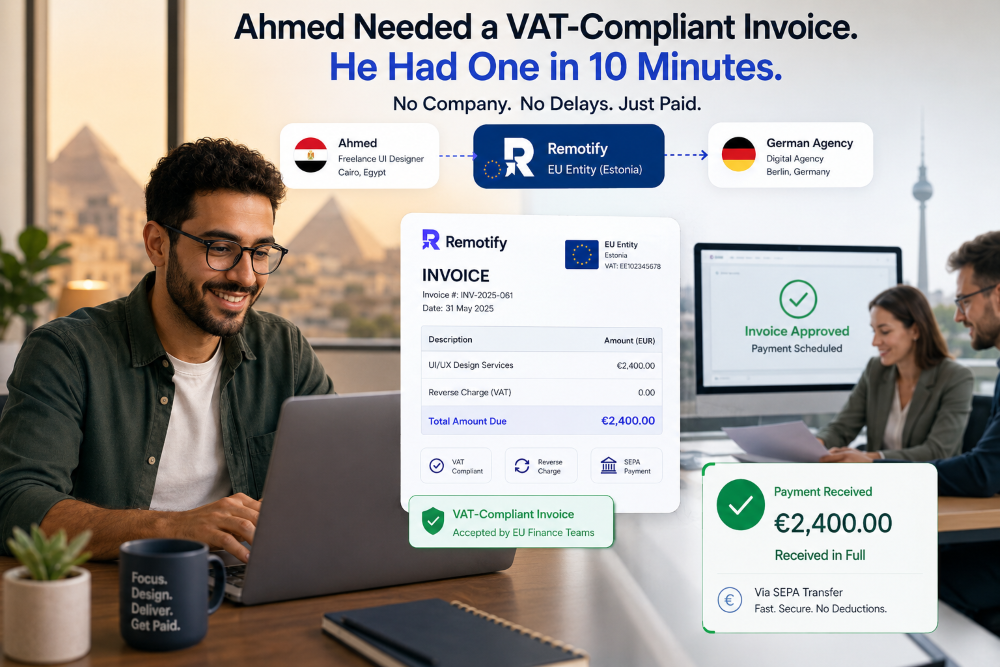
Ahmed is a freelance UI designer based in Cairo. He does good work, charges fair rates, and has clients across Europe. His latest project: a German digital agency, three weeks of work, €2,400 on completion.

The brief was clear. The deliverables were agreed. The timeline was met.

Then came the invoice.

The agency’s finance team came back within hours: they needed a VAT-compliant invoice from a registered EU entity. A personal invoice from Egypt wouldn’t clear their accounting system.

Ahmed didn’t have a registered company. He wasn’t planning to set one up for a single project. And he needed to get paid.

Ahmed needed a VAT-

Working with European clients shouldn't require a registered company. But getting paid often requires a VAT-compliant invoice.

The Problem With Getting Paid From Europe Without a Company

For freelancers in Egypt — and across the Arabic-speaking world — working with European clients is common. Getting paid by them cleanly is not.

  1.   European companies need real invoices. When a German, Dutch, or French company pays a supplier, they need documentation that holds up in their accounting system. A personal invoice from a non-EU freelancer typically doesn’t. It has no VAT number, no registered entity, and no clear tax treatment. The finance team flags it, and the payment stalls.
  2.   Personal invoices from Egypt don’t include a VAT number. European clients operating under reverse-charge VAT rules need a valid EU VAT number on the invoice to process the payment correctly. Without it, the transaction becomes a compliance problem for their Finanzamt or equivalent tax authority.
  3.   Setting up a company is disproportionate. Incorporating in Egypt or elsewhere purely to invoice one European client costs time, money, and ongoing administration. For a project worth a few thousand euros, it makes no sense.
  4.   SWIFT transfers to Egypt are slow and expensive. Even when a payment does go through, international wire transfers carry fees on both ends. The freelancer often receives meaningfully less than the agreed amount, with no visibility into when or how much.
  5.   KYC and verification delays hold everything up. European companies increasingly require some form of identity or compliance verification before paying an individual abroad. Without a platform to handle this, it falls on the freelancer to provide documentation ad hoc — and on the client to assess it.

Why Ahmed Used Remotify

Ahmed registered on Remotify, completed identity verification, and raised his invoice. The whole process took under 10 minutes.

His German client received an invoice from Remotify’s Estonian-registered EU entity, fully VAT-compliant, with reverse charge applied. Their finance team processed it without a single follow-up question.

A proper EU invoice, issued immediately. Remotify is registered in Estonia, inside the European Union. When Ahmed invoiced through Remotify, the German agency received a document that met every requirement their accountant had. VAT number, EU entity, reverse charge — all present, all correct.

No company required on either side. Ahmed didn’t need to set up an Egyptian company or obtain a foreign registration. Remotify acts as the legal intermediary. The client pays an EU entity; the freelancer receives the funds on the other side.

SEPA instead of SWIFT. Because Remotify holds a European bank account, the German agency paid via SEPA transfer. Fast, cheap, and familiar. No correspondent bank fees, no multi-day delays, no mystery deductions.

KYC and AML are already handled. Remotify verifies every freelancer before they can receive a payment. Ahmed’s identity was confirmed during registration. By the time the invoice was sent, the compliance check was already done — not by the German agency’s legal team, but by Remotify.

Ahmed received the full amount. The €2,400 landed in full. He could receive it in EUR or convert to Egyptian Pounds. No surprises, no deductions beyond Remotify’s transparent fee.

What This Means for Arabic-Speaking Freelancers

If you’re a freelancer in Egypt, Jordan, Morocco, Lebanon, or anywhere across the region — and you work with clients in Germany, the Netherlands, France, or anywhere in the EU — you’ve probably run into this wall.

The client likes your work. The project is agreed. But the payment gets stuck because your invoice doesn’t fit their system.

Remotify fixes that, without asking you to become an accountant or set up a company.

Your invoice is EU-compliant, the moment you raise it through Remotify

Your client pays via SEPA, fast, cheap, and familiar to their finance team

KYC is done during onboarding, no additional documentation required per project

You receive your payment in full, to 190+ countries, in your preferred currency

One project, one registration, then use it again for every European client that follows

Frequently Asked Questions

Do I need a registered company to use Remotify?

No. That’s the point. Remotify provides the EU legal entity. You invoice through it, your client pays it, and you receive the funds. No company setup required on your end.

How does the invoice satisfy my client’s VAT requirements?

Remotify is registered in Estonia, an EU member state. Invoices issued through Remotify include a valid EU VAT number and apply reverse charge where applicable. This meets the standard requirements for B2B payments across the EU.

How long does it take to get set up and send a first invoice?

Registration and KYC verification typically take under 10 minutes. Once verified, you can raise and send an invoice immediately.

How do I receive the payment?

Remotify supports payouts to 190+ countries. You can receive funds in EUR or convert to your local currency. Payment arrives after your client settles the invoice.

Am I responsible for taxes on the income?

Yes. Remotify handles invoicing and payment facilitation — not personal tax reporting. You remain responsible for declaring and paying any applicable taxes in your country of residence.

For freelancers in Egypt — and across the Arabic-speaking world — working with European clients is common. Getting paid by them cleanly is not.

  1.   European companies need real invoices. When a German, Dutch, or French company pays a supplier, they need documentation that holds up in their accounting system. A personal invoice from a non-EU freelancer typically doesn’t. It has no VAT number, no registered entity, and no clear tax treatment. The finance team flags it, and the payment stalls.
  2.   Personal invoices from Egypt don’t include a VAT number. European clients operating under reverse-charge VAT rules need a valid EU VAT number on the invoice to process the payment correctly. Without it, the transaction becomes a compliance problem for their Finanzamt or equivalent tax authority.
  3.   Setting up a company is disproportionate. Incorporating in Egypt or elsewhere purely to invoice one European client costs time, money, and ongoing administration. For a project worth a few thousand euros, it makes no sense.
  4.   SWIFT transfers to Egypt are slow and expensive. Even when a payment does go through, international wire transfers carry fees on both ends. The freelancer often receives meaningfully less than the agreed amount, with no visibility into when or how much.
  5.   KYC and verification delays hold everything up. European companies increasingly require some form of identity or compliance verification before paying an individual abroad. Without a platform to handle this, it falls on the freelancer to provide documentation ad hoc — and on the client to assess it.

Ahmed registered on Remotify, completed identity verification, and raised his invoice. The whole process took under 10 minutes.

His German client received an invoice from Remotify’s Estonian-registered EU entity, fully VAT-compliant, with reverse charge applied. Their finance team processed it without a single follow-up question.

A proper EU invoice, issued immediately. Remotify is registered in Estonia, inside the European Union. When Ahmed invoiced through Remotify, the German agency received a document that met every requirement their accountant had. VAT number, EU entity, reverse charge — all present, all correct.

No company required on either side. Ahmed didn’t need to set up an Egyptian company or obtain a foreign registration. Remotify acts as the legal intermediary. The client pays an EU entity; the freelancer receives the funds on the other side.

SEPA instead of SWIFT. Because Remotify holds a European bank account, the German agency paid via SEPA transfer. Fast, cheap, and familiar. No correspondent bank fees, no multi-day delays, no mystery deductions.

KYC and AML are already handled. Remotify verifies every freelancer before they can receive a payment. Ahmed’s identity was confirmed during registration. By the time the invoice was sent, the compliance check was already done — not by the German agency’s legal team, but by Remotify.

Ahmed received the full amount. The €2,400 landed in full. He could receive it in EUR or convert to Egyptian Pounds. No surprises, no deductions beyond Remotify’s transparent fee.

If you’re a freelancer in Egypt, Jordan, Morocco, Lebanon, or anywhere across the region — and you work with clients in Germany, the Netherlands, France, or anywhere in the EU — you’ve probably run into this wall.

The client likes your work. The project is agreed. But the payment gets stuck because your invoice doesn’t fit their system.

Remotify fixes that, without asking you to become an accountant or set up a company.

Your invoice is EU-compliant, the moment you raise it through Remotify

Your client pays via SEPA, fast, cheap, and familiar to their finance team

KYC is done during onboarding, no additional documentation required per project

You receive your payment in full, to 190+ countries, in your preferred currency

One project, one registration, then use it again for every European client that follows

Do I need a registered company to use Remotify?

No. That’s the point. Remotify provides the EU legal entity. You invoice through it, your client pays it, and you receive the funds. No company setup required on your end.

How does the invoice satisfy my client’s VAT requirements?

Remotify is registered in Estonia, an EU member state. Invoices issued through Remotify include a valid EU VAT number and apply reverse charge where applicable. This meets the standard requirements for B2B payments across the EU.

How long does it take to get set up and send a first invoice?

Registration and KYC verification typically take under 10 minutes. Once verified, you can raise and send an invoice immediately.

How do I receive the payment?

Remotify supports payouts to 190+ countries. You can receive funds in EUR or convert to your local currency. Payment arrives after your client settles the invoice.

Am I responsible for taxes on the income?

Yes. Remotify handles invoicing and payment facilitation — not personal tax reporting. You remain responsible for declaring and paying any applicable taxes in your country of residence.