...

Contractor Misclassification: What It Is and Who Carries the Risk

Misclassification is when someone is called a contractor on paper, but the work runs like employment. Authorities look at how the relationship actually works, not what the contract calls it — so writing “independent contractor” at the top of an agreement protects nobody. And when it goes wrong, the bill lands on the company, not the freelancer.

The specifics differ by country, and reclassification cases turn on the facts of the individual relationship. If you are weighing a particular arrangement, it is worth going through it with an employment lawyer or accountant where the work is performed.

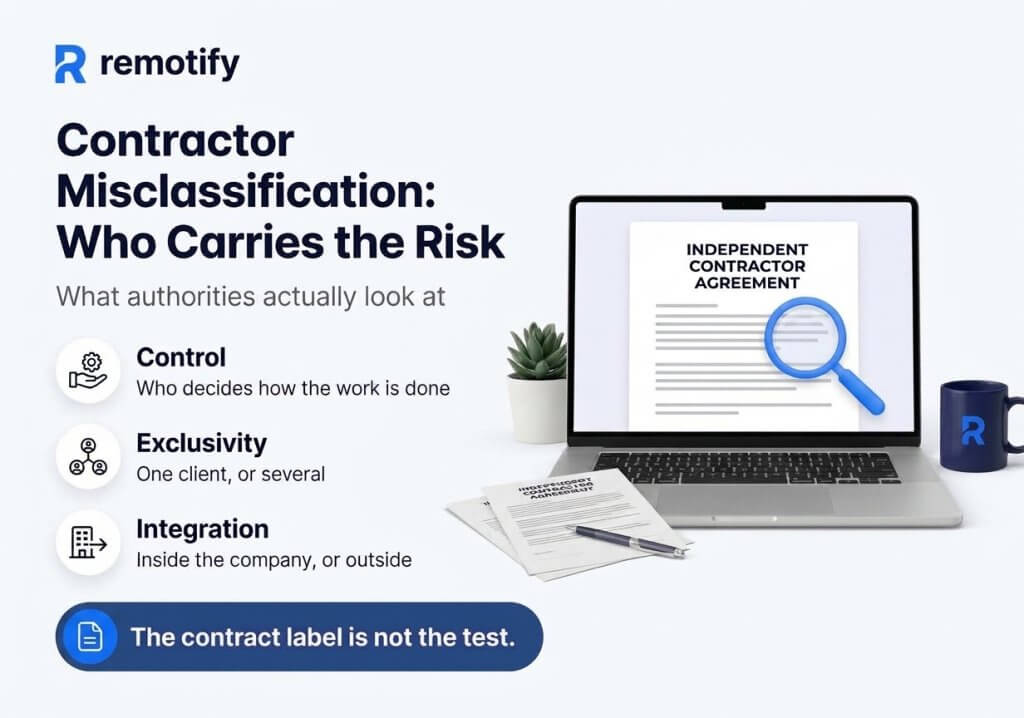
Independent contractor agreement under a magnifying glass, with the three factors behind contractor misclassification risk: control, exclusivity and integration

Table of Contents

The contract is not the test

Every country words this differently, but the underlying approach is the same almost everywhere: substance over form.

An inspector or a court looks at the day-to-day reality of the working relationship. If that reality looks like employment, the label on the contract does not save it. This is deliberate. If contracts decided the question, every employer would simply write “contractor” and the rules would mean nothing.

What actually gets looked at

The specifics vary by country, but the questions are strikingly consistent:

Control: Does the company direct how the work is done, or only what the outcome should be? This is usually the central question.

Time and place: Are the hours and location set by the company, or by the person doing the work?

Exclusivity: Does the person work only for this company, or do they have other clients and the freedom to take them?

Payment: Is it tied to deliverables and invoiced, or is it a fixed regular amount that behaves like a salary?

Duration and continuity: How long has the relationship run, and how continuous is it?

Tools and method: Does the person use their own equipment and their own way of working, or the company’s?

Integration: Is the person embedded in the organisation — internal systems, regular team meetings, reporting to a manager?

None of these is a single pass-or-fail box. The whole picture is what counts. One or two indicators pointing the wrong way is normal. Most of them pointing the wrong way is a problem.

Fixed-term project work is not the problem

A common worry: we have a project that will run six months or a year, so we sign a contractor for that period instead of hiring. Is that risky?

On its own, no. That is the most legitimate use of contractors there is — a defined piece of work with a defined end.

The risk comes from how those months are run, not from their number. Two companies can sign the identical twelve-month agreement and end up in completely different positions.

The clean version: The project and its deliverables are defined. The contractor works their own hours, their own way, with their own equipment. Payment follows milestones or invoiced work. They have other clients. They sit outside the company’s management chain.

The risky version: Same duration, but the person works nine to six, attends the team’s daily meetings, reports to a manager, uses a company laptop and internal systems, invoices the same amount every month, and has no other clients. Here the word “contractor” in the contract carries no weight, because the picture describes an employee.

Duration matters in two indirect ways. First, the longer a relationship runs, the more the other indicators tend to accumulate — being embedded in a team is hard to avoid over three years and easy to avoid over three months. Second, if a fixed-term contract is renewed again and again, the “defined project” framing stops being credible. A six-month agreement extended five times is an open-ended relationship in practice.

One thing worth separating out: some countries cap the duration of fixed-term employment contracts, after which they convert to permanent. That is a different rule and it does not apply to contractors. The two get confused often.


Who carries the contractor misclassification risk

Mostly the company.

If a relationship is reclassified, the client typically faces unpaid social security contributions and taxes going back over the relationship, interest, administrative fines, and back payment of the entitlements the person never received — things like severance, paid leave and overtime. In some countries this is calculated across the entire duration of the engagement.

The freelancer’s exposure is smaller but not zero. Their tax position can change retroactively. And in practice, the relationship often ends abruptly, because once a company spots the risk it tends to reach for the fastest fix.

What contractors can do

Work with more than one client. Set your own hours. Do the work your own way, with your own equipment. Contract and invoice per project rather than as a standing monthly amount. Stay out of the client’s internal reporting lines.

This is not about paperwork tricks. It is about actually being independent, and being able to show it if anyone asks.

Where Remotify fits, and where it does not

Remotify does not change how a working relationship is classified, and you should be sceptical of any service that suggests otherwise. Classification depends on how the work runs. The source of the invoice has nothing to do with it — if a company directs someone’s daily work, an invoice from an EU entity does not alter that.

What Remotify solves is a different problem that often sits next to this one. A freelancer without a registered company cannot issue an invoice their client’s accounting can accept. Remotify is an Estonia-registered EU entity that issues tax-compliant invoices on their behalf, so the client gets a proper EU invoice. That is an invoicing problem, not a classification one, and it is worth keeping the two apart.

FAQ

What is contractor misclassification?

Treating someone as an independent contractor when the working relationship functions as employment. It is assessed on how the work actually runs, not on what the contract says.

Can I hire a contractor for a six-month or one-year project?

Yes, and it is one of the clearest legitimate uses of contracting. What matters is whether the person works independently during that time, and whether the contract keeps getting renewed indefinitely.

Who gets penalised for misclassification?

Usually the company. Back contributions, back taxes, interest, fines and unpaid entitlements are typically the client’s liability.

Does a signed contract saying "independent contractor" protect us?

No. Authorities look past the label to the substance of the relationship.

Does using an invoicing service remove misclassification risk?

No. Nothing about where the invoice comes from changes how the work is organised. Any service claiming otherwise is overselling.

How long can a contractor work for the same client?

There is generally no fixed maximum for contractors. Long engagements attract more scrutiny because the other indicators tend to build up, but duration alone is not the test. Fixed-term employment contracts are a separate matter and are capped in some countries.

Need to pay a freelancer who has no company?

Remotify issues the invoice as an EU-registered entity, so your accounting gets a document it can record.

See how it works
Seraphinite AcceleratorOptimized by Seraphinite Accelerator
Turns on site high speed to be attractive for people and search engines.