Getting a payment declined or an invoice sent back is one of the more frustrating experiences in freelance work. You have delivered the project. The client is happy with the output. And then their finance team comes back with a query, or a flat rejection, over something that feels administrative.
The frustration is understandable, but the rejections are usually not arbitrary. Business clients, particularly larger companies and EU-incorporated businesses, have accounting and compliance obligations that require invoices to meet specific standards. An invoice that does not meet those standards creates a problem on their side, and their finance team sends it back rather than processing it and dealing with the fallout later.
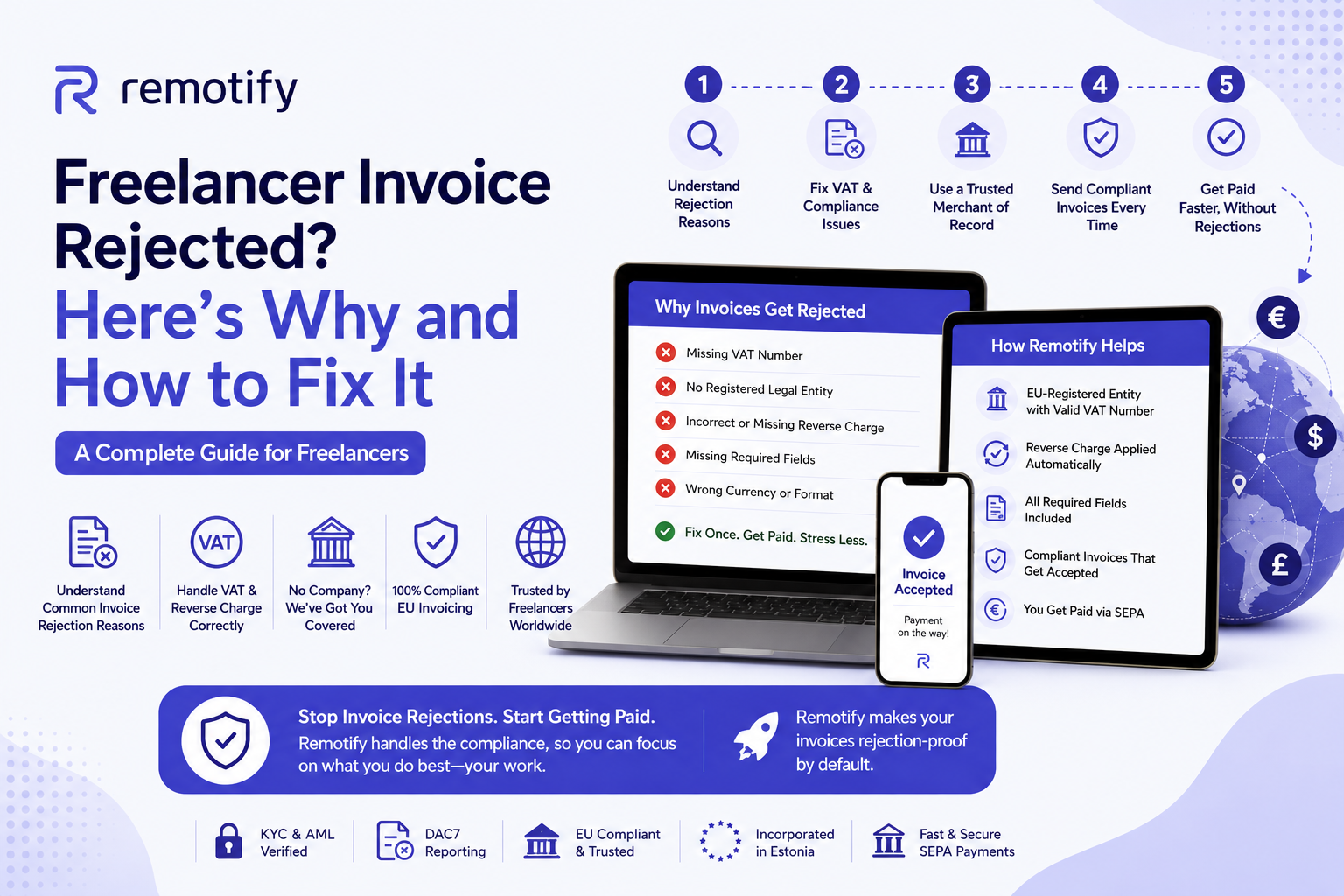
Understanding exactly what triggers a rejection means you can fix it once and stop repeating the same problem. Here are the most common reasons freelancer invoices get rejected, and what to do about each one.
This is probably the single most common rejection reason when billing EU-based business clients. If you are sending an invoice to a company in Germany, France, the Netherlands, or anywhere else in the EU, their accounts payable team needs to process the VAT correctly. To do that, they need a VAT number on your invoice.
If you do not have a VAT number because you are not registered in your country, or because your turnover falls below the local threshold, the invoice creates an immediate documentation problem for them. Even if you genuinely have no VAT obligation, the absence of a VAT number on a cross-border B2B invoice raises a flag in most accounting systems.
The fix depends on your situation. If you are approaching or above your country’s VAT registration threshold, registering and getting a VAT number resolves this permanently. If you are well below the threshold and registration is not practical, the more reliable solution is to route your invoice through a platform that already has a VAT number.
When you invoice through Remotify, the invoice sent to your client comes from Remotify’s EU-registered entity with a valid VAT number. Your client’s finance team has what they need, and the VAT question does not arise.
Many freelancers operate as individuals rather than registered companies, which is common and in many countries completely legitimate. But some business clients, particularly those in regulated sectors or with strict procurement policies, require invoices to come from a registered legal entity rather than a private individual.
This is not a comment on your professionalism or the quality of your work. It is a procurement and accounting requirement. An invoice from an unregistered individual can be difficult to process cleanly through an accounts payable system, and in some cases creates ambiguity about whether the transaction is subject to withholding tax or other obligations.
Registering a company is one way to solve this, but it comes with its own overhead: incorporation costs, annual filing obligations, accounting complexity, and in some jurisdictions a minimum capital requirement. For many freelancers, particularly those early in their career or working across multiple countries, it is not the right move yet.
A Merchant of Record platform solves this differently. Rather than you registering an entity, Remotify acts as the EU legal entity for invoicing purposes. Your client receives an invoice from an incorporated, VAT-registered business. You receive payment after the transaction clears. The entity problem is handled without you needing to set one up.
Reverse charge is one of the more confusing areas of VAT for freelancers billing across EU borders, and getting it wrong is a reliable way to get your invoice sent back.
Here is the basic rule: when a VAT-registered business in one EU country purchases a service from a supplier in a different EU country, VAT is typically not charged on the invoice. Instead, the buyer accounts for the VAT themselves under the reverse charge mechanism. The invoice should explicitly reference reverse charge and show a zero VAT amount with the applicable reason stated.
Freelancers run into problems in two directions here. The first is charging VAT when reverse charge should apply, which creates a double-counting problem for the client’s VAT return. The second is omitting the reverse charge reference entirely, which leaves the client’s finance team without the documentation they need to account for the transaction correctly.
The complication is that the rules vary depending on the supplier’s registration status, the buyer’s location, and the nature of the service. Applying reverse charge correctly as an unregistered individual is genuinely difficult.
When invoices go through Remotify, reverse charge is applied automatically on eligible cross-border B2B transactions. The determination is made correctly based on the transaction details, and the invoice reflects it without the freelancer needing to understand the underlying rules.
Beyond VAT, there are several fields that a compliant business invoice needs to include. Missing any of them can trigger a rejection from a thorough accounts payable team, even if everything else looks fine. The required fields vary slightly by jurisdiction, but a solid baseline for cross-border invoices includes:
Some clients also require a purchase order number on the invoice before they can process payment. If you are working with a larger company, it is worth confirming early in the engagement whether they have a PO requirement, because an invoice without a valid PO reference will sit in their system until it is resolved.
Running through this checklist before you send any invoice removes most of the avoidable rejections. The ones that remain are usually VAT-related, which brings us back to the entity question.
Some rejections are not about compliance at all. They are about format. A client paying in EUR might reject an invoice denominated in USD. A client using a specific accounting system might require invoices in a particular format or with particular reference codes. And some clients have internal policies that require invoices to be submitted through a vendor portal rather than by email.
These are worth confirming at the start of an engagement rather than after you have sent the first invoice. A quick question to the client’s accounts payable contact covering currency, preferred format, and submission method takes two minutes and can save a week of back and forth.
Currency flexibility is also worth noting as a practical consideration. Remotify can receive and pay in EUR, USD, or local currency depending on the arrangement, which removes the friction of currency mismatch between what you invoice and what lands in your account.
Most invoice rejection reasons trace back to the same root cause: the invoice comes from an individual without the VAT registration, legal entity, or compliance infrastructure that business clients require. Fixing this one invoice at a time, or chasing clients to explain why your invoice is still valid despite being from an unregistered individual, is a slow and frustrating process.
Remotify acts as a Merchant of Record, meaning it issues the invoice to your client on your behalf as an EU-registered entity incorporated in Estonia. Your client receives a VAT-compliant invoice from a registered business with a valid EU VAT number. Reverse charge is applied correctly on eligible cross-border B2B transactions. Every required field is present. And once the client pays Remotify, Remotify pays you via SEPA.
You do not need to register a company. You do not need to understand EU VAT rules. And you do not need to go back and forth with a client’s finance team about why your invoice does not have a VAT number. The compliance layer is built into the platform, and the invoice your client receives will clear their accounts payable process the first time.
Using a Merchant of Record platform handles the invoicing and payment side of things, but it does not touch your income tax obligations. Your income tax declaration in your country of residence remains your own responsibility. Remotify does not deduct income tax from your payment, does not file returns on your behalf, and has no relationship with your local tax authority.
If you are unsure how freelance income from international clients should be reported in your country, a local tax advisor is the right resource. This is particularly relevant if you are operating across multiple countries or if your freelance income is your primary source of earnings.
If you are a freelancer dealing with invoice rejections, or you want to make sure you never have to deal with them, Remotify is built for exactly this situation. See how the platform works and review current pricing at remotify.co/pricing.
The most common reasons are a missing VAT number, no registered legal entity behind the invoice, incorrect or absent reverse charge handling on cross-border EU transactions, or missing required fields like invoice number, payment terms, or a clear service description. Check each of these before resending, and confirm with the client’s accounts payable team if their rejection note was vague.
It depends on your jurisdiction and the client’s requirements. Many EU business clients expect a VAT number on incoming invoices. If you are not VAT registered, one option is to register voluntarily in your country. Another is to use a platform like Remotify, which issues the invoice from its own EU-registered entity with a valid VAT number, so the question does not arise on your client’s side.
Reverse charge is a VAT mechanism used on cross-border B2B transactions within the EU. When it applies, you do not charge VAT on the invoice, but you must include a reference stating that reverse charge applies and why. If you omit this reference when it is required, your client’s finance team cannot account for the transaction correctly and will likely send the invoice back.
Not necessarily. Some clients require invoices from a registered legal entity, but you can satisfy that requirement without incorporating yourself by using a Merchant of Record platform. Remotify issues the invoice as its own EU-registered entity, so your client receives an invoice from a registered business without you needing to set one up.
At minimum: a unique invoice number, invoice date, payment due date, your full name and address, the client’s full name and address, a description of services, the amount and currency, VAT treatment and number if applicable, and payment details. For EU cross-border invoices, correct VAT treatment including reverse charge where applicable is essential. Missing any of these is a common trigger for rejection.
Remotify issues the invoice to your client on your behalf as an EU-registered entity incorporated in Estonia. The invoice includes a valid VAT number, correct reverse charge handling on eligible cross-border transactions, and all required fields. Your client’s accounts payable team receives a compliant invoice that clears their process without you needing to manage the VAT and legal entity requirements yourself.
No. Remotify handles invoicing, VAT compliance, KYC and AML verification, DAC7 reporting, and SEPA payments. Your income tax obligations in your country of residence remain entirely your own responsibility. Remotify does not deduct income tax, does not file returns on your behalf, and has no contact with your local tax authority..

Getting a payment declined or an invoice sent back is one of the more frustrating experiences in freelance work. You have delivered the project. The client is happy with the output. And then their finance team comes back with a query, or a flat rejection, over something that feels administrative.
The frustration is understandable, but the rejections are usually not arbitrary. Business clients, particularly larger companies and EU-incorporated businesses, have accounting and compliance obligations that require invoices to meet specific standards. An invoice that does not meet those standards creates a problem on their side, and their finance team sends it back rather than processing it and dealing with the fallout later.
Understanding exactly what triggers a rejection means you can fix it once and stop repeating the same problem. Here are the most common reasons freelancer invoices get rejected, and what to do about each one.
This is probably the single most common rejection reason when billing EU-based business clients. If you are sending an invoice to a company in Germany, France, the Netherlands, or anywhere else in the EU, their accounts payable team needs to process the VAT correctly. To do that, they need a VAT number on your invoice.
If you do not have a VAT number because you are not registered in your country, or because your turnover falls below the local threshold, the invoice creates an immediate documentation problem for them. Even if you genuinely have no VAT obligation, the absence of a VAT number on a cross-border B2B invoice raises a flag in most accounting systems.
The fix depends on your situation. If you are approaching or above your country’s VAT registration threshold, registering and getting a VAT number resolves this permanently. If you are well below the threshold and registration is not practical, the more reliable solution is to route your invoice through a platform that already has a VAT number.
When you invoice through Remotify, the invoice sent to your client comes from Remotify’s EU-registered entity with a valid VAT number. Your client’s finance team has what they need, and the VAT question does not arise.
Many freelancers operate as individuals rather than registered companies, which is common and in many countries completely legitimate. But some business clients, particularly those in regulated sectors or with strict procurement policies, require invoices to come from a registered legal entity rather than a private individual.
This is not a comment on your professionalism or the quality of your work. It is a procurement and accounting requirement. An invoice from an unregistered individual can be difficult to process cleanly through an accounts payable system, and in some cases creates ambiguity about whether the transaction is subject to withholding tax or other obligations.
Registering a company is one way to solve this, but it comes with its own overhead: incorporation costs, annual filing obligations, accounting complexity, and in some jurisdictions a minimum capital requirement. For many freelancers, particularly those early in their career or working across multiple countries, it is not the right move yet.
A Merchant of Record platform solves this differently. Rather than you registering an entity, Remotify acts as the EU legal entity for invoicing purposes. Your client receives an invoice from an incorporated, VAT-registered business. You receive payment after the transaction clears. The entity problem is handled without you needing to set one up.
Reverse charge is one of the more confusing areas of VAT for freelancers billing across EU borders, and getting it wrong is a reliable way to get your invoice sent back.
Here is the basic rule: when a VAT-registered business in one EU country purchases a service from a supplier in a different EU country, VAT is typically not charged on the invoice. Instead, the buyer accounts for the VAT themselves under the reverse charge mechanism. The invoice should explicitly reference reverse charge and show a zero VAT amount with the applicable reason stated.
Freelancers run into problems in two directions here. The first is charging VAT when reverse charge should apply, which creates a double-counting problem for the client’s VAT return. The second is omitting the reverse charge reference entirely, which leaves the client’s finance team without the documentation they need to account for the transaction correctly.
The complication is that the rules vary depending on the supplier’s registration status, the buyer’s location, and the nature of the service. Applying reverse charge correctly as an unregistered individual is genuinely difficult.
When invoices go through Remotify, reverse charge is applied automatically on eligible cross-border B2B transactions. The determination is made correctly based on the transaction details, and the invoice reflects it without the freelancer needing to understand the underlying rules.
Beyond VAT, there are several fields that a compliant business invoice needs to include. Missing any of them can trigger a rejection from a thorough accounts payable team, even if everything else looks fine. The required fields vary slightly by jurisdiction, but a solid baseline for cross-border invoices includes:
Some clients also require a purchase order number on the invoice before they can process payment. If you are working with a larger company, it is worth confirming early in the engagement whether they have a PO requirement, because an invoice without a valid PO reference will sit in their system until it is resolved.
Running through this checklist before you send any invoice removes most of the avoidable rejections. The ones that remain are usually VAT-related, which brings us back to the entity question.
Some rejections are not about compliance at all. They are about format. A client paying in EUR might reject an invoice denominated in USD. A client using a specific accounting system might require invoices in a particular format or with particular reference codes. And some clients have internal policies that require invoices to be submitted through a vendor portal rather than by email.
These are worth confirming at the start of an engagement rather than after you have sent the first invoice. A quick question to the client’s accounts payable contact covering currency, preferred format, and submission method takes two minutes and can save a week of back and forth.
Currency flexibility is also worth noting as a practical consideration. Remotify can receive and pay in EUR, USD, or local currency depending on the arrangement, which removes the friction of currency mismatch between what you invoice and what lands in your account.
Most invoice rejection reasons trace back to the same root cause: the invoice comes from an individual without the VAT registration, legal entity, or compliance infrastructure that business clients require. Fixing this one invoice at a time, or chasing clients to explain why your invoice is still valid despite being from an unregistered individual, is a slow and frustrating process.
Remotify acts as a Merchant of Record, meaning it issues the invoice to your client on your behalf as an EU-registered entity incorporated in Estonia. Your client receives a VAT-compliant invoice from a registered business with a valid EU VAT number. Reverse charge is applied correctly on eligible cross-border B2B transactions. Every required field is present. And once the client pays Remotify, Remotify pays you via SEPA.
You do not need to register a company. You do not need to understand EU VAT rules. And you do not need to go back and forth with a client’s finance team about why your invoice does not have a VAT number. The compliance layer is built into the platform, and the invoice your client receives will clear their accounts payable process the first time.
Using a Merchant of Record platform handles the invoicing and payment side of things, but it does not touch your income tax obligations. Your income tax declaration in your country of residence remains your own responsibility. Remotify does not deduct income tax from your payment, does not file returns on your behalf, and has no relationship with your local tax authority.
If you are unsure how freelance income from international clients should be reported in your country, a local tax advisor is the right resource. This is particularly relevant if you are operating across multiple countries or if your freelance income is your primary source of earnings.
If you are a freelancer dealing with invoice rejections, or you want to make sure you never have to deal with them, Remotify is built for exactly this situation. See how the platform works and review current pricing at remotify.co/pricing.
The most common reasons are a missing VAT number, no registered legal entity behind the invoice, incorrect or absent reverse charge handling on cross-border EU transactions, or missing required fields like invoice number, payment terms, or a clear service description. Check each of these before resending, and confirm with the client’s accounts payable team if their rejection note was vague.
It depends on your jurisdiction and the client’s requirements. Many EU business clients expect a VAT number on incoming invoices. If you are not VAT registered, one option is to register voluntarily in your country. Another is to use a platform like Remotify, which issues the invoice from its own EU-registered entity with a valid VAT number, so the question does not arise on your client’s side.
Reverse charge is a VAT mechanism used on cross-border B2B transactions within the EU. When it applies, you do not charge VAT on the invoice, but you must include a reference stating that reverse charge applies and why. If you omit this reference when it is required, your client’s finance team cannot account for the transaction correctly and will likely send the invoice back.
Not necessarily. Some clients require invoices from a registered legal entity, but you can satisfy that requirement without incorporating yourself by using a Merchant of Record platform. Remotify issues the invoice as its own EU-registered entity, so your client receives an invoice from a registered business without you needing to set one up.
At minimum: a unique invoice number, invoice date, payment due date, your full name and address, the client’s full name and address, a description of services, the amount and currency, VAT treatment and number if applicable, and payment details. For EU cross-border invoices, correct VAT treatment including reverse charge where applicable is essential. Missing any of these is a common trigger for rejection.
Remotify issues the invoice to your client on your behalf as an EU-registered entity incorporated in Estonia. The invoice includes a valid VAT number, correct reverse charge handling on eligible cross-border transactions, and all required fields. Your client’s accounts payable team receives a compliant invoice that clears their process without you needing to manage the VAT and legal entity requirements yourself.
No. Remotify handles invoicing, VAT compliance, KYC and AML verification, DAC7 reporting, and SEPA payments. Your income tax obligations in your country of residence remain entirely your own responsibility. Remotify does not deduct income tax, does not file returns on your behalf, and has no contact with your local tax authority..