
What Is an MVP?
MVP stands for Minimum Viable Product. It is the simplest version of your product that still solves the main problem for real users. The goal is not to build something small for the sake of it, but to learn as quickly and cheaply as possible whether people actually want what you are building.
An MVP is not a half-finished product or a demo that only works on your laptop. It should be stable enough for real users to rely on, just without the extras. Think one core workflow done well, rather than ten features done badly.
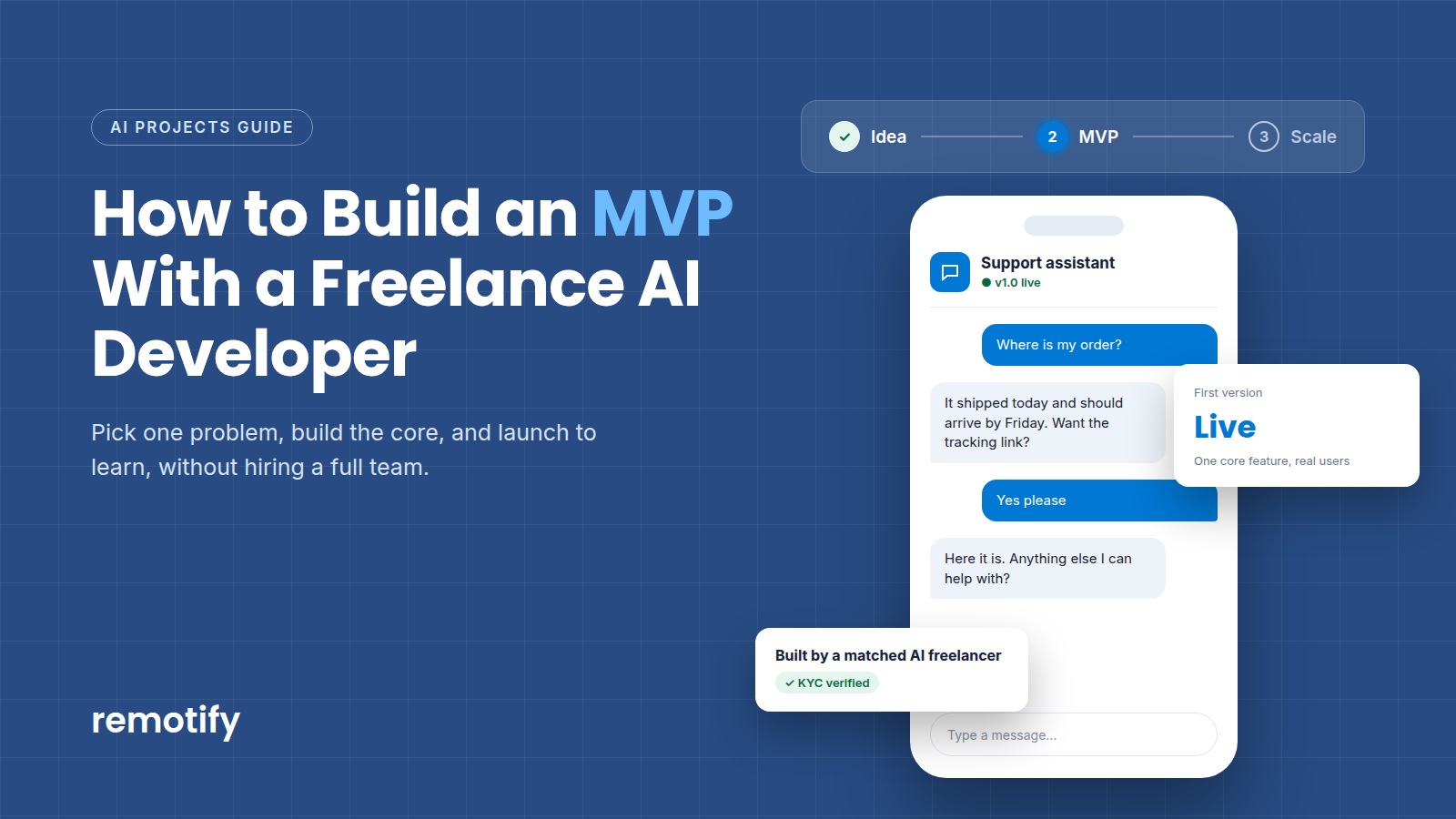
For example, a startup planning an AI customer support platform might launch with a single chatbot that answers questions from its help docs. No analytics dashboard, no integrations, no custom branding. If customers use it and it reduces support tickets, the team builds more. If not, they have saved months of work.
Why Build Your MVP With a Freelance AI Developer?
An MVP is a defined, time-boxed project, which is exactly where freelancers shine. Instead of spending months recruiting a full-time engineer before you even know if the idea works, you bring in a specialist for the build and decide what to do next once you have real feedback.
- Speed. You can start building as soon as you find the right person, instead of waiting through a long hiring process.
- Specialist skills. AI MVPs often need experience with LLM APIs, RAG systems or agents. A freelancer who has shipped these before avoids the beginner mistakes.
- Lower commitment. You pay for the project, not a permanent salary, benefits and equity before the product has proven itself.
- Flexibility. If the MVP works, you can keep the same freelancer for the next phase or use what you learned to hire in-house.
Step 1: Start With One Problem and One User
The most common reason MVPs fail is trying to do too much. Before you talk to any developer, write down two things in one sentence each: who your first user is, and the single problem you are solving for them.
"Help small e-commerce brands answer customer emails faster" is a good starting point. "An AI platform for all customer communication" is not. The narrower the problem, the faster and cheaper the MVP, and the clearer your results will be.
Step 2: Cut the Feature List to the Core
List every feature you imagine, then sort them into three groups:
- Must have. Without this, the product does not solve the core problem. This is your MVP.
- Nice to have. Useful, but users can live without it for the first version.
- Later. Ideas for once you have paying users and real data.
Be ruthless. Login screens, admin panels, polished design and integrations can often wait or be handled with simple off-the-shelf tools. A good AI freelancer will also tell you where AI genuinely adds value and where a simpler, non-AI solution would do the job.
Step 3: Find the Right AI Freelancer
Look for someone who has shipped products to real users, not just built demos. For an AI MVP, relevant experience matters: someone who has built a RAG-based assistant will move much faster on a similar project than a general web developer.
On the first call, ask:
- Have you built something similar before, and is it live?
- What would you build first, and what would you leave out?
- What will it cost to run each month after launch (API usage, hosting)?
- How will you hand over the code and documentation?
Strong candidates push back on scope and suggest cutting features. That is a good sign. Be wary of anyone who agrees to build everything on your list without question.
Step 4: Build in Short Milestones
Break the build into small milestones of a week or two, each ending with something you can see and test. A typical AI MVP might look like this:
- Scope and setup. Confirm the core feature, choose the tech stack, set up the project.
- Core feature. Build the main workflow end to end, even if it is rough.
- AI integration and testing. Connect the AI layer, test it on real data, and fix where it gets things wrong.
- Launch to first users. Polish what matters, deploy, and put it in front of real people.
Milestones keep the project on track, make it easy to spot problems early, and give you natural points to pay for completed work.
Step 5: Launch, Measure and Decide
Before launch, decide what success looks like. It might be the number of users who come back in their second week, the share of questions the AI answers correctly, or how many people would pay for it.
Then launch to a small group, watch how they use it, and talk to them. After a few weeks you will have one of three answers: double down and build the next phase, change direction based on what you learned, or stop before spending more. All three are a good outcome for an MVP.
What Does an AI MVP Cost?
Cost depends on complexity, the freelancer's experience and where they are based. As a rough guide, 2026 market data puts vetted freelance AI developers at around $30 to $100 an hour in Eastern Europe and Latin America, and $90 to $200 or more an hour in the US (HireHelper). One 2026 rate guide estimates a 4-week prototype from a mid-level freelancer at roughly $3,000 to $8,000 (Second Talent).
Remember to budget for running costs as well. LLM API calls, databases and hosting continue after launch, so ask your freelancer to estimate them before you start.
Common MVP Mistakes to Avoid
- Building too much. Every extra feature adds time and cost, and makes it harder to tell what users actually value.
- Skipping the brief. A vague request leads to vague quotes and a project that drifts.
- Ignoring running costs. An AI feature that is cheap to build can be expensive to run at scale.
- No plan for ownership. Agree in writing that the code belongs to your company, and make sure you get the repository and documentation at the end.
- Informal payments. Paying a freelancer abroad through ad hoc transfers with no proper invoice creates problems at your first audit or funding round.
Build Your MVP With a Freelancer Matched by Remotify
Remotify AI Projects matches you with an AI freelancer for your build and handles the compliance side, so you can focus on the product. Here is how it works:
Whether you are building a SaaS MVP, an internal AI tool or an AI-powered app, let Remotify handle the matching, invoicing and payment.
FAQ
1. What does MVP stand for?
Minimum Viable Product. It is the simplest version of a product that still solves the core problem for real users, built to test an idea before investing more.
2. How long does it take to build an AI MVP?
It depends on scope, but a focused MVP is often built in a few weeks rather than months. Keeping to one core feature is the biggest factor in keeping the timeline short.
3. Do I need a technical co-founder to build an MVP?
No. Many founders build their first version with a freelancer. You need a clear problem, a short brief and a developer who can explain their approach in plain language.
4. Can I keep working with the same freelancer after the MVP?
Yes. If the MVP works, many founders keep the same freelancer for the next phase, since they already know the codebase.
5. Who owns the code for my MVP?
That depends on your agreement with the freelancer, which is set directly between the two of you. Put IP ownership in writing before work starts.
