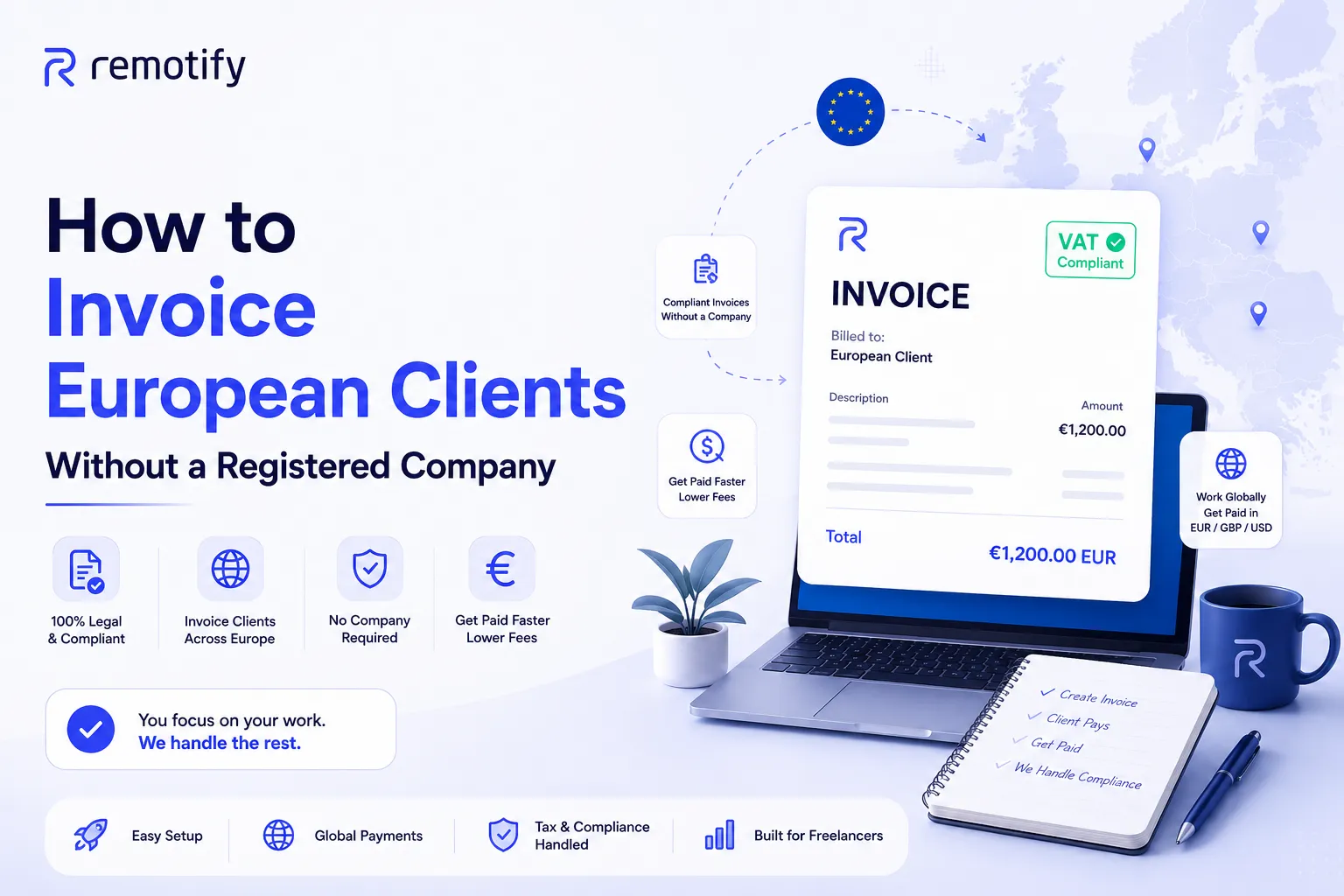
How to Invoice European Clients Without a Registered Company

You landed a client in Germany. Or France. Or Poland. The project is real, the budget is confirmed, and you’re ready to start.
Then they ask: “Can you send us an invoice?”

You don’t have company. You never needed one. Maybe this is your first freelance project. Maybe you’re still employed full-time and this is a side project. Maybe you’ve been freelancing informally for years and just never got around to registering.
Whatever the reason, you need to get paid. Legally. Now.

Here’s how you can do it without setting a company

Not having a company doesn’t mean you can’t work professionally with European clients. It means you need the right infrastructure, one that’s already built, already compliant, and ready to use today. Invoice your European clients properly – no company required.

Why You Haven't Registered a Company (And Why That's Okay)

Registering a business sounds like the obvious solution. But for most freelancers at this stage, it creates more problems than it solves.

It takes weeks. It costs money. It comes with ongoing obligations – tax filings, accounting fees, annual reports. And if this project is a one-off, or you’re not sure freelancing is going to stick, committing to a registered company feels like a big leap for one invoice.

You’re not doing anything wrong. You’re just at a different stage. And there’s a solution built exactly for that stage

The Problem With European Clients Specifically

European businesses operate under strict invoicing standards. To process an expense, pay it, and deduct it from their taxes, they need a VAT-compliant invoice from a registered legal entity.

A personal invoice – your name, your IBAN, a PDF you made yourself – doesn’t meet that standard. Their accountant will flag it. The payment gets delayed. Sometimes it doesn’t happen at all.

This isn’t unique to Germany or one particularly strict accountant. It’s the standard across the entire SEPA zone – 30+ countries, one unified invoicing requirement.

What You Actually Need

To invoice a European client properly, you need:

  • A registered legal entity issuing the invoice
  • A VAT number (or proper VAT exemption reference)
  • Reverse charge mechanism applied correctly for cross-border B2B
  • Mandatory invoice fields: invoice number, date, entity address, payment terms
  • A way for them to pay easily – ideally SEPA

Getting all of this on your own means registering a company, applying for a VAT number, and hiring an accountant to make sure you’re doing it right.

Or simply you use Remotify

How Remotify Works for Freelancers Without a Company

Remotify acts as the legal intermediary between you and your European client. You don’t need a company. You don’t need a VAT number. You don’t need an accountant.

Here’s what happens:

  • You sign up on Remotify – minutes, no company needed
  • You create your invoice – client details, project description, amount
  • Remotify issues a fully VAT-compliant EU invoice from its Estonia-registered entity
  • Your client receives a proper invoice – ready for their accounting system
  • They pay via SEPA transfer – fast, familiar, no friction
  • Remotify handles KYC, AML, and all compliance
  • You receive the money in your account – in EUR or your local currency

Your client gets what their accountant needs. You get paid. Nobody has to register a company.

Who This Is For

  • First-time freelancers who just landed their first real project
  • Full-time employees doing occasional side work
  • Freelancers transitioning out of employment and testing the market
  • Anyone who works project-to-project and doesn’t need a permanent business structure

You don’t need to be “a business” to work professionally. You need to deliver good work and get paid fairly. Remotify handles the rest.

What Your Client Receives

When you invoice through Remotify, your European client receives:

  • An invoice from an EU-registered entity (Estonia)
  • A valid VAT number
  • Reverse charge reference where applicable
  • All mandatory EU invoice fields
  • A familiar SEPA payment option

Their accountant sees a standard European supplier invoice. No questions, no delays, no rejected PDFs.

Frequently Asked Questions

Q1. Is it legal to invoice without a company in Europe?

Yes – when you invoice through Remotify, the invoice is issued by Remotify’s EU-registered entity on your behalf. The transaction is fully compliant with European regulations.

Q2. Will my European client accept a Remotify invoice?

Yes. Remotify issues VAT-compliant EU invoices that meet the accounting standards of all SEPA zone countries – Germany, France, Netherlands, Poland, Spain, Italy and 30+ more.

Q3. Do I need to register for VAT?

No. Remotify’s VAT number is used on the invoice. You don’t need your own.

Q4. What if I only have one project?

Perfect. There are no minimum commitments or monthly fees. You pay only when you invoice.

Q5. How fast will I get paid?

Once your client pays via SEPA, typically within the hour. No SWIFT, no delays, no intermediary banks.

Q6. What currencies can I receive?

You can receive EUR or convert to your local currency. Remotify supports payouts to 190+ countries.

Registering a business sounds like the obvious solution. But for most freelancers at this stage, it creates more problems than it solves.

It takes weeks. It costs money. It comes with ongoing obligations – tax filings, accounting fees, annual reports. And if this project is a one-off, or you’re not sure freelancing is going to stick, committing to a registered company feels like a big leap for one invoice.

You’re not doing anything wrong. You’re just at a different stage. And there’s a solution built exactly for that stage

European businesses operate under strict invoicing standards. To process an expense, pay it, and deduct it from their taxes, they need a VAT-compliant invoice from a registered legal entity.

A personal invoice – your name, your IBAN, a PDF you made yourself – doesn’t meet that standard. Their accountant will flag it. The payment gets delayed. Sometimes it doesn’t happen at all.

This isn’t unique to Germany or one particularly strict accountant. It’s the standard across the entire SEPA zone – 30+ countries, one unified invoicing requirement.

To invoice a European client properly, you need:

  • A registered legal entity issuing the invoice
  • A VAT number (or proper VAT exemption reference)
  • Reverse charge mechanism applied correctly for cross-border B2B
  • Mandatory invoice fields: invoice number, date, entity address, payment terms
  • A way for them to pay easily – ideally SEPA

Getting all of this on your own means registering a company, applying for a VAT number, and hiring an accountant to make sure you’re doing it right.

Or simply you use Remotify

Remotify acts as the legal intermediary between you and your European client. You don’t need a company. You don’t need a VAT number. You don’t need an accountant.

Here’s what happens:

  • You sign up on Remotify – minutes, no company needed
  • You create your invoice – client details, project description, amount
  • Remotify issues a fully VAT-compliant EU invoice from its Estonia-registered entity
  • Your client receives a proper invoice – ready for their accounting system
  • They pay via SEPA transfer – fast, familiar, no friction
  • Remotify handles KYC, AML, and all compliance
  • You receive the money in your account – in EUR or your local currency

Your client gets what their accountant needs. You get paid. Nobody has to register a company.

  • First-time freelancers who just landed their first real project
  • Full-time employees doing occasional side work
  • Freelancers transitioning out of employment and testing the market
  • Anyone who works project-to-project and doesn’t need a permanent business structure

You don’t need to be “a business” to work professionally. You need to deliver good work and get paid fairly. Remotify handles the rest.

When you invoice through Remotify, your European client receives:

  • An invoice from an EU-registered entity (Estonia)
  • A valid VAT number
  • Reverse charge reference where applicable
  • All mandatory EU invoice fields
  • A familiar SEPA payment option

Their accountant sees a standard European supplier invoice. No questions, no delays, no rejected PDFs.

Q1. Is it legal to invoice without a company in Europe?

Yes – when you invoice through Remotify, the invoice is issued by Remotify’s EU-registered entity on your behalf. The transaction is fully compliant with European regulations.

Q2. Will my European client accept a Remotify invoice?

Yes. Remotify issues VAT-compliant EU invoices that meet the accounting standards of all SEPA zone countries – Germany, France, Netherlands, Poland, Spain, Italy and 30+ more.

Q3. Do I need to register for VAT?

No. Remotify’s VAT number is used on the invoice. You don’t need your own.

Q4. What if I only have one project?

Perfect. There are no minimum commitments or monthly fees. You pay only when you invoice.

Q5. How fast will I get paid?

Once your client pays via SEPA, typically within the hour. No SWIFT, no delays, no intermediary banks.

Q6. What currencies can I receive?

You can receive EUR or convert to your local currency. Remotify supports payouts to 190+ countries.