Domestic invoicing is simple. You know the tax rules, you know the currency, and your client’s finance team isn’t six time zones away. Cross-border invoicing adds layers that most freelancers don’t realize exist until they’re deep in a payment dispute.
When you invoice international clients, you’re navigating:
Skip any of these, and what feels like a minor admin oversight can turn into a very expensive lesson.
A legally valid invoice isn’t just a PDF with your name and a number on it. To invoice international clients compliantly, your invoice typically needs to include:
Your details:
Your client’s details:
Invoice specifics:
Missing even one of these can cause a client’s accounting team to reject the invoice outright. And “my invoice got rejected” is a perfectly terrible reason to wait another 30 days for payment.
If you’re invoicing clients in the European Union, VAT is the big topic you need to understand. The rules differ depending on where you are based.
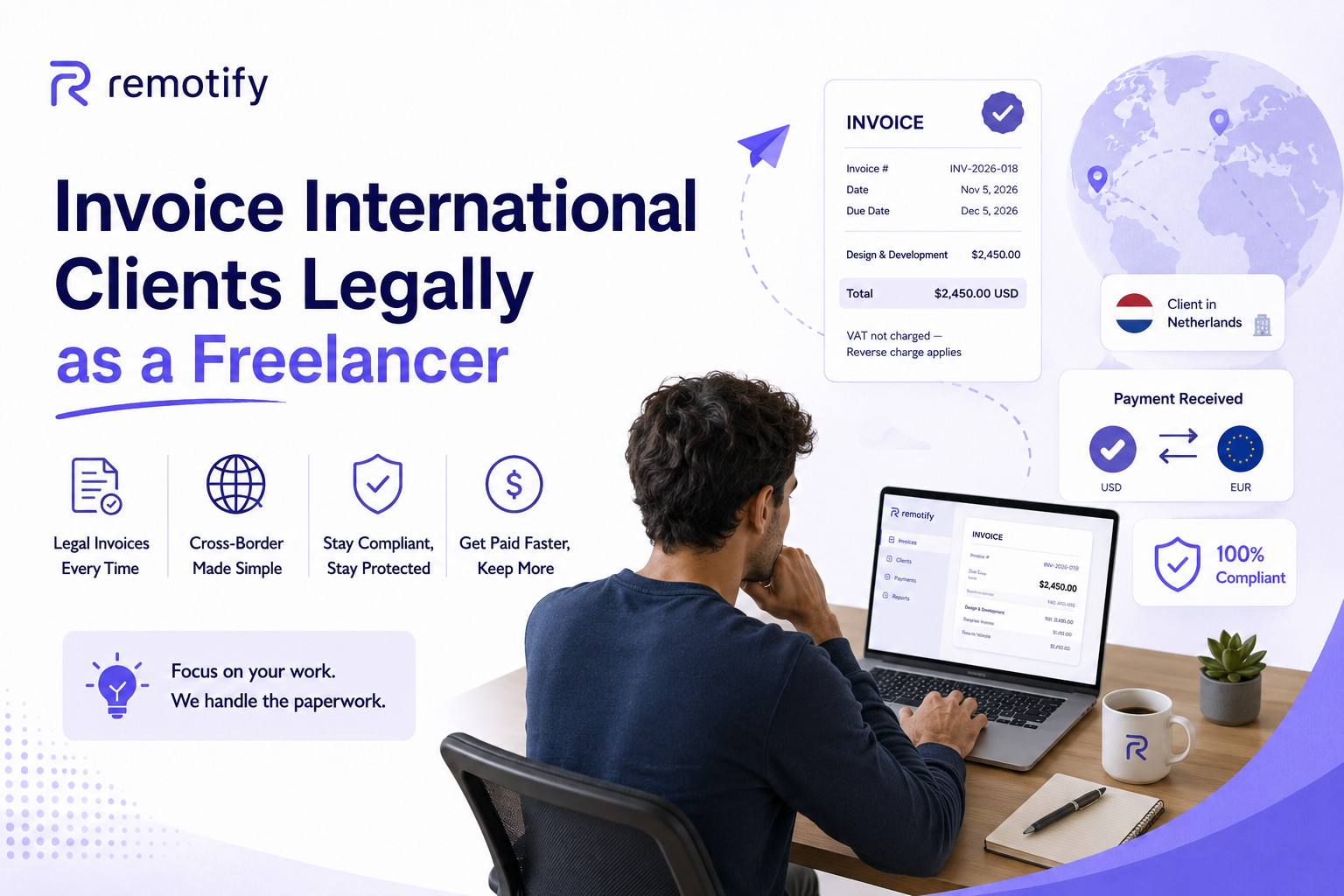
Good news: you generally don’t charge VAT to EU business clients. Instead, the reverse charge mechanism applies. This means your EU client is responsible for accounting for VAT in their own country — not you.
But — and this is important — you still need to state the reverse charge on your invoice. Something like:
“VAT not charged — reverse charge applies (Article 196, EU VAT Directive)”
Without that line, your client’s finance team may refuse the invoice or ask you to reissue it. Which adds weeks to your payment timeline. Add the line. Always.
Your situation is more complex and depends on your annual revenue. Most EU countries have a VAT registration threshold — below that threshold, you don’t charge VAT. Above it, you must register for VAT and include it on your invoices.
Once VAT-registered, you need to issue VAT compliant invoices that include your VAT number, the applicable VAT rate, and the VAT amount broken out separately from your service fee. For B2B invoices sent to VAT-registered clients in other EU countries, the reverse charge applies and you charge 0% VAT — but again, you must include the reverse charge note.
The takeaway: know your VAT status, and put the right information on every invoice.

Here’s an uncomfortable truth: in many countries, issuing invoices for services is a regulated activity. It implies you’re operating a business. And operating a business without the proper registration can create legal problems — even if you’re just a solo freelancer doing design work from your apartment.
This is especially relevant if you’re doing significant volume with international clients. The questions you need to answer for your own country:
Do I need to register as a freelancer or sole trader?
Many countries require some form of registration once you start earning from clients — domestic or international.
Do I need a business bank account?
Some jurisdictions require foreign income to flow through a specific type of account, or require you to declare it within a set number of days.
How do I declare this income?
International payments can trigger different tax treatment than domestic income. In some countries, foreign-earned income is taxed differently or qualifies for specific exemptions.
Is my invoice legally sufficient to prove the transaction?
Tax authorities in some countries require invoices to meet specific formatting standards to be accepted as valid business records.
Freelancer compliance isn’t about being paranoid. It’s about making sure the money you earn is money you get to keep — without an unexpected visit from your country’s tax authority asking pointed questions about that €20,000 wire from a German startup.
This is where many freelancers hit a wall. Some international clients — particularly larger businesses and enterprise companies — require invoices to come from a registered legal entity. They need a company name, a business registration number, and sometimes a VAT number, before they’ll even create a vendor profile for you.
So what do you do if you’re an individual freelancer without a registered company?
A few options:
Option 1: Register a sole trader / freelancer entity in your country. This works if your country makes it easy and inexpensive. In many places, it’s a straightforward process and gives you all the legal standing you need.
Option 2: Use a compliant invoicing platform. Platforms like Remotify exist precisely for this. They act as the invoicing entity on your behalf, issuing legally compliant invoices to your client in their required format, collecting payment, and passing it on to you. You keep working as an individual, your client gets an invoice that satisfies their procurement team, and everyone goes home happy.
This is particularly useful for freelancers in countries where business registration is complex, expensive, or slow — or for freelancers who want to start working with international clients immediately without waiting months for paperwork to process.
A legally correct invoice is great. A legally correct invoice in the wrong currency that costs you 4% in conversion fees is considerably less great.
When invoicing international clients, decide upfront:
Which currency will you invoice in?
USD and EUR are the most widely accepted for international freelance work. Invoicing in your client’s currency removes friction for them; invoicing in your preferred currency removes exchange rate risk for you. Negotiate this before you start the project, not after.
Who absorbs the conversion cost?
If your client pays in EUR and you need USD in your local bank account, someone is paying a conversion fee. Make sure it’s not silently you, every single time.
How will you receive the payment?
International wire transfers (SWIFT) can involve intermediary bank fees that shave money off your invoice total before it lands in your account. Explore alternatives — multi-currency accounts, platforms built for freelancer payments — that minimize these losses.
A good rule: always invoice slightly above your minimum acceptable amount to account for transfer costs, unless you’re using a platform that handles this transparently.
Before you send your next invoice to an international client, run through this:
Invoicing international clients legally comes down to three things: knowing what goes on the invoice, understanding how VAT and taxes apply across borders, and making sure you have the legal standing to issue invoices in the first place.
None of this is impossibly complicated. It’s just unfamiliar, and unfamiliarity is what trips most freelancers up. A few hours understanding the rules saves you from months of payment delays, rejected invoices, and tax headaches.
And if you’d rather spend those hours on actual work? That’s what platforms like Remotify are built for. We handle the compliance infrastructure so you can focus on doing what you’re actually good at — while your invoices go out legally, professionally, and without the 4 AM Googling.
Ready to invoice international clients without the guesswork? Get started with Remotify →
Domestic invoicing is simple. You know the tax rules, you know the currency, and your client’s finance team isn’t six time zones away. Cross-border invoicing adds layers that most freelancers don’t realize exist until they’re deep in a payment dispute.
When you invoice international clients, you’re navigating:
Skip any of these, and what feels like a minor admin oversight can turn into a very expensive lesson.
A legally valid invoice isn’t just a PDF with your name and a number on it. To invoice international clients compliantly, your invoice typically needs to include:
Your details:
Your client’s details:
Invoice specifics:
Missing even one of these can cause a client’s accounting team to reject the invoice outright. And “my invoice got rejected” is a perfectly terrible reason to wait another 30 days for payment.
If you’re invoicing clients in the European Union, VAT is the big topic you need to understand. The rules differ depending on where you are based.
Good news: you generally don’t charge VAT to EU business clients. Instead, the reverse charge mechanism applies. This means your EU client is responsible for accounting for VAT in their own country — not you.
But — and this is important — you still need to state the reverse charge on your invoice. Something like:
“VAT not charged — reverse charge applies (Article 196, EU VAT Directive)”
Without that line, your client’s finance team may refuse the invoice or ask you to reissue it. Which adds weeks to your payment timeline. Add the line. Always.
Your situation is more complex and depends on your annual revenue. Most EU countries have a VAT registration threshold — below that threshold, you don’t charge VAT. Above it, you must register for VAT and include it on your invoices.
Once VAT-registered, you need to issue VAT compliant invoices that include your VAT number, the applicable VAT rate, and the VAT amount broken out separately from your service fee. For B2B invoices sent to VAT-registered clients in other EU countries, the reverse charge applies and you charge 0% VAT — but again, you must include the reverse charge note.
The takeaway: know your VAT status, and put the right information on every invoice.
Here’s an uncomfortable truth: in many countries, issuing invoices for services is a regulated activity. It implies you’re operating a business. And operating a business without the proper registration can create legal problems — even if you’re just a solo freelancer doing design work from your apartment.
This is especially relevant if you’re doing significant volume with international clients. The questions you need to answer for your own country:
Do I need to register as a freelancer or sole trader?
Many countries require some form of registration once you start earning from clients — domestic or international.
Do I need a business bank account?
Some jurisdictions require foreign income to flow through a specific type of account, or require you to declare it within a set number of days.
How do I declare this income?
International payments can trigger different tax treatment than domestic income. In some countries, foreign-earned income is taxed differently or qualifies for specific exemptions.
Is my invoice legally sufficient to prove the transaction?
Tax authorities in some countries require invoices to meet specific formatting standards to be accepted as valid business records.
Freelancer compliance isn’t about being paranoid. It’s about making sure the money you earn is money you get to keep — without an unexpected visit from your country’s tax authority asking pointed questions about that €20,000 wire from a German startup.
This is where many freelancers hit a wall. Some international clients — particularly larger businesses and enterprise companies — require invoices to come from a registered legal entity. They need a company name, a business registration number, and sometimes a VAT number, before they’ll even create a vendor profile for you.
So what do you do if you’re an individual freelancer without a registered company?
A few options:
Option 1: Register a sole trader / freelancer entity in your country. This works if your country makes it easy and inexpensive. In many places, it’s a straightforward process and gives you all the legal standing you need.
Option 2: Use a compliant invoicing platform. Platforms like Remotify exist precisely for this. They act as the invoicing entity on your behalf, issuing legally compliant invoices to your client in their required format, collecting payment, and passing it on to you. You keep working as an individual, your client gets an invoice that satisfies their procurement team, and everyone goes home happy.
This is particularly useful for freelancers in countries where business registration is complex, expensive, or slow — or for freelancers who want to start working with international clients immediately without waiting months for paperwork to process.
A legally correct invoice is great. A legally correct invoice in the wrong currency that costs you 4% in conversion fees is considerably less great.
When invoicing international clients, decide upfront:
Which currency will you invoice in?
USD and EUR are the most widely accepted for international freelance work. Invoicing in your client’s currency removes friction for them; invoicing in your preferred currency removes exchange rate risk for you. Negotiate this before you start the project, not after.
Who absorbs the conversion cost?
If your client pays in EUR and you need USD in your local bank account, someone is paying a conversion fee. Make sure it’s not silently you, every single time.
How will you receive the payment?
International wire transfers (SWIFT) can involve intermediary bank fees that shave money off your invoice total before it lands in your account. Explore alternatives — multi-currency accounts, platforms built for freelancer payments — that minimize these losses.
A good rule: always invoice slightly above your minimum acceptable amount to account for transfer costs, unless you’re using a platform that handles this transparently.
Before you send your next invoice to an international client, run through this:
Invoicing international clients legally comes down to three things: knowing what goes on the invoice, understanding how VAT and taxes apply across borders, and making sure you have the legal standing to issue invoices in the first place.
None of this is impossibly complicated. It’s just unfamiliar, and unfamiliarity is what trips most freelancers up. A few hours understanding the rules saves you from months of payment delays, rejected invoices, and tax headaches.
And if you’d rather spend those hours on actual work? That’s what platforms like Remotify are built for. We handle the compliance infrastructure so you can focus on doing what you’re actually good at — while your invoices go out legally, professionally, and without the 4 AM Googling.
Ready to invoice international clients without the guesswork? Get started with Remotify →