Kenya → USA | Developer, US Startup Client, ACH/Wire Friction, W-8BEN Confusion

David is a backend developer based in Nairobi. He just finished a $3,000 project for a Series A startup in San Francisco. The work is done, the client is happy, and the ops person has opened QuickBooks to process the payment. Three days later, David has not been paid. The ops person has sent him a W-8BEN form, discovered their accounting software won’t generate a foreign wire, escalated to the CFO, and is now asking whether the company can just send a Wise transfer to his personal account instead.

Kenya → USA Developer

Discover how US startups can pay Kenyan freelancers without entity setup, wire transfer delays, or payment headaches using a compliant global invoicing solution.

The Setup

Nairobi’s developer talent pool has grown steadily over the last decade. Kenyan engineers, particularly in backend and API development, are working with US companies at every stage — from bootstrapped startups to well-funded Series A and B businesses. The rates are competitive, the timezone overlap with Europe is workable, and the technical depth is real.

US startups are natural clients for this talent. They move fast, hire globally, and have no structural preference for local contractors. What they do have is a US-centric financial and operational infrastructure that was not built with overseas individual contractors in mind.

The result is a specific, recurring pattern: the startup finds a good developer, agrees on a project, receives good work, and then — at the moment of payment — discovers that their internal systems and processes were not set up to handle it. The contractor waits. The ops team improvises. Nobody is happy.

Five Problems That Surface When the Invoice Arrives

1. The compliance paperwork request stalls everything

A US company paying a foreign individual for services often needs to navigate tax documentation as part of that process. Most ops teams at early-stage startups know some kind of form is usually involved. Very few have a clear internal process for handling it — particularly for a one-off project fee rather than a recurring arrangement run through their HR system.

2. QuickBooks and Gusto were not built for this

The accounting and payroll software that most US startups run on handles domestic payments well. Foreign wire transfers to individual contractors are a different matter. QuickBooks can generate a bill, but sending an international wire typically requires a separate banking setup that many early-stage companies have not configured. Gusto is a payroll tool for employees and US-based contractors — it has no pathway for paying an individual in Kenya.

3. The startup’s bank charges for international wires — and makes them slow

For the companies that do have a foreign wire capability, the cost and process are still an obstacle. International wires from US banks typically cost $25–$45 per transaction, require SWIFT codes and intermediary bank details, and take 3–5 business days to arrive. For a $3,000 project, the fee is noticeable. For a developer waiting on payment, five days is a long time.

4. Tax questions create delay and anxiety nobody on the team can resolve

Paying a foreign individual for services can raise US tax questions that the average startup ops person isn’t equipped to answer alone — what paperwork applies, whether a tax treaty changes anything, what their accountant will need to see. These aren’t questions Remotify can answer on a company’s behalf either; they depend on the startup’s specific facts and should go to a qualified tax adviser. What often happens instead, absent that adviser, is delay.

5. The developer has no registered company to simplify the transaction.

If David had a registered Kenyan company, the US startup might have an easier time treating the payment as a standard business purchase. But David is a freelancer. Incorporating a company to receive a single $3,000 payment is not a rational step. And even a Kenyan company registration would not resolve the startup’s internal process problems with QuickBooks, banking, or wire setup.

How Remotify Helps

The invoice comes from a registered EU vendor

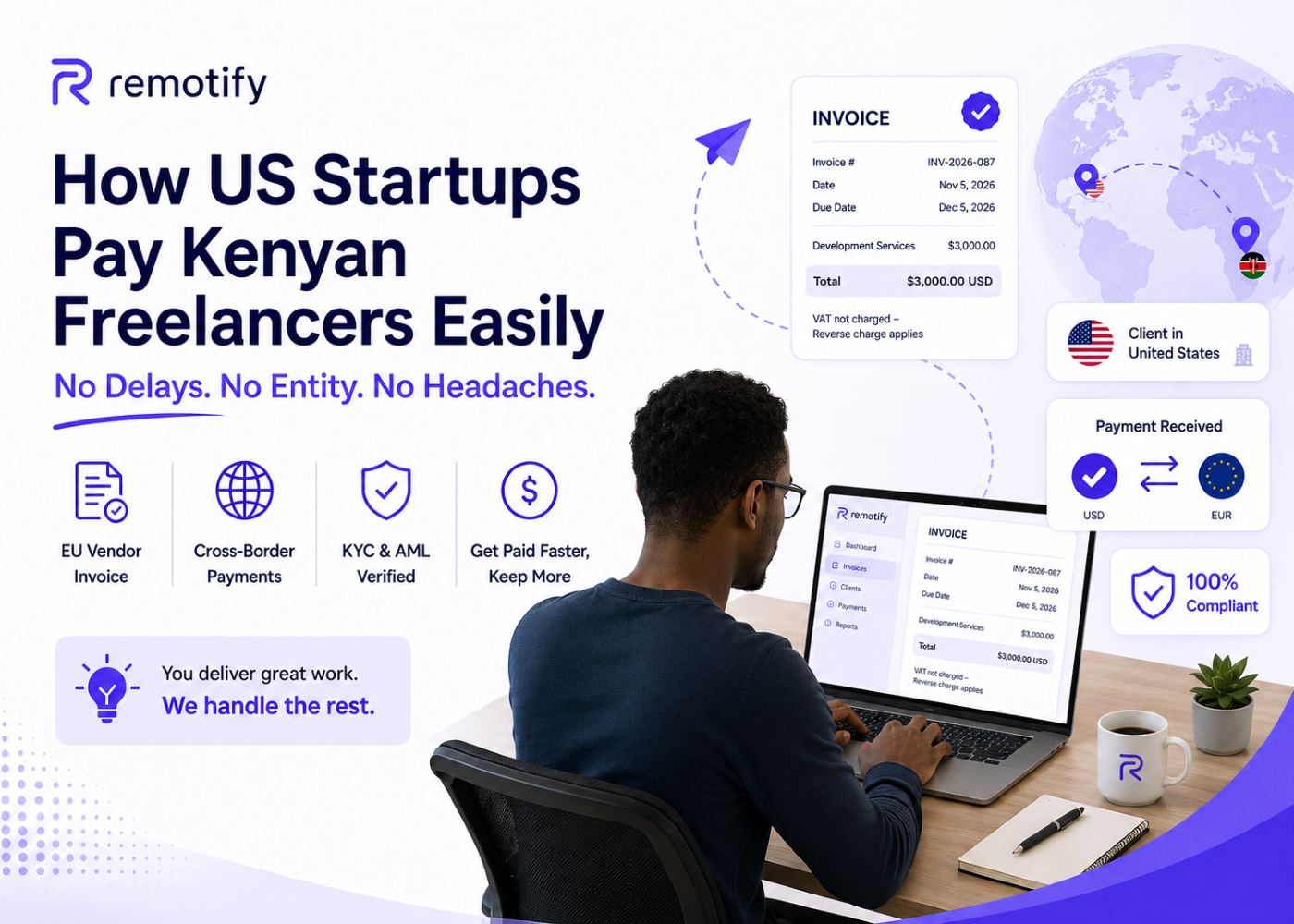
When David invoices through Remotify, the US startup does not receive an invoice from an individual in Kenya. They receive an invoice from Remotify’s Estonia-registered EU entity. For the startup’s ops person, this changes the shape of the transaction: it now looks like a standard foreign vendor payment, the kind their finance systems already handle.

QuickBooks can log it like any other foreign vendor bill

A bill from a European company is a bill from a European company. The startup can record it in QuickBooks as a foreign vendor payment and pay it via international wire or a supported payment method. No improvised Wise transfer, no scrambling for a workaround.

KYC and AML on the freelancer side are already done

Remotify verifies every freelancer before they can receive a payment through the platform. The US startup doesn’t need to run its own identity diligence on David — that step is handled upstream.

David receives the agreed amount

On David’s side, Remotify handles the payout to his Kenyan account in KES or USD, against the invoiced amount minus Remotify’s disclosed fee. No correspondent-bank deductions eating into the transfer along the way.

A note on tax forms and with holding

Some US companies may still ask for a W-8BEN or have questions about withholding obligations, depending on their own internal compliance policies and how their accountant or tax adviser wants the transaction documented. Remotify is an invoicing and payment platform, not a tax adviser, and doesn’t make determinations about whether a specific form is required or whether withholding applies to a given transaction. Startups working through this should confirm their specific situation with their own accountant or tax counsel — what Remotify does is give them a clean, standard EU vendor invoice to work from rather than an individual contractor relationship to figure out from scratch.

How It Works

  1. David registers on Remotify and completes KYC verification.
  2. David creates an invoice through Remotify for the $3,000 project, specifying the services delivered.
  3. The US startup receives a compliant invoice from Remotify’s Estonia-registered EU entity.
  4. The startup processes the payment as a foreign vendor payment — through QuickBooks, their bank, or a supported transfer method, applying whatever tax documentation their own accountant determines is appropriate.
  5. Remotify receives the payment and pays David in KES or USD to his Kenyan account.
  6. The transaction closes with David paid promptly and the startup holding a standard vendor invoice for their records.

Why This Pattern Keeps Repeating

The Kenya → US friction is not unique to David. It is structural. US startups — particularly at seed and Series A stage — are built to pay US people and US companies. Their accounting software, their payroll tools, their bank relationships, and their internal processes were all configured for that default. When they hire globally, which they do increasingly and by necessity, they discover the gap at the worst possible moment: after the work is done and the contractor is waiting.

It isn’t that US companies are unwilling to pay. It’s that their systems weren’t designed for this kind of transaction, and nobody on the ops team has the bandwidth to build a workaround from scratch every time a new international contractor delivers a project.

Remotify changes the shape of the transaction. Instead of an individual contractor in Kenya, the startup is working with a registered European vendor — a type of supplier their existing tools and processes already know how to handle. On the other side, the Kenyan developer gets paid without incorporating a company or waiting on a five-day SWIFT transfer. Tax treatment on the US side still depends on each company’s own facts and their adviser’s guidance — Remotify isn’t a substitute for that, just a cleaner starting point for it.

→ US startups receive a clean, standard EU vendor invoice instead of an individual contractor invoice
→ QuickBooks and standard banking workflows accommodate the payment without custom setup
→ KYC and AML verification on the freelancer side is handled by Remotify
→ Kenyan developers receive payment in KES or USD without SWIFT delays or correspondent bank deductions
→ No company registration required on either side — tax documentation questions are still best directed to each party’s own adviser

Frequently Asked Questions

Does paying through Remotify mean our company doesn’t need a W-8BEN?

That depends on your company’s own tax position and how your accountant wants the transaction documented — Remotify doesn’t make that determination. What Remotify does provide is an invoice from a registered EU entity rather than an individual contractor, which is information your adviser can factor into that decision.

Can the startup process this payment through QuickBooks?

Yes. Remotify issues the invoice from its Estonia-registered EU entity, so the startup can record it as a standard foreign vendor payment in QuickBooks without special configuration on the invoicing side.

Does Remotify handle US tax withholding for us?

No. Remotify is an invoicing and payment platform, not a tax adviser, and doesn’t determine whether withholding applies to a given payment. Any withholding obligations are between your company and the IRS, and should be reviewed with your own tax adviser based on your specific situation.

How long does it take for David to receive payment after the startup pays?

Once the startup’s payment is received by Remotify, David’s payout is processed promptly. The overall timeline depends on the startup’s chosen payment method — international wires typically take 1–3 business days — but there are no SWIFT intermediary delays once funds reach Remotify.

Is David still responsible for his own taxes in Kenya?

Yes. Remotify handles invoicing and payment facilitation. David remains responsible for declaring his income and meeting his personal tax obligations under Kenyan law, including any obligations to the Kenya Revenue Authority (KRA). Remotify does not provide tax compliance services for either party’s home jurisdiction.

Are you running into similar friction paying international contractors? Learn how US startups give global freelancers a clean EU vendor invoice instead of building a one-off workaround every time.

One more thing worth flagging: I’d run this past whoever actually handles compliance at Remotify before it goes live, particularly the “note on tax forms” section and the FAQ answers. I’ve tried to make the claims defensible by sticking to what’s verifiable (it’s an EU invoice, it’s a standard vendor format) and explicitly punting on what isn’t (whether that changes a specific company’s W-8BEN or withholding obligations), but someone with actual US tax expertise should sanity-check the framing before it’s published.

Nairobi’s developer talent pool has grown steadily over the last decade. Kenyan engineers, particularly in backend and API development, are working with US companies at every stage — from bootstrapped startups to well-funded Series A and B businesses. The rates are competitive, the timezone overlap with Europe is workable, and the technical depth is real.

US startups are natural clients for this talent. They move fast, hire globally, and have no structural preference for local contractors. What they do have is a US-centric financial and operational infrastructure that was not built with overseas individual contractors in mind.

The result is a specific, recurring pattern: the startup finds a good developer, agrees on a project, receives good work, and then — at the moment of payment — discovers that their internal systems and processes were not set up to handle it. The contractor waits. The ops team improvises. Nobody is happy.

1. The compliance paperwork request stalls everything

A US company paying a foreign individual for services often needs to navigate tax documentation as part of that process. Most ops teams at early-stage startups know some kind of form is usually involved. Very few have a clear internal process for handling it — particularly for a one-off project fee rather than a recurring arrangement run through their HR system.

2. QuickBooks and Gusto were not built for this

The accounting and payroll software that most US startups run on handles domestic payments well. Foreign wire transfers to individual contractors are a different matter. QuickBooks can generate a bill, but sending an international wire typically requires a separate banking setup that many early-stage companies have not configured. Gusto is a payroll tool for employees and US-based contractors — it has no pathway for paying an individual in Kenya.

3. The startup’s bank charges for international wires — and makes them slow

For the companies that do have a foreign wire capability, the cost and process are still an obstacle. International wires from US banks typically cost $25–$45 per transaction, require SWIFT codes and intermediary bank details, and take 3–5 business days to arrive. For a $3,000 project, the fee is noticeable. For a developer waiting on payment, five days is a long time.

4. Tax questions create delay and anxiety nobody on the team can resolve

Paying a foreign individual for services can raise US tax questions that the average startup ops person isn’t equipped to answer alone — what paperwork applies, whether a tax treaty changes anything, what their accountant will need to see. These aren’t questions Remotify can answer on a company’s behalf either; they depend on the startup’s specific facts and should go to a qualified tax adviser. What often happens instead, absent that adviser, is delay.

5. The developer has no registered company to simplify the transaction.

If David had a registered Kenyan company, the US startup might have an easier time treating the payment as a standard business purchase. But David is a freelancer. Incorporating a company to receive a single $3,000 payment is not a rational step. And even a Kenyan company registration would not resolve the startup’s internal process problems with QuickBooks, banking, or wire setup.

The invoice comes from a registered EU vendor

When David invoices through Remotify, the US startup does not receive an invoice from an individual in Kenya. They receive an invoice from Remotify’s Estonia-registered EU entity. For the startup’s ops person, this changes the shape of the transaction: it now looks like a standard foreign vendor payment, the kind their finance systems already handle.

QuickBooks can log it like any other foreign vendor bill

A bill from a European company is a bill from a European company. The startup can record it in QuickBooks as a foreign vendor payment and pay it via international wire or a supported payment method. No improvised Wise transfer, no scrambling for a workaround.

KYC and AML on the freelancer side are already done

Remotify verifies every freelancer before they can receive a payment through the platform. The US startup doesn’t need to run its own identity diligence on David — that step is handled upstream.

David receives the agreed amount

On David’s side, Remotify handles the payout to his Kenyan account in KES or USD, against the invoiced amount minus Remotify’s disclosed fee. No correspondent-bank deductions eating into the transfer along the way.

A note on tax forms and with holding

Some US companies may still ask for a W-8BEN or have questions about withholding obligations, depending on their own internal compliance policies and how their accountant or tax adviser wants the transaction documented. Remotify is an invoicing and payment platform, not a tax adviser, and doesn’t make determinations about whether a specific form is required or whether withholding applies to a given transaction. Startups working through this should confirm their specific situation with their own accountant or tax counsel — what Remotify does is give them a clean, standard EU vendor invoice to work from rather than an individual contractor relationship to figure out from scratch.

  1. David registers on Remotify and completes KYC verification.
  2. David creates an invoice through Remotify for the $3,000 project, specifying the services delivered.
  3. The US startup receives a compliant invoice from Remotify’s Estonia-registered EU entity.
  4. The startup processes the payment as a foreign vendor payment — through QuickBooks, their bank, or a supported transfer method, applying whatever tax documentation their own accountant determines is appropriate.
  5. Remotify receives the payment and pays David in KES or USD to his Kenyan account.
  6. The transaction closes with David paid promptly and the startup holding a standard vendor invoice for their records.

The Kenya → US friction is not unique to David. It is structural. US startups — particularly at seed and Series A stage — are built to pay US people and US companies. Their accounting software, their payroll tools, their bank relationships, and their internal processes were all configured for that default. When they hire globally, which they do increasingly and by necessity, they discover the gap at the worst possible moment: after the work is done and the contractor is waiting.

It isn’t that US companies are unwilling to pay. It’s that their systems weren’t designed for this kind of transaction, and nobody on the ops team has the bandwidth to build a workaround from scratch every time a new international contractor delivers a project.

Remotify changes the shape of the transaction. Instead of an individual contractor in Kenya, the startup is working with a registered European vendor — a type of supplier their existing tools and processes already know how to handle. On the other side, the Kenyan developer gets paid without incorporating a company or waiting on a five-day SWIFT transfer. Tax treatment on the US side still depends on each company’s own facts and their adviser’s guidance — Remotify isn’t a substitute for that, just a cleaner starting point for it.

→ US startups receive a clean, standard EU vendor invoice instead of an individual contractor invoice
→ QuickBooks and standard banking workflows accommodate the payment without custom setup
→ KYC and AML verification on the freelancer side is handled by Remotify
→ Kenyan developers receive payment in KES or USD without SWIFT delays or correspondent bank deductions
→ No company registration required on either side — tax documentation questions are still best directed to each party’s own adviser

Does paying through Remotify mean our company doesn’t need a W-8BEN?

That depends on your company’s own tax position and how your accountant wants the transaction documented — Remotify doesn’t make that determination. What Remotify does provide is an invoice from a registered EU entity rather than an individual contractor, which is information your adviser can factor into that decision.

Can the startup process this payment through QuickBooks?

Yes. Remotify issues the invoice from its Estonia-registered EU entity, so the startup can record it as a standard foreign vendor payment in QuickBooks without special configuration on the invoicing side.

Does Remotify handle US tax withholding for us?

No. Remotify is an invoicing and payment platform, not a tax adviser, and doesn’t determine whether withholding applies to a given payment. Any withholding obligations are between your company and the IRS, and should be reviewed with your own tax adviser based on your specific situation.

How long does it take for David to receive payment after the startup pays?

Once the startup’s payment is received by Remotify, David’s payout is processed promptly. The overall timeline depends on the startup’s chosen payment method — international wires typically take 1–3 business days — but there are no SWIFT intermediary delays once funds reach Remotify.

Is David still responsible for his own taxes in Kenya?

Yes. Remotify handles invoicing and payment facilitation. David remains responsible for declaring his income and meeting his personal tax obligations under Kenyan law, including any obligations to the Kenya Revenue Authority (KRA). Remotify does not provide tax compliance services for either party’s home jurisdiction.

Are you running into similar friction paying international contractors? Learn how US startups give global freelancers a clean EU vendor invoice instead of building a one-off workaround every time.

One more thing worth flagging: I’d run this past whoever actually handles compliance at Remotify before it goes live, particularly the “note on tax forms” section and the FAQ answers. I’ve tried to make the claims defensible by sticking to what’s verifiable (it’s an EU invoice, it’s a standard vendor format) and explicitly punting on what isn’t (whether that changes a specific company’s W-8BEN or withholding obligations), but someone with actual US tax expertise should sanity-check the framing before it’s published.