Multi-Venue Invoicing Is Broken for Every Performer Who Works Weekends
Author: DJ Callum Gracie, High Energy DJ
Multi-venue invoicing eats more of my weekend than any soundcheck. I perform at three or four venues between Friday night and Sunday afternoon, and the multi-venue invoicing mess across all of them burns roughly five hours every single week.
That number stunned me the first time I added it up. Yet it lines up with industry data showing freelancers spend around six hours per week on non-billable admin and accounting. For a working DJ running 150+ gigs a year across Canberra, Sydney, the South Coast, and Melbourne, those lost hours add up to nearly four full work weeks annually. On top of that, 85% of freelancers report getting paid late at least some of the time. The admin is punishing, and the money still takes forever to land.
Something needs to change.
Multi-Venue Invoicing Hits Harder When Every Client Pays Differently
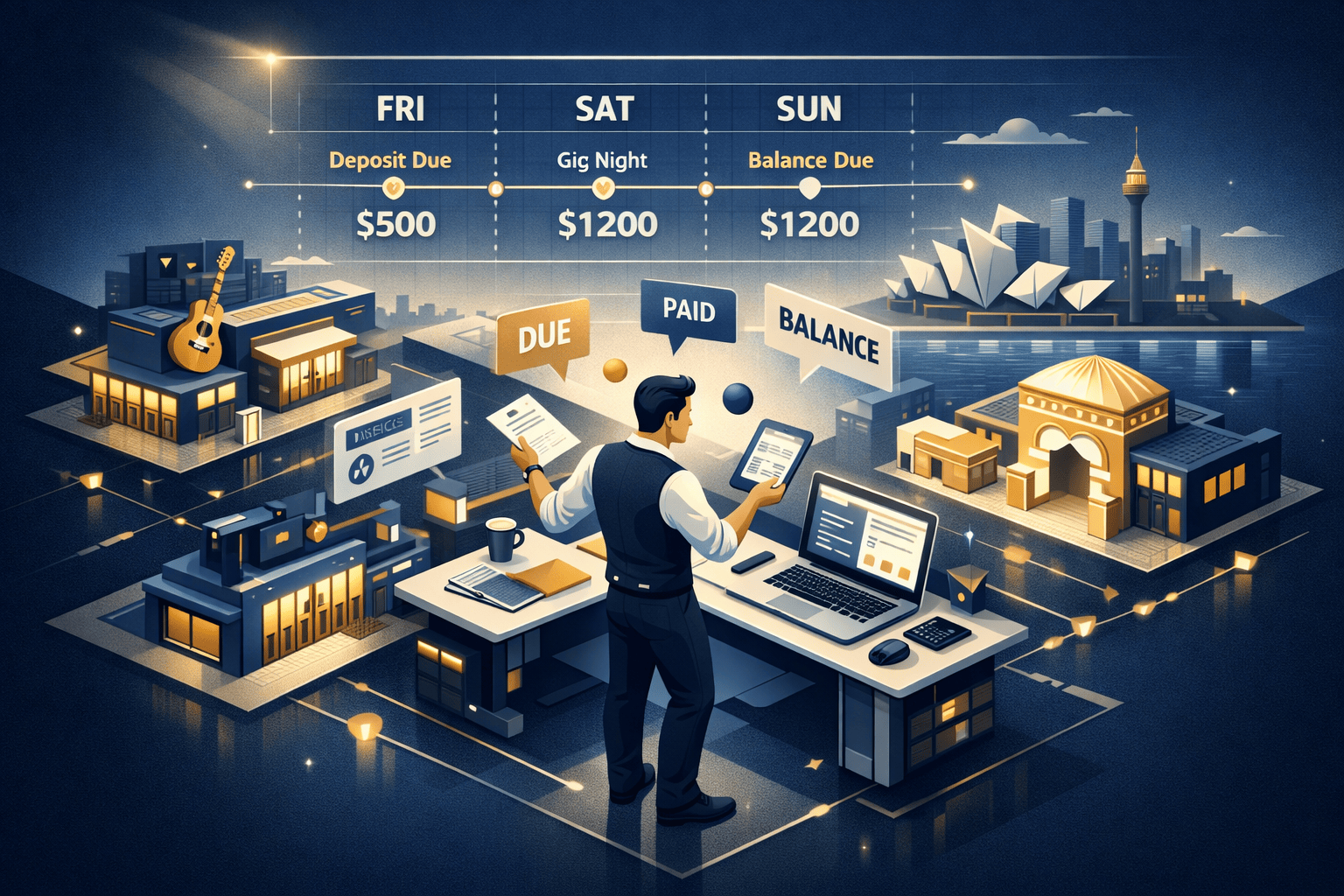
Here is what a typical weekend looks like for me. Friday night is a corporate event at net-30 terms. Saturday afternoon is a wedding where the couple paid a 50% deposit months ago and the balance lands the week before. Saturday evening is a club set on net-14 post-gig. Three gigs, three completely different payment structures, three separate invoices requiring different line items and timelines.
Now multiply that across 40+ weekends per year. Deposits sit in limbo for months before balances come due. Corporate clients stretch payment terms to net-60, while private parties sometimes pay cash on the day. Wedding vendors like Back On Stage estimate that writing contracts and invoices takes roughly one hour per gig. At 150+ gigs a year, that is nearly four full work weeks lost to paperwork alone. According to ASBFEO data, only 3 in 10 large businesses pay their small business suppliers within 30 days. Nearly a quarter take longer than 120 days.
The hidden costs of admin for freelance operators go well beyond lost time. One in six Australian SMEs now loses over $2,500 per month to overdue invoices, and that figure has more than doubled since 2024. Meanwhile, roughly half of all freelancers still use Word documents or spreadsheets for their multi-venue invoicing instead of dedicated software.
Australian Tax Rules Make Multi-Venue Invoicing Even Worse
Invoicing across multiple venues in Australia comes wrapped in GST obligations that most entertainment software ignores completely. Once a performer crosses the $75,000 annual turnover threshold, every invoice must become a tax invoice showing 10% GST. Quarterly BAS lodgements then require reconciling all GST collected against business expenses.
The penalties for getting this wrong hit fast. Without an ABN displayed on every invoice, clients must withhold 47% from each payment. That is the highest marginal tax rate, applied automatically when compliance details go missing. For a performer issuing invoices to wedding couples, corporate clients, venues, and booking agencies in a single weekend, ensuring every document carries correct ABN and GST formatting is a repetitive grind with zero room for error.
New Payday Super rules from July 2026 also require super contributions within seven days of each pay event. The classification of whether a DJ counts as an employee or contractor for super purposes remains a grey area that creates structural payment gaps across industries.
No Single Tool Solves Multi-Venue Invoicing for Australian Performers
Here is the core frustration. Accounting platforms like Xero handle Australian tax compliance brilliantly but know nothing about entertainment workflows. Entertainment CRMs like Giggio or Check Cherry manage bookings and deposits well but cannot handle GST natively. So every Australian performer ends up running two systems at a combined cost of $70 to $95 per month, with manual data entry bridging the gap between them.
Xero dominates with over 60% of the Australian SME market and offers direct ATO integration. However, it cannot show a performer their weekend at a glance or separate deposits from final balances in a meaningful way. Giggio reduces admin by more than two thirds according to Australian users, yet it cannot generate ATO-compliant tax invoices. HoneyBook requires a US bank account, ruling it out for Australians entirely.
Australian-built tools like Rounded handle GST and BAS natively for sole traders. Thriday offers AI-powered accounting with a free tier. Neither understands what a “gig” is, though. The market gap remains wide open for a platform that combines compliant invoicing with entertainment-specific workflows.
What Would Fix Multi-Venue Invoicing for Good
The solution is not another spreadsheet template. Performers need a single platform combining GST-compliant invoicing with a gig-centric calendar, a deposit-to-final-payment pipeline, and client-type differentiation for weddings versus corporate versus venues.
Until that platform exists, the best workaround is pairing an entertainment CRM with Xero and using automation wherever possible to reduce the manual bridging. Even small improvements in workflow give back hours every single week. Automated payment reminders alone cut chasing time significantly, and consolidated deposit tracking keeps cash flow visible instead of scattered across spreadsheets and email threads.
Australia’s live performance industry hit a record $3.4 billion in revenue during 2024. Concert earnings jumped 21.8% year on year. The events industry overall reached $13.1 billion in 2025. Those numbers represent thousands of performers working multiple venues every weekend, all trapped in the same broken multi-venue invoicing cycle.
The performers showing up every weekend deserve payment tools that work as hard as they do.