...

NHR Is Dead: What Portugal’s New IFICI Tax Regime Means for Remote Workers

Portugal’s famous 10 year flat tax deal for new residents, the Non Habitual Resident (NHR) regime, closed to new applicants on 1 January 2024 and has not reopened. It was replaced by a narrower incentive called IFICI, the Tax Incentive for Scientific Research and Innovation, which only applies to specific highly qualified professions and requires a formal application by 15 January of the year after you become a tax resident. Most remote workers and freelancers who assume the old NHR terms still apply to them do not, in fact, qualify for either regime, and will be taxed under Portugal’s standard progressive rates unless they meet IFICI’s stricter criteria.

IFICI Tax

Planning a move to Portugal? Don't assume the old NHR tax benefits still apply. Learn who qualifies for IFICI and what to expect if you don't.

What Actually Happened to NHR

For over a decade, Portugal’s NHR regime was the reason so many freelancers, consultants, and remote workers chose Lisbon or Porto over anywhere else in Europe. New tax residents could lock in a 20 percent flat rate on qualifying Portuguese source income and, in many cases, an exemption on foreign sourced income for a full 10 years. It was simple, it was generous, and it applied to a wide range of professions.

That version of NHR closed to new applicants on 1 January 2024, under the 2024 State Budget Law. If you already held NHR status before that cutoff, nothing about your situation changes. Your 10 year window continues to run exactly as before. A transitional window also stayed open for people who could show concrete ties to Portugal before the cutoff, such as a signed property contract, an employment agreement, or a pending residency application, and this extended for some applicants until 31 March 2025.

For anyone arriving in Portugal now without one of those grandfathered situations, the original NHR is simply not available. This is the part that trips people up, because a huge amount of blog content, forum advice, and relocation guides online still describes NHR as though the 2024 closure never happened.

It is worth understanding why the closure happened in the first place, because it explains why the replacement looks so different. The annual cost of NHR tax exemptions had climbed past 1.7 billion euros by 2024, and rising property prices in Lisbon and Porto had become a genuine political issue, with NHR frequently blamed for pricing out local buyers. Rather than extend a blanket incentive to anyone with foreign income, the government shifted toward a narrower tool aimed at specific skill sets it wanted to attract.

IFICI Explained: Who It Is Actually For

The regime that replaced NHR is called IFICI, short for the Tax Incentive for Scientific Research and Innovation, sometimes referred to informally as NHR 2.0. It took effect on 1 January 2024, with the detailed implementing rules published later under Ordinance 352/2024, applied retroactively to the start of that year.

IFICI keeps the headline number that made NHR attractive: a 20 percent flat rate on qualifying Portuguese source income, alongside exemptions on much of your foreign sourced income, for up to 10 years. But the eligibility bar is considerably higher, and the pool of qualifying professions is much smaller.

To qualify, you generally cannot have been a Portuguese tax resident in the five years before your application, and you cannot have previously benefited from NHR or Portugal’s separate Regressar programme for returning residents. On top of that, you need to demonstrate either a Bachelor’s level qualification plus three years of relevant professional experience, or a PhD level qualification, which waives the experience requirement. And critically, your income needs to come from an eligible activity, generally tied to sectors like scientific research, higher education, technology, engineering, or roles at recognised startups and innovation focused companies.

There is also a hard deadline that did not exist under old NHR in the same way: you need to formally apply for IFICI with the Portuguese tax authority by 15 January of the year following the year you become a tax resident. Miss that window and the regime is off the table for that residency period.

Why Most Remote Workers and Freelancers Will Not Qualify

This is the part worth sitting with if you are a freelancer, consultant, or solo founder thinking about relocating to Portugal because you read that it has a great tax deal for remote workers. IFICI was not built with the average remote freelancer in mind. It was built to attract researchers, engineers, and people working inside a narrow list of recognised innovation sectors.

If your work is marketing consulting, design, writing, general software contracting outside a qualifying company, coaching, or any of the dozens of freelance categories that do not map onto science, technology research, or higher education, you are unlikely to meet the eligible activity requirement, regardless of how many years of experience or how strong your degree is.

There is also a quieter change that catches people off guard: foreign pension income, which used to get a flat 10 percent rate under old NHR, is now fully taxable under IFICI. If part of your retirement or long term income planning assumed the old pension treatment, that assumption no longer holds.

None of this means Portugal stopped being a reasonable place to base a freelance business. It means the tax incentive that used to apply broadly now applies narrowly, and everyone else who moves to Portugal as a freelancer will simply be taxed under the country’s standard progressive income tax brackets, the same as a Portuguese national with no special regime.

It is also worth flagging a related myth: some people assume that if they cannot get IFICI, they can simply reapply for old NHR terms instead, or that the two regimes are interchangeable depending on which application form you file. They are not. If you already benefited from NHR in the past, you are generally barred from IFICI altogether, and if you never held NHR, you cannot retroactively apply for it now that it is closed. There is no path that lets you pick whichever regime happens to suit your situation better.

What This Means If You Are Planning a Move

The practical takeaway is straightforward: check your own eligibility against the actual IFICI criteria before you build a relocation plan around a tax rate you read about in a five year old article. If you hold a qualifying degree and work in one of the eligible sectors, it is worth having a Portuguese accountant confirm your specific situation and help you file the application on time, since the 15 January deadline is unforgiving.

If you do not qualify, that is not a reason to abandon Portugal as a base. Many freelancers running international client relationships from Portugal do so profitably under standard tax rates, particularly once you factor in the country’s lower cost of living relative to much of Western Europe and the practical advantages of an EU residency for invoicing and banking. What changes is your planning: you are budgeting against progressive rates rather than a flat 20 percent, and you should size your pricing and savings accordingly.

Either way, one thing stays constant regardless of which tax regime applies to you: you still need a clean, compliant way to invoice clients outside Portugal and get paid without creating unnecessary friction with your bank or with Portuguese tax authorities.

Getting Paid Does Not Depend On Your Tax Status

Whether you end up under IFICI or standard Portuguese tax rates, the mechanics of invoicing an international client and receiving payment are a separate problem from your tax regime, and one that catches almost as many people off guard. This is where a Merchant of Record like Remotify fits in. Remotify acts as the EU registered legal entity that issues a VAT compliant invoice to your client on your behalf and then pays you once the transaction settles, using SEPA transfers rather than slower, costlier international wire transfers. Onboarding runs through standard KYC and AML verification, and Remotify handles the DAC7 reporting obligations that EU platforms are required to meet, so you are not left tracking that compliance paperwork yourself. Remotify is incorporated in Estonia, giving it EU registration and the ability to issue invoices that hold up cleanly across borders. None of this touches your personal income tax filing in Portugal, which remains your own responsibility regardless of which regime you fall under. What it does is remove the friction of proving to a client, or a bank, that your invoicing setup is legitimate while you sort out the rest.

Getting Started

If you are relocating to Portugal as a freelancer and want an invoicing and payment setup that works from day one, regardless of your eventual tax status, you can see how Remotify’s plans work at remotify.co/pricing. Setting this up before your first international invoice is due tends to save a lot of back and forth later, particularly once recibos verdes obligations and VAT thresholds start applying to your Portuguese activity.

Frequently Asked Questions

Is NHR still available in Portugal in 2026?

No, not for new applicants. NHR closed on 1 January 2024. If you already held NHR status before that date, your existing 10 year benefits continue unaffected. Anyone arriving now falls under IFICI, if they qualify, or standard progressive tax rates.

What is IFICI and how is it different from NHR?

IFICI, the Tax Incentive for Scientific Research and Innovation, replaced NHR from 1 January 2024. It offers the same 20 percent flat rate on qualifying Portuguese income for up to 10 years, but only for specific professions in sectors like research, technology, and higher education, unlike the much broader NHR.

Can freelancers and remote workers qualify for IFICI?

Some can, but most cannot. You need a qualifying degree plus relevant experience or a PhD, and your income needs to come from an eligible activity tied to research, technology, engineering, or recognised innovation sectors. General freelance categories like marketing, design, or writing usually do not qualify.

What happens if I do not qualify for IFICI?

You are taxed under Portugal’s standard progressive income tax brackets, the same rates that apply to Portuguese residents with no special regime. This does not stop you from running a freelance business from Portugal, it simply means your planning should assume standard rates rather than a flat 20 percent.

Is there a deadline to apply for IFICI?

Yes. You need to formally apply with the Portuguese tax authority by 15 January of the year following the year you become a tax resident. Missing this deadline means you cannot access the regime for that residency period.

Does Remotify help with IFICI or NHR applications?

No. Remotify is a Merchant of Record focused on invoicing international clients and getting freelancers paid compliantly. Personal tax regime applications like IFICI need a Portuguese accountant or tax advisor who can assess your specific eligibility.

Do I still need to handle my own income tax if I use Remotify?

Yes. Remotify issues compliant invoices and pays you through SEPA after KYC and AML checks, but your personal income tax declaration in Portugal remains entirely your own responsibility, regardless of whether you qualify for IFICI or fall under standard rates.

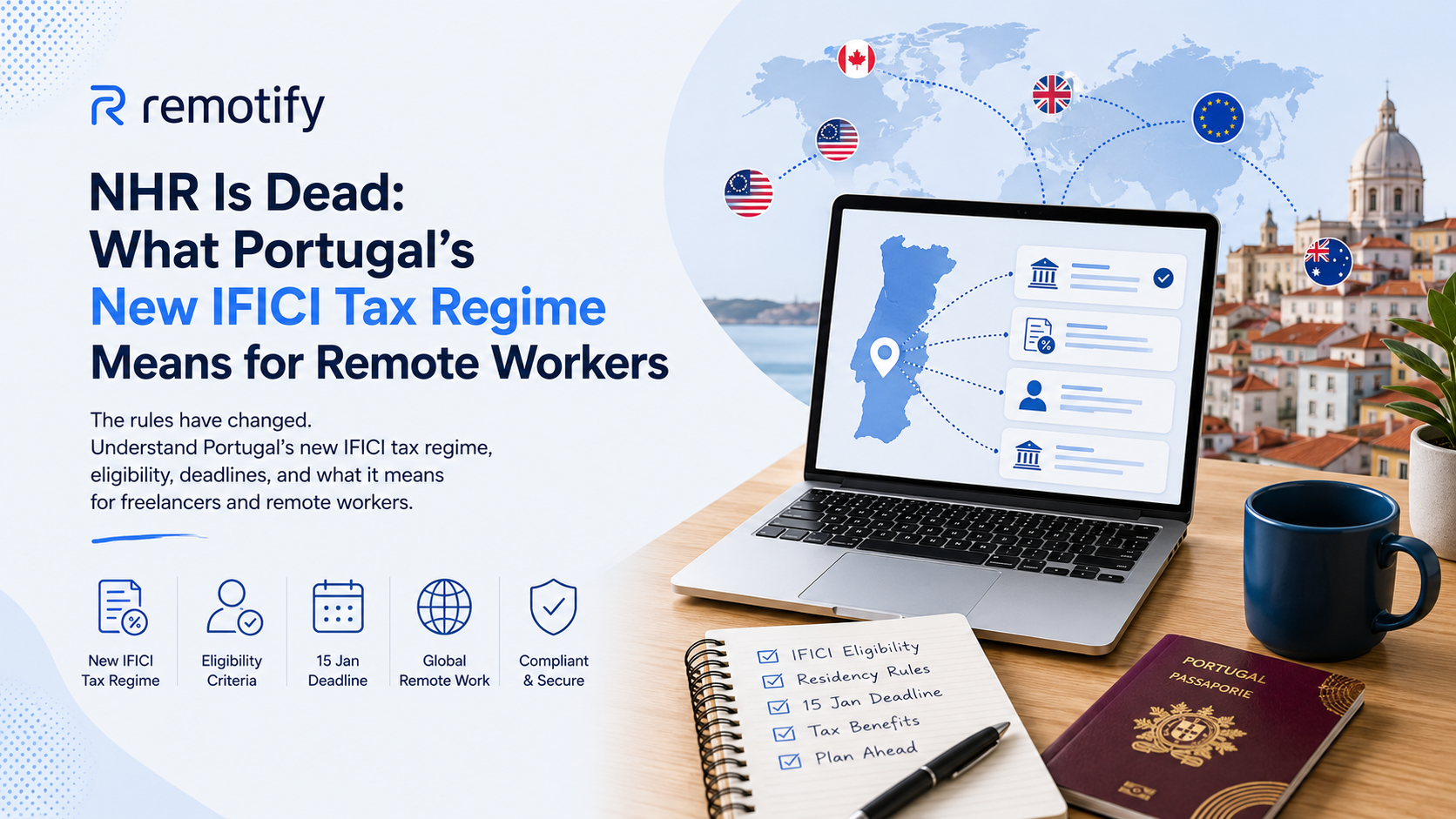
For over a decade, Portugal’s NHR regime was the reason so many freelancers, consultants, and remote workers chose Lisbon or Porto over anywhere else in Europe. New tax residents could lock in a 20 percent flat rate on qualifying Portuguese source income and, in many cases, an exemption on foreign sourced income for a full 10 years. It was simple, it was generous, and it applied to a wide range of professions.

That version of NHR closed to new applicants on 1 January 2024, under the 2024 State Budget Law. If you already held NHR status before that cutoff, nothing about your situation changes. Your 10 year window continues to run exactly as before. A transitional window also stayed open for people who could show concrete ties to Portugal before the cutoff, such as a signed property contract, an employment agreement, or a pending residency application, and this extended for some applicants until 31 March 2025.

For anyone arriving in Portugal now without one of those grandfathered situations, the original NHR is simply not available. This is the part that trips people up, because a huge amount of blog content, forum advice, and relocation guides online still describes NHR as though the 2024 closure never happened.

It is worth understanding why the closure happened in the first place, because it explains why the replacement looks so different. The annual cost of NHR tax exemptions had climbed past 1.7 billion euros by 2024, and rising property prices in Lisbon and Porto had become a genuine political issue, with NHR frequently blamed for pricing out local buyers. Rather than extend a blanket incentive to anyone with foreign income, the government shifted toward a narrower tool aimed at specific skill sets it wanted to attract.

The regime that replaced NHR is called IFICI, short for the Tax Incentive for Scientific Research and Innovation, sometimes referred to informally as NHR 2.0. It took effect on 1 January 2024, with the detailed implementing rules published later under Ordinance 352/2024, applied retroactively to the start of that year.

IFICI keeps the headline number that made NHR attractive: a 20 percent flat rate on qualifying Portuguese source income, alongside exemptions on much of your foreign sourced income, for up to 10 years. But the eligibility bar is considerably higher, and the pool of qualifying professions is much smaller.

To qualify, you generally cannot have been a Portuguese tax resident in the five years before your application, and you cannot have previously benefited from NHR or Portugal’s separate Regressar programme for returning residents. On top of that, you need to demonstrate either a Bachelor’s level qualification plus three years of relevant professional experience, or a PhD level qualification, which waives the experience requirement. And critically, your income needs to come from an eligible activity, generally tied to sectors like scientific research, higher education, technology, engineering, or roles at recognised startups and innovation focused companies.

There is also a hard deadline that did not exist under old NHR in the same way: you need to formally apply for IFICI with the Portuguese tax authority by 15 January of the year following the year you become a tax resident. Miss that window and the regime is off the table for that residency period.

This is the part worth sitting with if you are a freelancer, consultant, or solo founder thinking about relocating to Portugal because you read that it has a great tax deal for remote workers. IFICI was not built with the average remote freelancer in mind. It was built to attract researchers, engineers, and people working inside a narrow list of recognised innovation sectors.

If your work is marketing consulting, design, writing, general software contracting outside a qualifying company, coaching, or any of the dozens of freelance categories that do not map onto science, technology research, or higher education, you are unlikely to meet the eligible activity requirement, regardless of how many years of experience or how strong your degree is.

There is also a quieter change that catches people off guard: foreign pension income, which used to get a flat 10 percent rate under old NHR, is now fully taxable under IFICI. If part of your retirement or long term income planning assumed the old pension treatment, that assumption no longer holds.

None of this means Portugal stopped being a reasonable place to base a freelance business. It means the tax incentive that used to apply broadly now applies narrowly, and everyone else who moves to Portugal as a freelancer will simply be taxed under the country’s standard progressive income tax brackets, the same as a Portuguese national with no special regime.

It is also worth flagging a related myth: some people assume that if they cannot get IFICI, they can simply reapply for old NHR terms instead, or that the two regimes are interchangeable depending on which application form you file. They are not. If you already benefited from NHR in the past, you are generally barred from IFICI altogether, and if you never held NHR, you cannot retroactively apply for it now that it is closed. There is no path that lets you pick whichever regime happens to suit your situation better.

The practical takeaway is straightforward: check your own eligibility against the actual IFICI criteria before you build a relocation plan around a tax rate you read about in a five year old article. If you hold a qualifying degree and work in one of the eligible sectors, it is worth having a Portuguese accountant confirm your specific situation and help you file the application on time, since the 15 January deadline is unforgiving.

If you do not qualify, that is not a reason to abandon Portugal as a base. Many freelancers running international client relationships from Portugal do so profitably under standard tax rates, particularly once you factor in the country’s lower cost of living relative to much of Western Europe and the practical advantages of an EU residency for invoicing and banking. What changes is your planning: you are budgeting against progressive rates rather than a flat 20 percent, and you should size your pricing and savings accordingly.

Either way, one thing stays constant regardless of which tax regime applies to you: you still need a clean, compliant way to invoice clients outside Portugal and get paid without creating unnecessary friction with your bank or with Portuguese tax authorities.

Whether you end up under IFICI or standard Portuguese tax rates, the mechanics of invoicing an international client and receiving payment are a separate problem from your tax regime, and one that catches almost as many people off guard. This is where a Merchant of Record like Remotify fits in. Remotify acts as the EU registered legal entity that issues a VAT compliant invoice to your client on your behalf and then pays you once the transaction settles, using SEPA transfers rather than slower, costlier international wire transfers. Onboarding runs through standard KYC and AML verification, and Remotify handles the DAC7 reporting obligations that EU platforms are required to meet, so you are not left tracking that compliance paperwork yourself. Remotify is incorporated in Estonia, giving it EU registration and the ability to issue invoices that hold up cleanly across borders. None of this touches your personal income tax filing in Portugal, which remains your own responsibility regardless of which regime you fall under. What it does is remove the friction of proving to a client, or a bank, that your invoicing setup is legitimate while you sort out the rest.

If you are relocating to Portugal as a freelancer and want an invoicing and payment setup that works from day one, regardless of your eventual tax status, you can see how Remotify’s plans work at remotify.co/pricing. Setting this up before your first international invoice is due tends to save a lot of back and forth later, particularly once recibos verdes obligations and VAT thresholds start applying to your Portuguese activity.

Is NHR still available in Portugal in 2026?

No, not for new applicants. NHR closed on 1 January 2024. If you already held NHR status before that date, your existing 10 year benefits continue unaffected. Anyone arriving now falls under IFICI, if they qualify, or standard progressive tax rates.

What is IFICI and how is it different from NHR?

IFICI, the Tax Incentive for Scientific Research and Innovation, replaced NHR from 1 January 2024. It offers the same 20 percent flat rate on qualifying Portuguese income for up to 10 years, but only for specific professions in sectors like research, technology, and higher education, unlike the much broader NHR.

Can freelancers and remote workers qualify for IFICI?

Some can, but most cannot. You need a qualifying degree plus relevant experience or a PhD, and your income needs to come from an eligible activity tied to research, technology, engineering, or recognised innovation sectors. General freelance categories like marketing, design, or writing usually do not qualify.

What happens if I do not qualify for IFICI?

You are taxed under Portugal’s standard progressive income tax brackets, the same rates that apply to Portuguese residents with no special regime. This does not stop you from running a freelance business from Portugal, it simply means your planning should assume standard rates rather than a flat 20 percent.

Is there a deadline to apply for IFICI?

Yes. You need to formally apply with the Portuguese tax authority by 15 January of the year following the year you become a tax resident. Missing this deadline means you cannot access the regime for that residency period.

Does Remotify help with IFICI or NHR applications?

No. Remotify is a Merchant of Record focused on invoicing international clients and getting freelancers paid compliantly. Personal tax regime applications like IFICI need a Portuguese accountant or tax advisor who can assess your specific eligibility.

Do I still need to handle my own income tax if I use Remotify?

Yes. Remotify issues compliant invoices and pays you through SEPA after KYC and AML checks, but your personal income tax declaration in Portugal remains entirely your own responsibility, regardless of whether you qualify for IFICI or fall under standard rates.

Seraphinite AcceleratorOptimized by Seraphinite Accelerator
Turns on site high speed to be attractive for people and search engines.