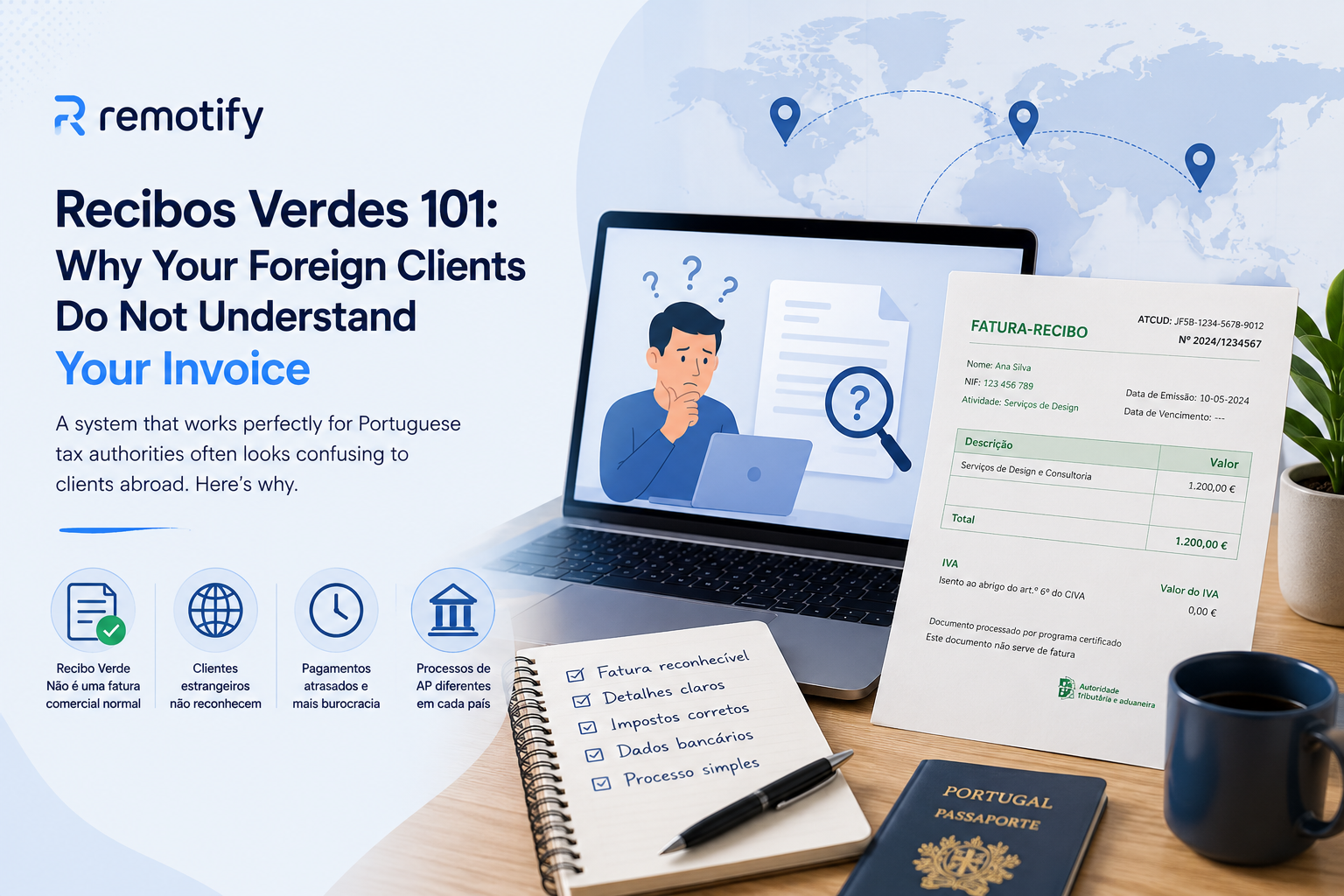
Recibo verde translates literally to green receipt, and it refers to the electronic document that registered freelancers in Portugal issue through the Portal das Finanças, the Portuguese tax authority’s online platform. When you perform a service, you log into the portal, select the client, describe the service, enter the amount, and the system generates a document called a fatura recibo, an invoice receipt combined into one, or in some cases a separate fatura and recibo depending on whether payment has already arrived.
This document serves two purposes at once. It is your declaration to the Portuguese tax authority of income earned, which feeds into your IRS income tax and social security calculations. And it is, technically, the invoice you are meant to give your client as proof of the transaction. Portuguese freelancers use it constantly and rarely think twice about it, because everyone they invoice locally is used to seeing one.
The problem shows up the moment your client is not Portuguese.
A recibo verde is generated entirely by Portuguese tax software, not by you, and not by any invoicing tool you have chosen. That means you cannot add your own logo, adjust the layout, or format it the way an international client’s finance system expects a vendor invoice to look. Every field is labelled in Portuguese. Your tax identification number, the NIF, appears where a client might expect a business registration number or tax ID they recognise. Since 2023, every document also carries an ATCUD code, a unique sequential validation number the Portuguese tax authority requires on all invoicing documents, which means nothing to a client outside Portugal and often reads as an error code or a typo.
On top of that, the numbering sequence is imposed by the tax authority’s own rules, not by you, so it will not match whatever invoice numbering convention your client’s accounting software expects to log against a purchase order.
None of this is a flaw in the system. It works exactly as intended for Portuguese tax administration. It was simply never designed with a foreign accounts payable department in mind.
Most accounts payable teams outside Portugal work from a fairly standard checklist before releasing a payment: a recognisable invoice number, a clear due date, the vendor’s bank details in a familiar format, and VAT or sales tax handled in a way their system already understands. A recibo verde disrupts almost every part of that checklist at once.
Take VAT. If your client is a business elsewhere in the EU, the reverse charge mechanism usually applies, meaning you do not add Portuguese VAT to the invoice and your client accounts for it on their end instead. If your client is outside the EU, the service is often exempt from VAT entirely. Either way, the recibo verde will show 0 percent VAT or a VAT exemption reference to a specific article of the Portuguese VAT code, written in Portuguese, with no explanation. A finance team unfamiliar with Portuguese tax law frequently reads a missing VAT line as a mistake rather than a compliant outcome, and holds the payment until someone confirms it is not an error.
There is also a timing mismatch. In many cases, a recibo is only generated after you have already received payment, since it functions as a receipt rather than a request for payment. But a foreign client’s process usually expects the opposite order: an invoice arrives first, approval happens, then payment is released. If you cannot produce a document before payment because your only invoicing option is a recibo verde tied to money already received, that alone can stall the transaction.
Add in the fact that the whole document is rendered in Portuguese, with no bilingual option built into the government portal, and it becomes clear why a client’s finance team might reply asking for something else entirely, or simply sit on the payment while they figure out what they are looking at.
The direct cost is time. Freelancers report the same pattern repeatedly: send the recibo verde, wait, get an email back asking for a proper invoice or a translation, resend with an explanation, then wait again for the next payment cycle to come around because the client’s approval window has already closed. For a single invoice, that might mean a payment slipping by a week or two. Across a full year of client work, it adds up to a meaningful amount of cash flow sitting in limbo for no reason related to the actual work delivered.
It also tends to fall hardest on newer client relationships, precisely when you can least afford friction. A long standing client who has seen your recibo verde before knows what it is and pays anyway. A new client, working with a Portuguese freelancer for the first time, has no such context, and their default response to an unfamiliar document is caution rather than trust.
There is also a quieter cost, which is how it reads to the client. A confusing, unfamiliar document creates friction at exactly the point where you want the relationship to feel simple and professional. It does not reflect badly on your work, but it does create an impression of complexity that has nothing to do with the quality of what you delivered.
It is worth being precise here, because the fix is not to stop issuing recibos verdes. As a Portuguese tax resident working independently, you are required to declare that income through the Portal das Finanças regardless of where your client is based. That obligation does not go away, and nothing about how you invoice a client changes what you owe Portuguese tax authorities.
What can change is what the client actually sees. There is no rule that says the only document you are allowed to send a foreign client is the raw recibo verde exactly as the tax portal generates it. Your domestic tax declaration and your client facing invoice can be two separate things, as long as the underlying income is still reported correctly in Portugal.
This is the specific gap a Merchant of Record like Remotify is built to close. Remotify acts as the EU registered legal entity in the transaction, issuing your client a standard, VAT compliant commercial invoice in a format their accounts payable team already recognises, with clean invoice numbering, clear terms, and payment routed through SEPA rather than a slower international transfer. Your client pays Remotify, and Remotify pays you, which means the document your client is reacting to is a familiar business invoice rather than a Portuguese government tax form. Onboarding runs through standard KYC and AML checks, and Remotify handles the DAC7 reporting obligations that EU platforms must meet on your behalf. Remotify is incorporated in Estonia, which gives it EU registration and the standing to issue invoices that hold up cleanly across borders. None of this replaces your recibo verde obligation to the Portuguese tax authority, which remains entirely your own responsibility. What it does is separate the two problems, so your client’s payment process is never held up by a document that was only ever meant for Finanças in the first place.
If you are relocating to Portugal as a freelancer and want an invoicing and payment setup that works from day one, regardless of your eventual tax status, you can see how Remotify’s plans work at remotify.co/pricing. Setting this up before your first international invoice is due tends to save a lot of back and forth later, particularly once recibos verdes obligations and VAT thresholds start applying to your Portuguese activity.
A recibo verde is an electronic invoice and tax receipt issued through Portugal’s Finanças portal by registered freelancers and self-employed workers. Anyone who is a Portuguese tax resident working independently must issue one for income earned, including income from clients based outside Portugal.
The document is generated in Portuguese by Portugal’s tax authority using government formatting, including a NIF and an ATCUD validation code that mean nothing outside Portugal. It also lacks standard elements like a familiar invoice number or bank details layout that most accounts payable systems expect.
No. Your obligation to declare income to the Portuguese tax authority through the Finanças portal remains yours regardless of how a client is invoiced. What can change is the document your client actually receives, which is a separate matter from your domestic tax filing.
For B2B clients elsewhere in the EU, the reverse charge mechanism usually applies, meaning you do not add VAT and your client accounts for it locally. For clients outside the EU, the service is often VAT exempt entirely. Both outcomes are compliant, though they frequently confuse finance teams unfamiliar with Portuguese VAT rules.
A recibo functions as a receipt for money already received, while a fatura functions as an invoice requesting payment. Depending on how you issue the document, you may only be able to generate it after funds arrive, which conflicts with a foreign client’s usual process of approving an invoice before releasing payment.
Remotify issues your client a standard EU compliant commercial invoice as the legal entity in the transaction, rather than a recibo verde. Your client pays Remotify through a familiar invoicing process, and Remotify pays you by SEPA transfer, removing the confusion around an unfamiliar Portuguese tax document.
Yes. Remotify handles the invoice your client sees and the payment you receive, but your personal income tax declaration and recibo verde filing with the Portuguese tax authority remain your own responsibility, and a Portuguese accountant is still the right resource for that side of things.

Recibo verde translates literally to green receipt, and it refers to the electronic document that registered freelancers in Portugal issue through the Portal das Finanças, the Portuguese tax authority’s online platform. When you perform a service, you log into the portal, select the client, describe the service, enter the amount, and the system generates a document called a fatura recibo, an invoice receipt combined into one, or in some cases a separate fatura and recibo depending on whether payment has already arrived.
This document serves two purposes at once. It is your declaration to the Portuguese tax authority of income earned, which feeds into your IRS income tax and social security calculations. And it is, technically, the invoice you are meant to give your client as proof of the transaction. Portuguese freelancers use it constantly and rarely think twice about it, because everyone they invoice locally is used to seeing one.
The problem shows up the moment your client is not Portuguese.
A recibo verde is generated entirely by Portuguese tax software, not by you, and not by any invoicing tool you have chosen. That means you cannot add your own logo, adjust the layout, or format it the way an international client’s finance system expects a vendor invoice to look. Every field is labelled in Portuguese. Your tax identification number, the NIF, appears where a client might expect a business registration number or tax ID they recognise. Since 2023, every document also carries an ATCUD code, a unique sequential validation number the Portuguese tax authority requires on all invoicing documents, which means nothing to a client outside Portugal and often reads as an error code or a typo.
On top of that, the numbering sequence is imposed by the tax authority’s own rules, not by you, so it will not match whatever invoice numbering convention your client’s accounting software expects to log against a purchase order.
None of this is a flaw in the system. It works exactly as intended for Portuguese tax administration. It was simply never designed with a foreign accounts payable department in mind.
Most accounts payable teams outside Portugal work from a fairly standard checklist before releasing a payment: a recognisable invoice number, a clear due date, the vendor’s bank details in a familiar format, and VAT or sales tax handled in a way their system already understands. A recibo verde disrupts almost every part of that checklist at once.
Take VAT. If your client is a business elsewhere in the EU, the reverse charge mechanism usually applies, meaning you do not add Portuguese VAT to the invoice and your client accounts for it on their end instead. If your client is outside the EU, the service is often exempt from VAT entirely. Either way, the recibo verde will show 0 percent VAT or a VAT exemption reference to a specific article of the Portuguese VAT code, written in Portuguese, with no explanation. A finance team unfamiliar with Portuguese tax law frequently reads a missing VAT line as a mistake rather than a compliant outcome, and holds the payment until someone confirms it is not an error.
There is also a timing mismatch. In many cases, a recibo is only generated after you have already received payment, since it functions as a receipt rather than a request for payment. But a foreign client’s process usually expects the opposite order: an invoice arrives first, approval happens, then payment is released. If you cannot produce a document before payment because your only invoicing option is a recibo verde tied to money already received, that alone can stall the transaction.
Add in the fact that the whole document is rendered in Portuguese, with no bilingual option built into the government portal, and it becomes clear why a client’s finance team might reply asking for something else entirely, or simply sit on the payment while they figure out what they are looking at.
The direct cost is time. Freelancers report the same pattern repeatedly: send the recibo verde, wait, get an email back asking for a proper invoice or a translation, resend with an explanation, then wait again for the next payment cycle to come around because the client’s approval window has already closed. For a single invoice, that might mean a payment slipping by a week or two. Across a full year of client work, it adds up to a meaningful amount of cash flow sitting in limbo for no reason related to the actual work delivered.
It also tends to fall hardest on newer client relationships, precisely when you can least afford friction. A long standing client who has seen your recibo verde before knows what it is and pays anyway. A new client, working with a Portuguese freelancer for the first time, has no such context, and their default response to an unfamiliar document is caution rather than trust.
There is also a quieter cost, which is how it reads to the client. A confusing, unfamiliar document creates friction at exactly the point where you want the relationship to feel simple and professional. It does not reflect badly on your work, but it does create an impression of complexity that has nothing to do with the quality of what you delivered.
It is worth being precise here, because the fix is not to stop issuing recibos verdes. As a Portuguese tax resident working independently, you are required to declare that income through the Portal das Finanças regardless of where your client is based. That obligation does not go away, and nothing about how you invoice a client changes what you owe Portuguese tax authorities.
What can change is what the client actually sees. There is no rule that says the only document you are allowed to send a foreign client is the raw recibo verde exactly as the tax portal generates it. Your domestic tax declaration and your client facing invoice can be two separate things, as long as the underlying income is still reported correctly in Portugal.
This is the specific gap a Merchant of Record like Remotify is built to close. Remotify acts as the EU registered legal entity in the transaction, issuing your client a standard, VAT compliant commercial invoice in a format their accounts payable team already recognises, with clean invoice numbering, clear terms, and payment routed through SEPA rather than a slower international transfer. Your client pays Remotify, and Remotify pays you, which means the document your client is reacting to is a familiar business invoice rather than a Portuguese government tax form. Onboarding runs through standard KYC and AML checks, and Remotify handles the DAC7 reporting obligations that EU platforms must meet on your behalf. Remotify is incorporated in Estonia, which gives it EU registration and the standing to issue invoices that hold up cleanly across borders. None of this replaces your recibo verde obligation to the Portuguese tax authority, which remains entirely your own responsibility. What it does is separate the two problems, so your client’s payment process is never held up by a document that was only ever meant for Finanças in the first place.
If you are relocating to Portugal as a freelancer and want an invoicing and payment setup that works from day one, regardless of your eventual tax status, you can see how Remotify’s plans work at remotify.co/pricing. Setting this up before your first international invoice is due tends to save a lot of back and forth later, particularly once recibos verdes obligations and VAT thresholds start applying to your Portuguese activity.
A recibo verde is an electronic invoice and tax receipt issued through Portugal’s Finanças portal by registered freelancers and self-employed workers. Anyone who is a Portuguese tax resident working independently must issue one for income earned, including income from clients based outside Portugal.
The document is generated in Portuguese by Portugal’s tax authority using government formatting, including a NIF and an ATCUD validation code that mean nothing outside Portugal. It also lacks standard elements like a familiar invoice number or bank details layout that most accounts payable systems expect.
No. Your obligation to declare income to the Portuguese tax authority through the Finanças portal remains yours regardless of how a client is invoiced. What can change is the document your client actually receives, which is a separate matter from your domestic tax filing.
For B2B clients elsewhere in the EU, the reverse charge mechanism usually applies, meaning you do not add VAT and your client accounts for it locally. For clients outside the EU, the service is often VAT exempt entirely. Both outcomes are compliant, though they frequently confuse finance teams unfamiliar with Portuguese VAT rules.
A recibo functions as a receipt for money already received, while a fatura functions as an invoice requesting payment. Depending on how you issue the document, you may only be able to generate it after funds arrive, which conflicts with a foreign client’s usual process of approving an invoice before releasing payment.
Remotify issues your client a standard EU compliant commercial invoice as the legal entity in the transaction, rather than a recibo verde. Your client pays Remotify through a familiar invoicing process, and Remotify pays you by SEPA transfer, removing the confusion around an unfamiliar Portuguese tax document.
Yes. Remotify handles the invoice your client sees and the payment you receive, but your personal income tax declaration and recibo verde filing with the Portuguese tax authority remain your own responsibility, and a Portuguese accountant is still the right resource for that side of things.